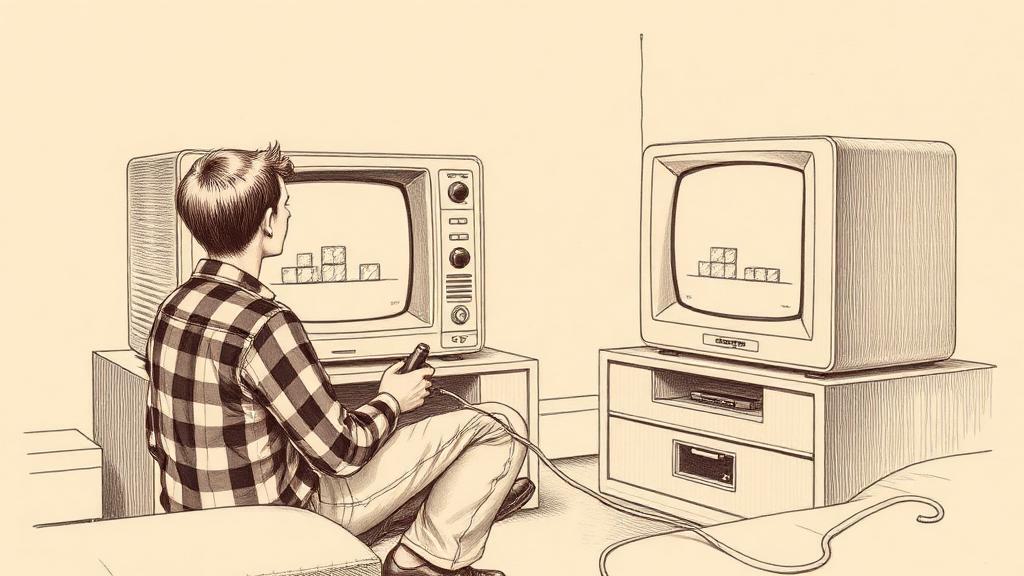
The Atari 2600, or the machine Bushnell sold Atari to build
Jay Miner’s Television Interface Adaptor had no memory for images. To make a game console without a framebuffer, he designed the TIA chip to draw the screen one line at a time as the electron beam swept across the tube, trusting the programmer to update every register between scanlines. Miss a cycle and the image tears. They called this technique “racing the beam,” and the machine it ran inside was the Atari 2600, which shipped in September 1977 and would sell thirty million units.
The machine had been in development since late 1975 under the codename Stella—named by Joe Decuir, a recent Berkeley graduate hired to debug the prototype, after his bicycle. Work happened at Cyan Engineering, Atari’s skunkworks lab in Grass Valley, California, staffed by veterans Steve Mayer and Larry Emmons. Nolan Bushnell, who had built Atari from Pong’s coin-box overflow into the country’s fastest-growing consumer electronics company, sold the firm to Warner Communications in 1976 specifically to raise the capital to ship it. The VCS launched in September 1977 for $199: two joysticks, a pair of paddle controllers, and four game cartridges included.
The cartridge slot was the point. The Fairchild Channel F had beaten Atari to market by nearly a year with interchangeable cartridges, but mustered only 22 games in its commercial life. The 2600 would eventually carry over 500. Swap the cartridge and you had a different game; the console was now a platform with an ongoing commercial life, not a single-purpose toy whose novelty wore off in a month. Publishers—not just Atari—could build businesses on selling software alone.
The console’s true scale became clear in 1980. Atari negotiated the home rights to Taito’s Space Invaders—the first time an arcade title had ever been officially licensed for a home console—and the effect startled even Atari’s own projections. Space Invaders quadrupled 2600 sales. Consumers bought the console specifically to own one cartridge. By 1982, Atari was selling ten million VCS units per year in the United States alone. The term “killer app” would not exist for another decade, but the phenomenon had just been demonstrated at scale in suburban living rooms.
The 2600 also produced its own disruption. In 1979, four of Atari’s most productive programmers—frustrated that the company refused to put developer names on cartridge boxes—quit and founded Activision. It was the first independent third-party console game publisher in history, and its existence was only possible because a cartridge-based platform existed for it to publish on.
When the industry collapsed in 1983 under the weight of bad software and lost consumer confidence, it was a cartridge-based Nintendo console that rebuilt it two years later. The box was smaller, the games sharper, the chip faster—but the beam still had to be raced.
Sources
- Atari 2600 — Wikipedia — launch details, codename Stella, Joe Decuir, Bushnell/Warner sale, sales figures, Space Invaders licensing effect.
- Television Interface Adaptor — Wikipedia — TIA chip design, Jay Miner, racing the beam technique.
- Fairchild Channel F — Wikipedia — prior cartridge launch (November 1976), library size comparison.
- Space Invaders — Wikipedia — 1980 home console licensing deal and quadrupled sales.
- Computer History Museum — Computer Games — home gaming market growth, 1977–1982 context.