The car phone, or how eighty pounds of vacuum tubes first put a telephone on the road
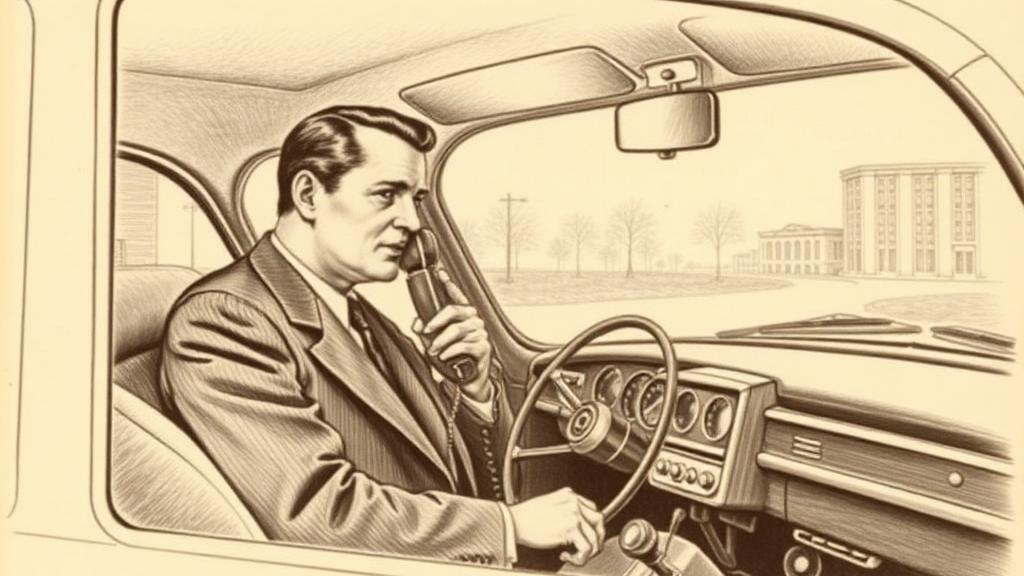
On June 17, 1946, a St. Louis building contractor named Henry Perkinson made a telephone call from his car. Every time he pressed the push-to-talk button to speak, the headlights dimmed.
This was not a malfunction. The radio-telephone cabinet in his trunk weighed 80 pounds, ran on vacuum tubes hot enough to bake bread (Invention & Technology Magazine), and drew so much current that the car’s electrical system had nothing left to spare on illumination (wb6nvh.com). Perkinson was among the first subscribers to Southwestern Bell’s Mobile Telephone Service — MTS — launched that day by AT&T on 152 MHz across metropolitan St. Louis, with a single high-powered base station blanketing the city from an antenna atop a tall building (Wikipedia).
The system was half-duplex. You pressed to talk, released to listen. You could not do both at once. And you did not dial. To place a call, you found an open channel, flagged a human operator over the air, and gave her both your number and the destination; she patched you through to the public network by hand. Incoming calls worked in reverse: the operator announced your number aloud over the shared channel, and you picked up when you heard it. Every subscriber on that channel heard every announcement — a shared party line with no walls and no illusion of privacy (wb6nvh.com).
There were initially six channels in St. Louis. Radio frequency interference quickly reduced the usable count to three. Those three channels served the entire city.
Despite the operator dependency, the push-to-talk half-duplex, the 80-pound trunk installation, and the $15 monthly charge on top of per-call fees, waiting lists developed wherever the service went (Invention & Technology Magazine). By 1948, MTS had spread to 60 American cities, carrying 4,000 subscribers and 117,000 calls per month (Wikipedia). The subscribers were not hobbyists. They were utility companies, news reporters, truck fleet operators, and contractors — people for whom the gap between the office and the road had a measurable dollar value.
Bell Labs drew the architectural lesson fast. On December 11, 1947 — just eighteen months after Perkinson’s first call — engineer Douglas H. Ring wrote an internal memo proposing a completely different geometry: instead of one giant tower covering a metropolitan area, a honeycomb of small, low-power cells, each recycling frequencies assigned to non-adjacent cells (Wikipedia). Frequency reuse, Ring argued, would multiply network capacity by orders of magnitude. His colleague W. Rae Young proposed the hexagonal cell shape. The blueprint for cellular telephony was complete in 1947. The electronics capable of executing it would take another three decades to mature.
What MTS unlocked was not a product. It was a proof of demand — three channels oversubscribed in every city, waiting lists as far as the service reached. Bell Labs knew exactly what was waiting on the other side of a scalable architecture.
Three channels for a city in 1946. Ring’s hexagons eventually gave that city millions. The math was always there; they just needed time to build the switch fast enough to follow a car down the road.
Sources
- Mobile Telephone Service — Wikipedia — launch date and city, technical specifications (frequencies, channels, operator procedure), subscriber growth figures.
- The Cell Phone Revolution — Invention & Technology Magazine — first subscribers including Henry Perkinson, vacuum tube heat (“bake bread”), waiting lists, $15/month pricing.
- The Mobile Telephone in Bell System Service, 1946–1993 — wb6nvh.com — 80-lb equipment weight, current draw and headlight dimming, party-line channel behavior.
- Douglas H. Ring — Wikipedia — December 11, 1947 Bell Labs cellular memo, Ring’s patents, W. Rae Young’s contribution.