COBOL, or how a committee invented the world's most durable programming language
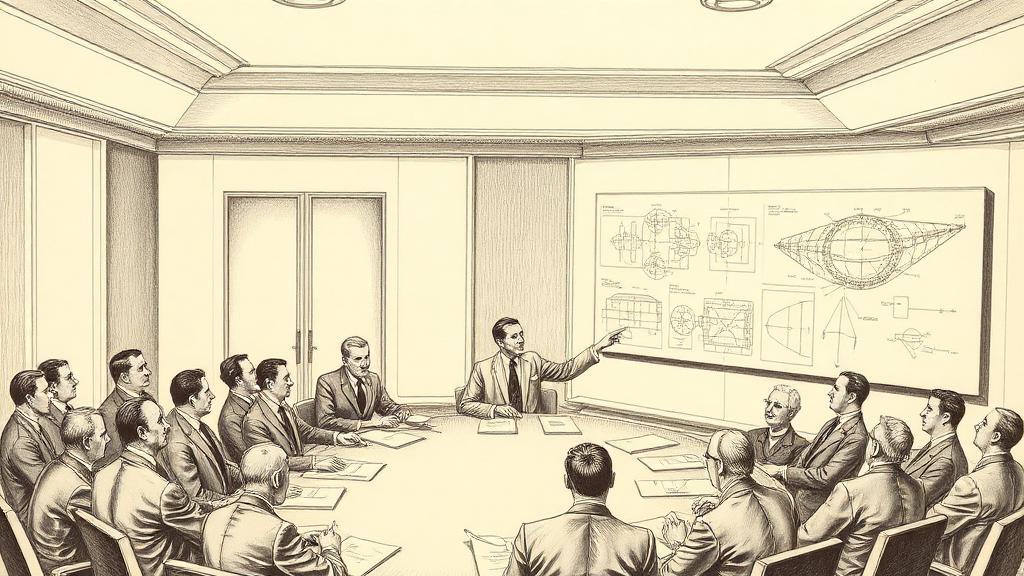
Forty-one people filed into the Pentagon on 28 May 1959, tasked with preventing a quiet catastrophe. The Department of Defense was running 225 computers across its agencies, had invested over $200 million in programming them, and had discovered, inconveniently, that almost none of those programs could run on more than one machine. Every hardware upgrade meant rewriting everything from scratch. The mandate: a shared language for business computing that could run on any machine from any manufacturer.
The effort went by the name CODASYL — the Conference on Data Systems Languages — and it was chaired by Charles A. Phillips of the DoD. The problem it addressed had no prestige to it. No symbolic reasoning, no elegant mathematics. The target was payroll and inventory and billing: the operational machinery of large organizations that needed to process a hundred thousand transactions reliably before anyone arrived at the office in the morning.
On the table was a working model: FLOW-MATIC, a language built by Grace Hopper and her team at UNIVAC by 1957. Hopper had spent years making the case that programmers should not be required to memorize the peculiarities of each machine’s instruction set — that a command meaning “read the next record” ought to say, more or less, “read the next record.” FLOW-MATIC ran only on UNIVAC machines, but it proved the idea was workable. The Short Range Committee took the concept and was given three months to produce a portable standard. Betty Holberton, one of the committee members, called the deadline “gross optimism.”
They delivered anyway. The first distribution of COBOL — Common Business-Oriented Language — went out on 17 December 1959. The first program actually ran on an RCA 501 on 17 August 1960. Hopper would later claim that COBOL 60 was “95 percent FLOW-MATIC” — a figure Jean Sammet, one of the lead designers, disputed while acknowledging Hopper’s foundational role.
The most memorable commentary on the effort arrived not in a technical paper but in a package. Sometime late in 1959, frustrated by the committee’s halting progress, Howard Bromberg of RCA bought a fifteen-dollar tombstone with “COBOL” engraved on it and mailed it to Charles Phillips. It was not a subtle message. The committee reportedly got its act together.
The DoD’s decision not to copyright COBOL turned out to be as consequential as any line in the specification. With no licensing fee and no owner to negotiate with, manufacturers implemented it freely, and it spread. By 1970 COBOL was the most widely used programming language in the world. Banks, insurers, and government payroll systems were built on it, and those systems were not replaced in the following decades — there was simply too much of them, and they worked.
FLOW-MATIC proved that English could be a programming language. COBOL proved that a committee could write one — and that boring, reliable software is the kind most likely to outlive everyone who argued about it.
Sources
- COBOL — Wikipedia — Pentagon meeting details, CODASYL formation, Short Range Committee timeline, Bromberg tombstone anecdote, Jean Sammet’s role, the 95% FLOW-MATIC claim.
- Hopper Invents the Computer Language COBOL — EBSCO Research Starters — FLOW-MATIC as the first English-language data processing compiler, why the DoD drove the effort, COBOL’s spread as the most-used language by 1970.