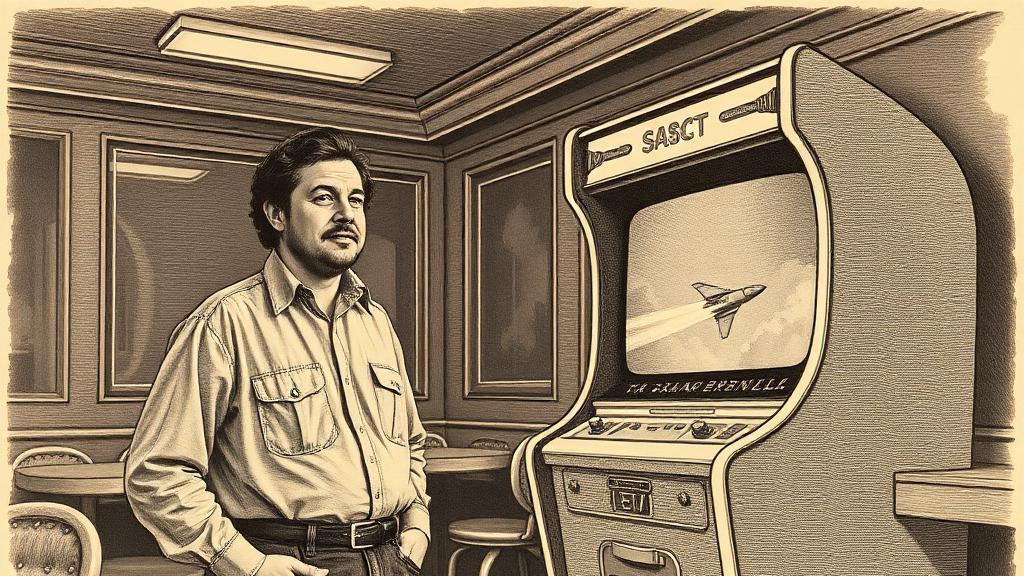
Computer Space, the world's first coin-operated video game
In August 1971, a bar near Stanford University called The Dutch Goose agreed to accept an unusual delivery: a curvy, glittering fiberglass cabinet in fire-engine red, built around a 19-inch black-and-white television and 185 integrated circuits wired to simulate two rocket ships and a set of flying saucers. No computer sat inside. Ted Dabney had worked out how to fake the physics with discrete hardware, eliminating the six-figure minicomputer that had made Spacewar! unthinkable as a commercial product. The bar’s patrons — mostly Stanford students who knew what a computer terminal looked like — fed it quarters. Nolan Bushnell drove home convinced he had built the future.
He had. He’d also built a machine that most of America would find baffling.
Bushnell was 28 and working as a lab supervisor at Ampex in Sunnyvale when he first conceived of transplanting Spacewar! — Steve Russell’s 1962 PDP-1 game, played in university machine rooms — into a coin-operated cabinet. The obstacle was simple and absolute: a computer capable of running Spacewar! cost more than a house. Dabney’s solution was to design custom motion circuitry from discrete components, producing something that could track coordinates and render moving objects on screen without a general-purpose CPU. Bushnell sculpted the cabinet prototype in modeling clay at his kitchen table; Nutting Associates, a coin-op vending company in Mountain View, California, agreed to manufacture it (Wikipedia).
Computer Space debuted at the Music Operators of America trade show on October 15, 1971, in four colors — red, blue, white, and yellow — the most futuristic objects in a hall full of pinball machines. The player commanded a rocket ship against flying saucers, managing thrust, rotation, and fire with three separate buttons. Nutting manufactured roughly 1,500 units; more than 1,000 had sold by spring 1972, generating over a million dollars in revenue (Wikipedia). By the standards of coin-op novelties, that was a success. By the standards Bushnell was reaching for, it was a lesson.
The lesson was the bar crowd. The Dutch Goose had been a self-selecting sample — technically literate, comfortable with three buttons and a physics simulation. A typical tavern patron, after several drinks, was not. Bushnell later said the controls were “just too complicated for half-pissed bar patrons to comprehend,” and that no one would want to read instructions to play a video game (World Video Game Hall of Fame, The Strong). He filed that observation carefully.
When Bushnell and Dabney founded Atari, Inc. on June 27, 1972 — the name borrowed from a Go term for a stone in danger of capture — and hired engineer Al Alcorn, Bushnell gave him a deliberately trivial first project: build the simplest possible game. One dial. One dot. Two rectangles. Pong shipped on November 29, 1972. The first cabinet installed at Andy Capp’s Tavern in Sunnyvale jammed within days — not from a malfunction, but because the coin box was full.
Computer Space was inducted into the World Video Game Hall of Fame at The Strong National Museum of Play in Rochester in 2023 (The Strong). The fiberglass cabinet, once manufactured in a hot-tub factory, now lives behind glass. What doesn’t live behind glass is the principle it demonstrated: that a purpose-built box could run a game, take money, and survive inside a bar. The industry’s next forty years would be spent figuring out how to make that box simpler, smaller, cheaper, and eventually invisible — because the machine in your pocket today is also a coin-op, just with a different coin.
Sources
- Computer Space — Wikipedia — technical design (185 ICs, Dabney’s motion circuitry), cabinet colors, MOA trade show debut October 15 1971, sales figures (~1,500 units, $1M+ revenue), Bushnell quote on bar-patron complexity.
- Computer Space — World Video Game Hall of Fame, The Strong — museum documentation of first commercial coin-op video game status, 2023 Hall of Fame induction, Bushnell’s design philosophy and the Dutch Goose field test.