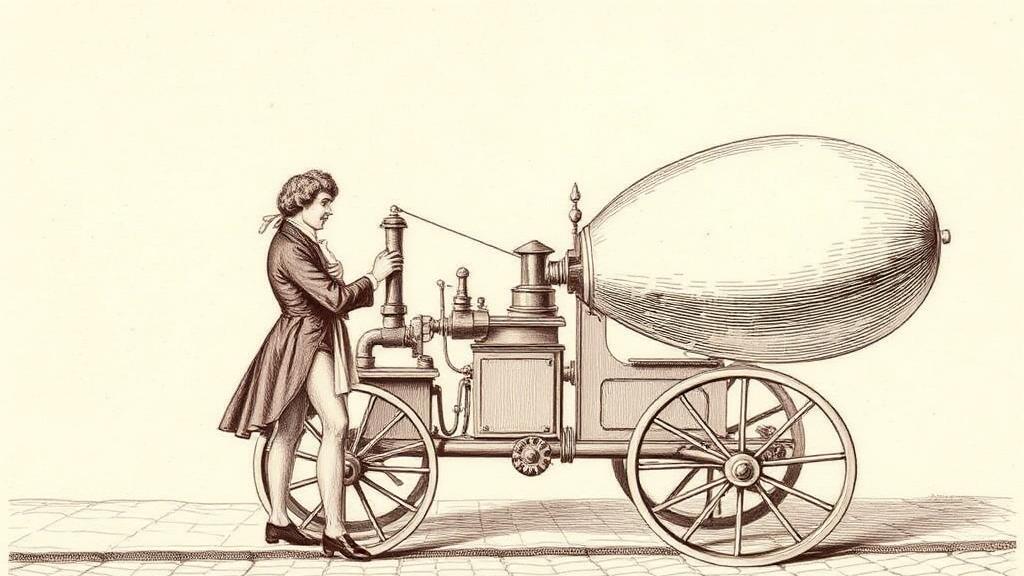
De Rivaz's hydrogen carriage: the first internal-combustion automobile
On a street in Vevey in October 1813, a six-meter machine with two-meter wheels lurched up a nine-percent slope carrying four men and three hundred kilograms of stone. It covered twenty-six meters, then stopped. The men climbed down. Everyone agreed this had been a success.
The machine belonged to François Isaac de Rivaz, born in Paris in 1752 to a clockmaker who moved the family to Savoy. He grew up fluent in mathematics and mechanics, eventually settling in Valais as a surveyor and politician — and before all that, a French artillery officer. The artillery background matters: de Rivaz had spent years watching explosions drive cannonballs through bores, and at some point he began wondering whether a controlled version of that same event could be made to push a piston instead.
He began experimenting with cylinders in 1804. By January 30, 1807, he held French patent No. 731 in Paris, covering a hydrogen-powered engine with electric spark ignition (Wikipedia — De Rivaz engine). By 1808, he had fitted it to a wheeled carriage tested in Valais — the world’s first internal-combustion automobile (Accelleron, Charge!).
The engine’s workings were ingenious and awkward in equal measure. Hydrogen gas, stored in a balloon attached to the carriage by a pipe, was admitted to the cylinder in timed pulses. Alessandro Volta had shown, a decade earlier, that an electric spark could ignite a gas mixture; de Rivaz borrowed the principle directly. The explosion drove the piston up; gravity pulled it back down; a ratchet mechanism translated the vertical jerk into forward wheel rotation via rope and pulley. There was no compression ratio, no crank, no connecting rod. Each firing was essentially hand-operated.
The 1813 grand char mécanique was de Rivaz’s bid to make the case undeniable. Six meters long, wheels two meters in diameter, total weight approaching a ton, cylinder one and a half meters long with a piston stroke of 97 centimeters. Loaded in Vevey with seven hundred pounds of stone and wood plus four passengers, it ran twenty-six meters at 3 km/h up a nine-percent grade on October 22, 1813 (Wikipedia — De Rivaz engine). The achievement was real. The practicality was not. The machine needed a crew to operate its valves, weighed as much as a small house, and could be outpaced by a brisk walker.
De Rivaz never commercialized the design, and serious internal-combustion development went largely quiet for another half-century. But the architecture he had proved in Valais — a chemical fuel, a spark, a piston, a wheel — was the correct one. When Étienne Lenoir drove a gas-powered carriage from Paris to Joinville-le-Pont in 1863, and when Karl Benz registered his Patent-Motorwagen in 1885, they were refining a blueprint that an artillery officer in Switzerland had sketched sixty years earlier.
The balloon became a fuel tank. The ratchet became a gearbox. The hand-operated valve became a carburetor. What de Rivaz held in 1807 was more idea than engine — but the idea proved stubbornly correct.
Sources
- De Rivaz engine — Wikipedia — Engine technical details, patent date (January 30, 1807, No. 731), the 1813 grand char mécanique dimensions, and the Vevey test results.
- François Isaac de Rivaz — Wikipedia — Biography: Paris birth in 1752, clockmaker father, career in Valais as surveyor and politician, the 1808 automobile.
- Accelleron, Charge! — “Making the Explosive Switch from Steam Power to Internal Combustion” — Confirms the 1808 vehicle test in Valais and notes de Rivaz’s background as a French artillery officer.