Donkey Kong: the game that made Nintendo
In early 1981, approximately 2,000 Radar Scope arcade cabinets sat in a warehouse in Redmond, Washington, going nowhere. Nintendo of America had ordered them from Japan on the expectation that the space-shooter market was still expanding. It wasn’t. Hiroshi Yamauchi, Nintendo’s president, called back to Tokyo with a directive: build a new game, quickly, using those exact cabinets as the hardware. The assignment landed on Shigeru Miyamoto, a 28-year-old in the product-planning division who had never shipped a video game.
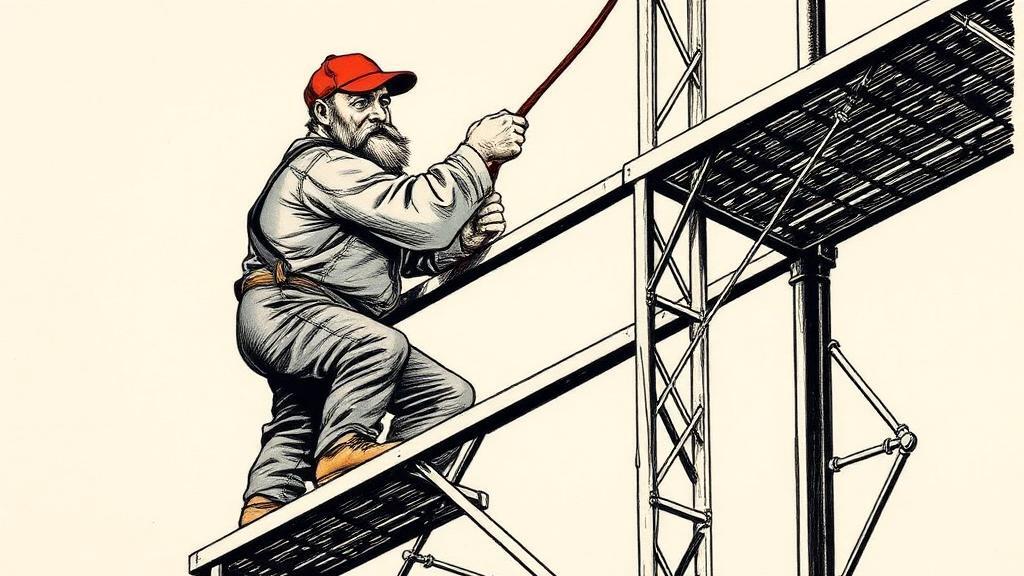
Miyamoto’s first instinct was to borrow. Nintendo held a tentative Popeye license, and he sketched a love-triangle game around Bluto, Popeye, and Olive Oyl. When the license negotiations stalled, he reached for his Japanese-English dictionary. He needed a name for a lumbering, stubborn ape. “Donkey,” the dictionary told him, meant something like foolish or silly. “Kong” was common Japanese slang for gorilla. The villain had a name. For the hero — a barrel-dodging carpenter at the bottom of a construction-site scaffold — the working title was simply Jumpman, because that was the most remarkable thing he could do.
What Miyamoto built in those few months was structurally unlike anything the arcades had offered before. The dominant model of 1981 was an undifferentiated assault: shoot the ships, dodge the asteroids, eat the ghosts. Donkey Kong gave players a scene — steel girders rising through the frame, the ape at the top clutching a woman named Pauline, and a small mustachioed figure at the bottom who had to climb up and rescue her. Four distinct screens told a story with a beginning, a middle, and a goal. The jump mechanic was new enough that it defined the character; the goal was specific enough to give the player a reason.
The hero’s permanent name arrived by accident. When Nintendo of America relocated to Redmond and rented warehouse space from a man named Mario Segale, the employees noticed a resemblance between their stout, mustached landlord and the stout, mustached carpenter on the screen. The character became Mario before the official US release. Segale, a genuinely private man, gave almost no interviews about the tribute in his lifetime.
Location tests in Seattle bars in June 1981 generated $30 a day — roughly 120 plays — every day for a week. Minoru Arakawa, Nintendo of America’s president, had his skeleton crew convert all 2,000 Radar Scope cabinets using conversion kits shipped from Japan. By October, Nintendo was shipping 4,000 units a month. Within a year, 60,000 cabinets had sold in the United States alone, generating $180 million in revenue. By 1982, US sales had reached $280 million.
The Strong National Museum of Play inducted Donkey Kong into the World Video Game Hall of Fame in 2017, citing its role in establishing the platformer genre and introducing Nintendo’s defining characters. The citation doesn’t dwell on the 2,000 unsold cabinets — because that’s not what survived. Miyamoto had been handed scrap hardware and a deadline. He handed back a medium.
Sources
- Donkey Kong (1981 video game) — Wikipedia — development history, Radar Scope salvage, the Popeye license, character naming, commercial figures, Mario Segale.
- Donkey Kong — The Strong National Museum of Play — World Video Game Hall of Fame induction, narrative innovation, legacy.