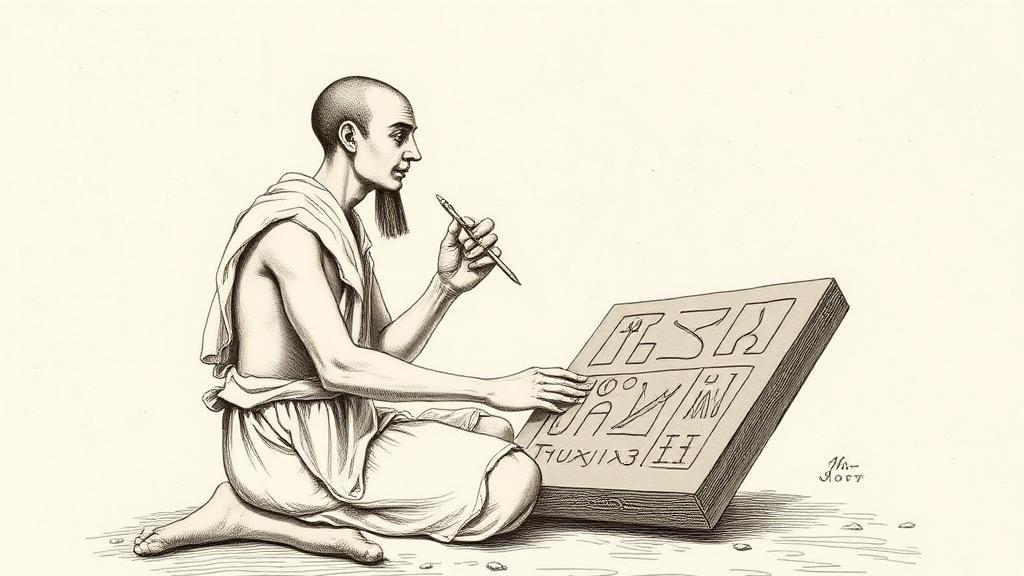
Egyptian hieroglyphs, or how language learned to last
Two signs carved into a gray slate palette, sometime around 3100 BCE, tell you the name of a king: a catfish, then a chisel. Sound them out in ancient Egyptian — nar + mer — and you have Narmer, the pharaoh credited with unifying Egypt, and the earliest ruler whose name we can still pronounce. The Narmer Palette is now in the Cairo Museum. The name has been standing there, legible, for five thousand years.
The palette is among the earliest artifacts to show hieroglyphs in a mature form, but the script itself is a little older. In 1998, the German archaeologist Günter Dreyer, excavating a predynastic tomb at Abydos — about 300 miles south of Cairo — turned up approximately 150 tags of bone and ivory, each roughly two centimeters by one and a half, each punched with a hole and threaded on string. They were attached to burial goods in the tomb of a ruler archaeologists call Scorpion I, and dated to between 3200 and 3400 BCE — the oldest known writing in Egypt, and among the oldest anywhere on earth. The discovery also upended a long-held assumption: that phonetic writing had first evolved in Mesopotamia and spread outward from there.
The glyphs on those tags were not decorative. They were receipts: quantities, origins, commodities. Hieroglyphs, at their birth, were doing paperwork.
The system that grew from those inventory labels was elaborate by design. Egyptian scribes deployed three types of signs simultaneously: logograms for whole words, phonograms for sounds, and determinatives — silent classifiers placed at the end of a word to signal what category of thing it belonged to. The same bird sign could mean “duck,” the sound sa, or simply “bird-creature,” depending on context. Over time the script grew to more than a thousand distinct characters — in effect, three writing systems running inside one. Embedded within all of it were 24 uniliteral signs, each representing a single consonant — effectively an alphabet — which a scribe could, in theory, use to write anything. They never simplified to just those. The full system remained in use for more than three thousand years.
It lasted until 394 CE, when a priest named Esmet-Akhom carved what we now recognize as the last known hieroglyphic inscription at the temple of Philae, on the Nile’s first cataract. Fourteen centuries would pass before anyone could read it again.
That anyone could is down to a slab of granodiorite pulled from the mud near Rosetta in 1799, inscribed with the same priestly decree in hieroglyphs, demotic, and Greek. In September 1822, Jean-François Champollion, aged 31 and in poor health, completed his decipherment, ran to his brother Jacques-Joseph’s office at the Institut de France, announced “Je tiens mon affaire” — I have it — and reportedly collapsed on the spot, unconscious for five days.
Hieroglyphs never became an alphabet; that turn was left to others. But they proved the necessary prior point: that language itself — not just tallies and commodities, but names, stories, royal decrees — could be fixed to a surface. Everything that followed was an argument about how many signs you really needed.
Sources
- Egyptian hieroglyphs — Wikipedia — Narmer Palette, system structure (logograms, phonograms, determinatives), last inscription at Philae (394 CE).
- Earliest Egyptian Glyphs — Archaeology Magazine — Günter Dreyer’s 1998 excavation at Abydos; bone and ivory tags dated 3200–3400 BCE.
- Egyptian Hieroglyphs — World History Encyclopedia — sign types, scribal practice, Champollion’s decipherment and announcement at the Institut de France.