Seven boxes in Washington
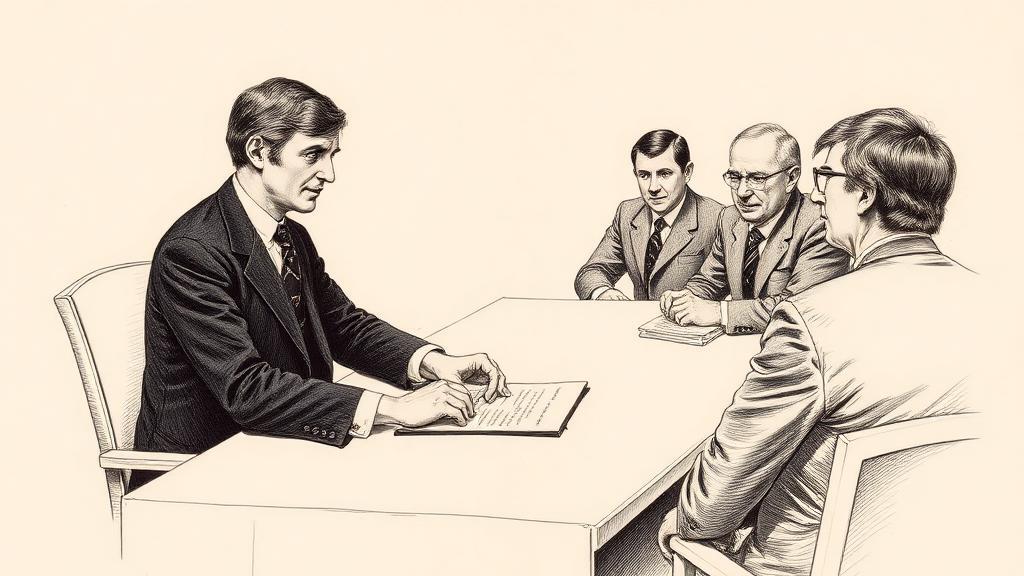
On the morning of February 28, 1978, a French engineer named Hubert Zimmermann spread a diagram across a conference table in Washington, D.C. Delegates from ten countries were watching. The diagram showed seven labeled boxes stacked vertically. Zimmermann had sketched them in the preceding weeks, drawing on his experience building the CYCLADES datagram network in France, and he was about to tell this ISO committee that the entire problem of making incompatible computers talk to each other could be decomposed into this stack — one clean layer at a time.
The problem was urgent in the way only a fragmented market can make things urgent. By the late 1970s, every major vendor had its own proprietary networking architecture: IBM had Systems Network Architecture, DEC had DECnet, Honeywell had HDSA. They were incompatible by design. A machine from one maker could not talk to a machine from another without bespoke glue code that worked only for that exact pair. The US computer-communications market was growing toward $5 billion a year and fracturing into walled islands.
The British Standards Institute had proposed to ISO in 1977 that the industry needed a common architecture. ISO formed Technical Committee 97, Subcommittee 16, and appointed Charles Bachman — a Turing Award winner from Honeywell who had spent years thinking about distributed data — to chair it. IBM objected that Bachman was too close to the work. ISO overruled IBM.
Zimmermann’s seven layers answered one question with unusual precision: what does each piece of a networked conversation actually need to know? The Physical layer handles raw bits over wire or fiber. Data Link manages clean transmission between adjacent nodes. Network routes packets across multiple hops. Transport reassembles them reliably at the destination. Session manages conversation state. Presentation handles translation and encryption. Application serves whatever software the user runs.
The architectural insight was peer-to-peer abstraction. Layer 4 on one machine communicates logically with layer 4 on the other, both sides indifferent to what happens beneath. Swap the physical medium, swap the encryption, swap the routing protocol — the upper layers notice nothing. The model was published as ISO 7498 in 1984, simultaneously as ITU-T X.200.
The model’s problem was not its architecture. By 1984, TCP/IP had already been mandatory on ARPANET for over a year. TCP/IP was free — bundled into Berkeley Unix and shipped to every university on the network. OSI’s specification documents cost money to purchase. The US Department of Commerce mandated OSI compliance for government procurement in 1988, giving OSI one last institutional lifeline. It was not enough.
The reckoning came at the 1992 IETF meeting. Some in the Internet Architecture Board had floated replacing IPv4 with OSI’s ConnectionLess Network Protocol. The assembled engineers were not pleased. Vint Cerf, co-inventor of TCP/IP, performed a theatrical striptease on stage, shedding a three-piece suit to reveal a T-shirt reading “IP on Everything.” The engineer Einar Stefferud delivered the epitaph: “OSI is a beautiful dream, and TCP/IP is living it.”
OSI lost, but it defined the vocabulary. The seven-layer stack became the universal teaching framework for networking — every certification exam and troubleshooting guide for the following four decades organized the subject around those seven boxes. One OSI routing protocol, IS-IS, was so cleanly designed it was later adapted for TCP/IP networks and still runs on major ISP backbones. And the principle at the heart of OSI — each layer ignorant of every other’s internals, communicating only through defined interfaces — is the grammar of distributed architecture since.
Zimmermann drew those seven boxes to prevent a Tower of Babel. The internet that followed ignored the blueprint and built its own tower. But it borrowed the grammar.
Sources
- OSI model — Wikipedia — seven-layer structure, ISO 7498 and ITU-T X.200 publication, Bachman, Zimmermann, IS-IS legacy.
- OSI: The Internet That Wasn’t — IEEE Spectrum — Protocol Wars, Vint Cerf’s striptease, Stefferud’s epitaph, TCP/IP’s cost advantage.
- ISO/OSI 1979–1980 — History of Computer Communications — Zimmermann’s February 1978 Washington meeting, committee process, Bachman’s role.