coffee · 3 min read
Pasqua Rosée and London's first coffeehouse
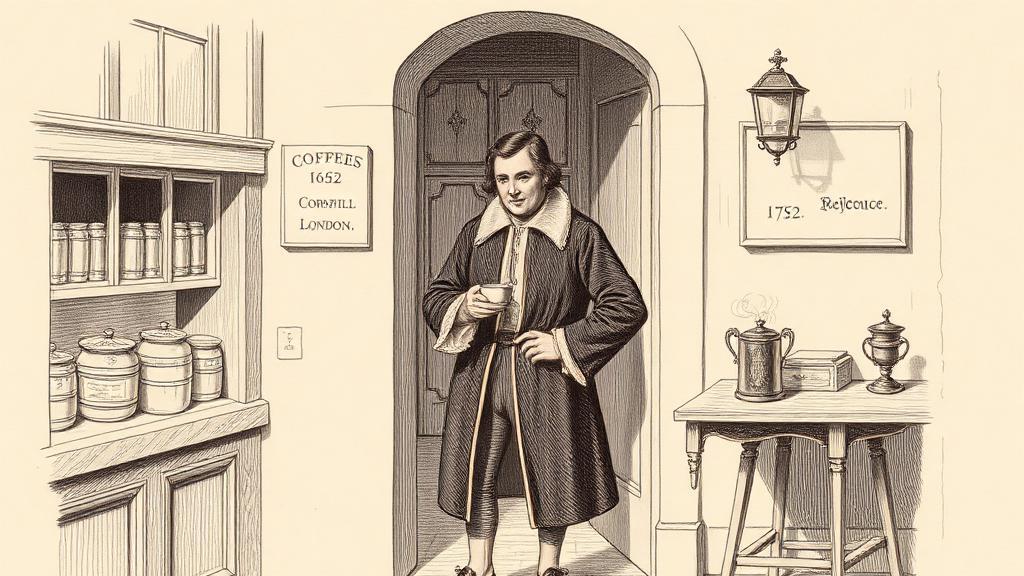
In 1652, a man from Ragusa stood outside a narrow shop on St Michael’s Alley, off Cornhill, and handed strangers a printed broadsheet. At the top it read: “The Vertue of the Coffee Drink.” Below followed a list of cures: dropsy, gout, scurvy, “hypocondriack winds.” The drink he was selling, the broadsheet assured London passers-by, was good for the spleen, the stomach, the eyesight, and the head. The earliest coffee advertisement in the English language was, by modern standards, spectacularly wrong about almost everything except that coffee wakes you up.
Pasqua Rosée was born into the Greek community of the Republic of Ragusa — the maritime republic now southernmost Croatia — in the early seventeenth century (Wikipedia). By 1651 he was in Smyrna (modern İzmir), serving Daniel Edwards, a Levant Company merchant, as clerk, translator, and daily coffee-maker. When Edwards returned to London in late 1651, he brought Rosée with him. Friends came constantly to taste the strange Turkish drink and stayed for hours; Edwards, his family life complicated by the parade of visitors, decided to solve the problem commercially.
There was one obstacle. To trade in the City of London, a man needed to be a Freeman, and Pasqua Rosée was nothing of the sort — a foreigner with no guild affiliation and an accent that marked him as thoroughly not-from-here. Edwards’s solution was to install Rosée as the public face of the enterprise and add Christopher Bowman, a freeman and former apprentice of Edwards’s father-in-law, as a partner. A creative workaround dressed up as a business structure.
The shop at St Michael’s Alley measured 27.5 by 19 feet and cost four pounds a year. Contemporary estimates put annual turnover at £450 to £600 — a respectable return for a room not much bigger than a modern bedroom. Rosée served the coffee strong, dark, and Turkish-style. London’s tavern keepers, alarmed by the competition, petitioned the Lord Mayor to close it on the grounds that Rosée was not a freeman. The petition failed.
And then Rosée disappeared. The last record of him is from 1658. An apothecary named John Houghton, writing in 1699, said vaguely that Rosée had left “for some misdemeanour,” offering no evidence. Unverifiable stories have him fleeing to the Continent to sell coffee in Germany or Holland. Bowman kept the business running until tuberculosis killed him in 1662; his widow continued through at least 1663, by which point eighty-three coffeehouses were operating in London alone (London Walks). In 1666 the Great Fire settled the question of the premises — St Michael’s Alley burned. A pub called the Jamaica Wine House stands there now, with a plaque marking the tercentenary.
What the tavern keepers understood, and feared correctly, was that the coffeehouse was a different kind of room. For a penny — the price of admission — anyone could sit for two or three hours with a fire, a newspaper, and whoever else showed up. Contemporary observers called them “penny universities” (Wikipedia). At Lloyd’s Coffee House on Tower Street, marine underwriters gathered to cover ship voyages; the institution that became Lloyd’s of London carried the address into the modern world. At Jonathan’s Coffee House in Exchange Alley, traders scrawled share prices; that room became the London Stock Exchange.
Rosée probably had no idea he was founding anything. He was a multilingual servant with a product, a rented room, and a talent for the handbill. But the room had a logic of its own.
Sources
- Pasqua Rosée — Wikipedia — origins in Ragusa, career with Daniel Edwards in Smyrna, the 1652 coffeehouse, the Freeman dispute, disappearance after 1658, the 1666 fire.
- English coffeehouses in the 17th and 18th centuries — Wikipedia — “penny universities,” social role, Lloyd’s and Jonathan’s Coffee House origins.
- History of London’s Coffee Houses — London Walks — growth to 83 coffeehouses by 1663, and 500–600 by the early 18th century.