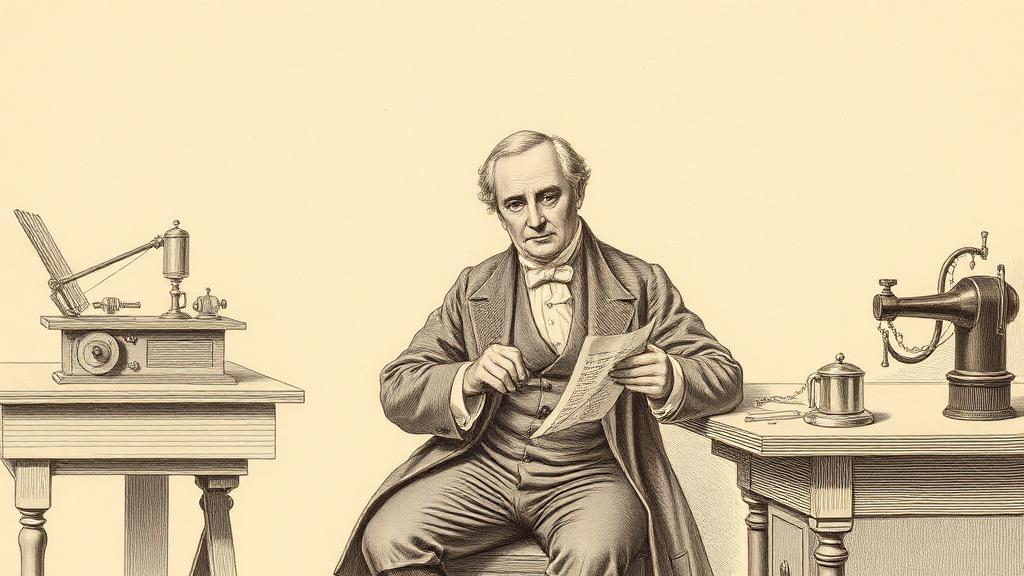
The Playfair cipher, or the one the Foreign Office refused
In January 1854, at a dinner hosted by Lord Granville at which the guests included Prince Albert and Prime Minister Palmerston, Lyon Playfair stood up between courses, borrowed a piece of paper, and wrote a single word at the top: PALMERSTON. From it, he built a grid, and then he showed the room how to encrypt a secret message. He was demonstrating a cipher invented by his friend Charles Wheatstone — and, by doing so, ensuring that posterity would attach his name to it instead.
Wheatstone had devised the scheme early that year. The document he signed is dated 26 March 1854. The idea was simple enough to state and subtle enough to matter: instead of encrypting one letter at a time, encrypt two. Break the plaintext into pairs — bigrams — and substitute each pair using a 5×5 grid built from a shared keyword. Because the same letter can encrypt differently depending on what follows it, the 26-letter alphabet blossoms into 600 possible bigrams, and the frequency patterns that had broken every cipher since Al-Kindi’s ninth-century treatise no longer work straight.
Playfair brought the cipher to official attention. He lobbied the Foreign Office. A senior official found it too complicated. Wheatstone offered to prove that any London schoolboy could master it in fifteen minutes. The reply — delivered with the serenity of a man who had never been obliged to teach anyone anything — was: “That is very possible, but you could never teach it to attachés.” The Foreign Office passed. The War Office eventually did not.
By the Boer War (1899–1902), British forces were using the cipher in the field. By 1914, it was the standard British Army cipher at the tactical level. The Germans broke it early in the war — a trained analyst with a long enough message can recover the key square from bigram frequencies — but British commanders kept using it for short field dispatches on the logic that intelligence about a position is rarely useful once the troops have moved. The first published solution appeared the same year, in a nineteen-page pamphlet by Lieutenant Joseph O. Mauborgne of the U.S. Army Signal Corps.
On the night of 1–2 August 1943, a Japanese destroyer rammed and sank the American patrol torpedo boat PT-109 in Blackett Strait, Solomon Islands. The surviving crew, led by Lieutenant John F. Kennedy, swam through the dark to a coral island barely large enough to hold them. Kennedy sent a rescue message encrypted in Playfair under the key ROYAL NEW ZEALAND NAVY, routing it through the Allied coastwatcher network. An Australian lieutenant named Arthur Reginald Evans decoded it on a jungle ridge on Kolombangara at 0930. The crew was rescued by nightfall. The cipher that the Foreign Office deemed too complicated for its attachés had just helped keep a future president alive.
What Wheatstone had done in 1854 was pose a question that cryptography has been answering ever since: what happens if you encrypt groups of characters rather than one at a time? Every monoalphabetic cipher before him was vulnerable to frequency analysis at the character level. His digraph substitution raised the analytical cost by an order of magnitude. When the U.S. government standardised the Data Encryption Standard in 1976, its designers worked with 64-bit blocks; when AES replaced it in 2001, they worked with 128-bit blocks. The principle is Wheatstone’s, applied to silicon.
The Foreign Office attachés never did learn it. The idea they turned away — encrypt in blocks, not singles — became the load-bearing assumption of every cipher that followed.
Sources
- Playfair cipher — Wikipedia — Wheatstone’s 1854 invention, the Granville dinner, the Foreign Office rebuff, Boer War and WWI military use, mechanics of bigram substitution.
- John F. Kennedy and PT-109 — JFK Presidential Library — the PT-109 rescue, 2 August 1943, role of the coastwatcher network and the Playfair-encrypted message.
- Playfair Cipher — The Cipher Museum — operational use in Boer War and WWI, field deployment, and the history of official adoption.