Pong, or the game Alcorn built to learn his job
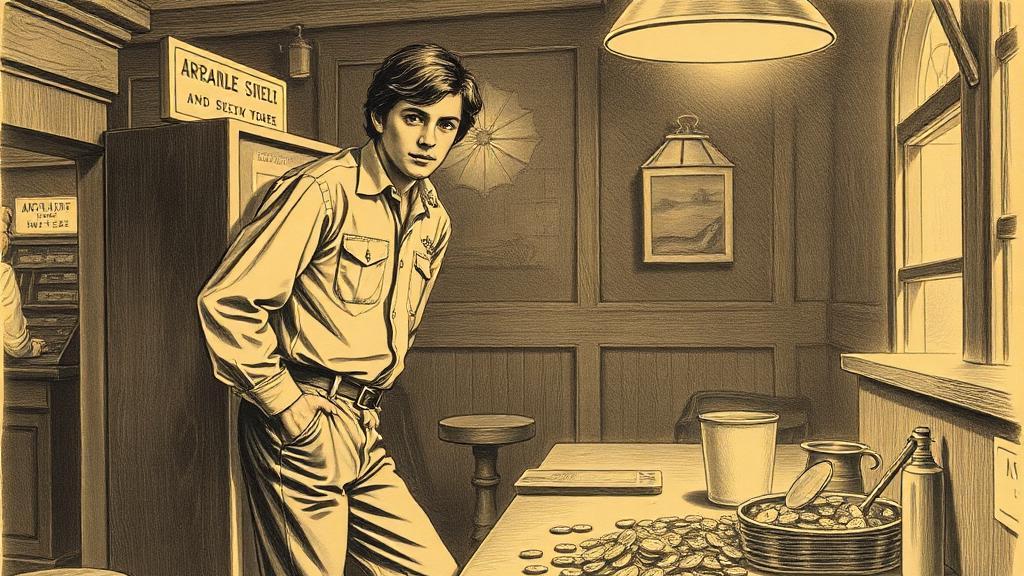
The machine broke two weeks after Allan Alcorn installed it at Andy Capp’s Tavern on West El Camino Real in Sunnyvale. That was the message, anyway — a polite call from the bar manager saying customers were coming in early just to play the thing, and now it had stopped working. Alcorn drove over, opened the coin box, and quarters cascaded out. The machine hadn’t broken. It had filled up.
That was August or September 1972, and that overflowing coin box was the moment a training exercise became an industry.
Atari had been incorporated on June 27, 1972, by Nolan Bushnell and Ted Dabney in Sunnyvale, California. Their third employee was a young engineer named Allan Alcorn with solid electronics experience and no video game background whatsoever. That was the point. Bushnell assigned Alcorn the simplest possible project as an introduction to the job: one moving spot, two paddles, a score. He told Alcorn there was a contract with General Electric involved — there wasn’t. The whole thing was meant to be a warmup. What Alcorn built, in three months, was Pong.
The machine had no CPU. Sixty-six integrated circuits, a pair of 555 timers, and some transistors handled everything — video generation, collision detection, scoring — through hardwired discrete logic. It was elegant in the way a well-set mousetrap is elegant: nothing unnecessary, nothing wrong. Alcorn divided each paddle into eight segments so the return angle varied depending on where the ball struck, which turned a reflex test into a game. He found that the sync generator could be repurposed to produce tones and gave the ball its now-famous bounce. Rally speed increased as a match continued; a missed shot reset everything.
When the coin box overflowed, Bushnell understood what it meant before the quarters stopped falling. Atari had planned to license the design. Instead they built the cabinets themselves. By 1973 they had filled 2,500 orders; by end of 1974, more than 8,000 units were earning $35 to $40 per day in bars, bowling alleys, and shopping malls — four times the revenue of any other coin-operated machine on the market. Fifteen companies in the US and Japan entered the space to build their own versions. Magnavox, whose Odyssey console had partly inspired Pong, sued Atari for patent infringement and settled in 1976 for $1.5 million; Bushnell’s lawyers thought he’d probably win in court, but estimated the legal bill would run about the same.
Pong was inducted into the World Video Game Hall of Fame by The Strong National Museum of Play in 2015. The original arcade cabinet sits in the Smithsonian. Andy Capp’s Tavern, now operating as Rooster T. Feathers, still stands on West El Camino Real and is recognised as one of the first public establishments to host a coin-operated video game. These are the things that happen when a training exercise turns out to matter.
What the coin overflow proved was simpler than the industry it spawned. People would pay, repeatedly, in public, to play — and they would come back for more. Every arcade that followed, every quarter dropped into Space Invaders or Pac-Man or Donkey Kong, rested on that single demonstration. Alcorn built Pong to learn his job. It turned out to be the foundation.
Sources
- Pong — Wikipedia — Founding of Atari, Alcorn’s training-exercise assignment, the GE contract fiction, technical specifications, Magnavox lawsuit and settlement.
- Pong — Computer History Museum — Commercial figures: order volumes, daily revenue, competitive impact by end of 1974.
- Pong — World Video Game Hall of Fame, The Strong Museum of Play — Hall of Fame induction 2015, Smithsonian collection, cultural legacy.
- Allan Alcorn on Pong — IEEE Spectrum — Alcorn’s first-hand account of the Andy Capp’s installation and the overflowing coin box.