The machine at the end of the hallway
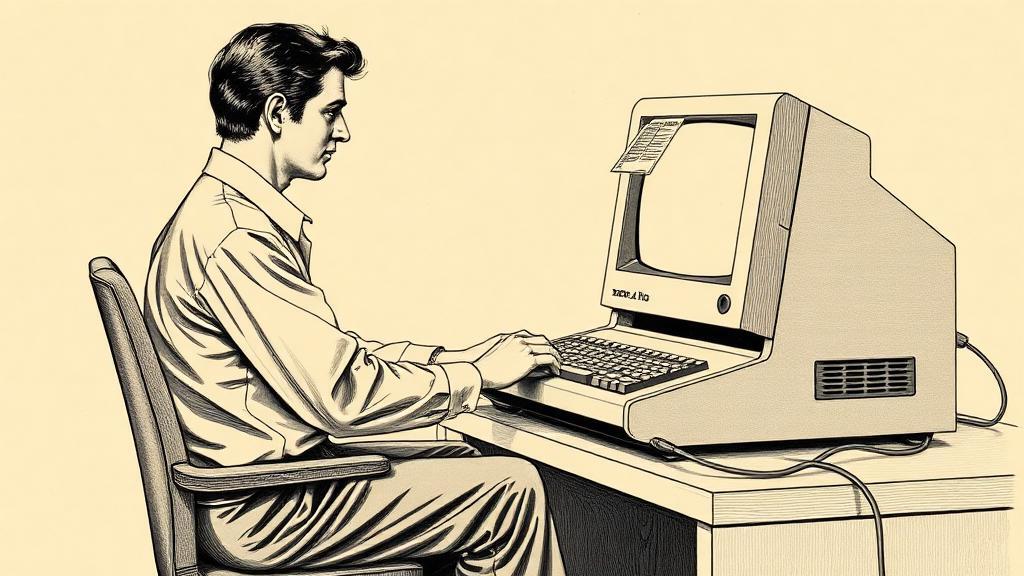
By 1975, every researcher at Xerox PARC had a personal computer on their desk — something almost nobody else in the world could say. The Alto, first operational in 1973, fit under a standard table, had a graphical display driven by a mouse, and could typeset a memo that looked like it came from a print shop. What it could not do, alone, was print that memo. The laser printer down the hall produced three immaculate pages a minute, and it cost roughly as much as a house. Nobody was getting one of their own.
So the Altos shared it.
Robert Metcalfe and David Boggs had built a 100-node Ethernet at PARC by mid-1975, running at 2.94 megabits per second over thick coaxial cable (IEEE Spectrum). The network connected individual workstations to shared resources through a protocol called PUP — PARC Universal Packet — a precursor to TCP/IP that let packets travel by name across multiple networks. File storage ran on a system called IFS, the Interim File System, designed by Boggs and Ed Taft. The name said everything about PARC’s internal culture: “interim” because something better was surely on its way.
Something better never arrived.
The IFS ran on ordinary Altos fitted with larger disk packs and became, by default, the permanent storage layer of the PARC computing environment. By the early 1980s, those servers — named Filene, Ibis, Indigo, Io, and Ivy — held years of research code, drafts, and email from hundreds of scientists, preserved on a system that was supposed to be temporary (Computer History Museum). The word “interim” stayed in the name long after anyone stopped expecting a replacement.
The architecture they were running had not yet been named. Computer scientists at ARPANET’s Stanford Research Institute had used the terms “server-host” and “user-host” in foundational documents as early as 1969 — RFC 4 and RFC 5 — but the specific word “client,” meaning a process making structured requests of another process across a network, did not appear in print until 1978, when Howard Sturgis, James Mitchell, and Jay Israel published a Xerox PARC technical report titled “Separating Data from Function in a Distributed File System” (Wikipedia). They defined the term with care, noting that the client was not the person at the keyboard but the machine making the request — a distinction that mattered once the model spread beyond a single building full of researchers who already knew each other.
The pattern was simple: one machine requests, another responds. It became the structural atom of networked computing. The Web runs on it — your browser is the client, the server is the server. S3 runs on it. Every API call a smartphone makes to every service it depends on runs on it. The underlying choreography has not changed since 1975, when a workstation on Coyote Hill Road told an Interim File Server it needed a file and the server, obligingly, sent one.
The names Filene and Ibis are gone. The pattern they ran on persists in every data center on earth.
Sources
- 50 Years Later, We’re Still Living in the Xerox Alto’s World — IEEE Spectrum — Ethernet development, 100-node PARC network, and the Alto computing environment in 1975.
- Client–server model — Wikipedia — History of the terminology, ARPANET usage of “server-host” and “user-host,” and the 1978 Sturgis/Mitchell/Israel paper.
- Xerox PARC Interim File System Archive — Computer History Museum — IFS server names (Filene, Ibis, Indigo, Io, Ivy), scope of the archive, and documentation of the permanent IFS infrastructure.