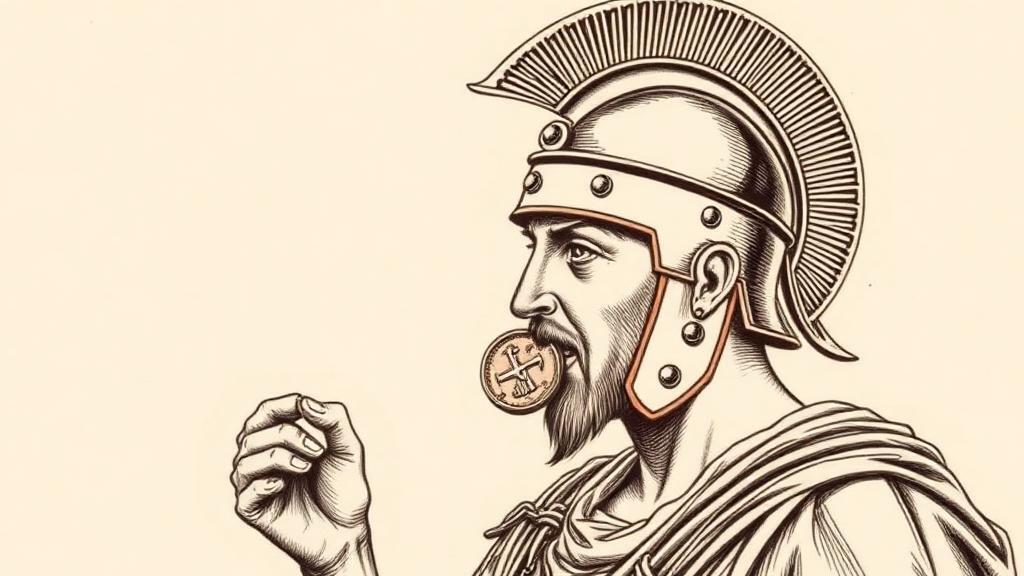
The aureus and the long debasement
On the Danube frontier around 265 CE, a Roman legionary drew his monthly pay: a handful of antoninianii, each stamped with the emperor’s radiate crown and worth two denarii by official decree. He bit one, as Romans did when testing coin metal. The silver wash came off on his teeth. Underneath: bronze.
This was the end of a 300-year slide that began with a man who needed to pay his soldiers. Julius Caesar, in 49 BCE, standardized the aureus — a gold coin struck at one-fortieth of a Roman pound, nearly pure gold, worth 25 denarii of 98% silver. Augustus formalized the hierarchy. Even Germanic tribes on the northern frontier preferred old Roman coins to their own, because they could trust the weight.
Nero was the first man to take a knife to it. In 64 CE — the same year Rome burned — he quietly reduced the denarius from about 97% silver to 93% and trimmed its weight. He needed money for reconstruction and, probably, for himself. The cut was small enough that people kept accepting the coins. The door was open.
The debasement then became an imperial tradition. Marcus Aurelius took silver content to 75%; Septimius Severus hit 46%. Then in 215 CE, Caracalla introduced the antoninianus — a coin with a radiate crown to signal it was worth two denarii, but containing silver worth only 1.5 denarii. Gresham’s Law, which would not be named for another thirteen centuries, did the rest: good money fled the market; bad money filled it.
By the reign of Gallienus (253–268 CE), the antoninianus had been scraped to 2.4% silver. Wheat that cost two sestertii per modius under Augustus now cost four hundred. The 200-fold price rise maps almost exactly onto the 200-fold erosion of the coinage.
In 271 CE, the emperor Aurelian discovered that his own finance official — a man named Felicissimus, described in the Historia Augusta as “the lowest of all my slaves, to whom I had committed the care of the privy-purse” — had been systematically stealing the remaining silver from coins and substituting copper. When Aurelian moved to shut it down, the mint workers on Rome’s Caelian Hill armed themselves and fought back. The suppression cost roughly 7,000 Roman soldiers’ lives. The Roman mint was closed for two years. The currency had contained so little actual silver that stealing it had been worth a war.
Diocletian issued his Edict on Maximum Prices in 301 CE, fixing legal ceilings on 1,400 goods and services. Merchants pulled their stock and sold in secret. The edict collapsed. Constantine did what Diocletian couldn’t: he introduced the solidus around 312 CE — 4.5 grams of gold, 98% pure. The coin circulated, largely unchanged, for 700 years.
What the debasement actually destroyed was not gold or silver but trust. Soldiers demanded payment in kind. Tax collection shifted to grain and labor because no one could price anything in a currency that changed by the month. The Western Empire fragmented; the East survived partly because the solidus gave it a floor the West never had.
Constantine’s solidus held for seven centuries. Every currency that followed has eventually found its own Gallienus.
Sources
- Aureus — Wikipedia — Caesar’s standardization, Augustus’s exchange rates, and the eventual transition to the solidus.
- NGC Ancients: The Decline of Roman Silver Coinage — emperor-by-emperor purity percentages from Augustus through the late empire.
- Antoninianus — Wikipedia — Caracalla’s double-denarius fraud, Gresham’s Law in practice, and the Aurelian reforms.