Touch-Tone: Bell's push-button phone and the day dialing became a command
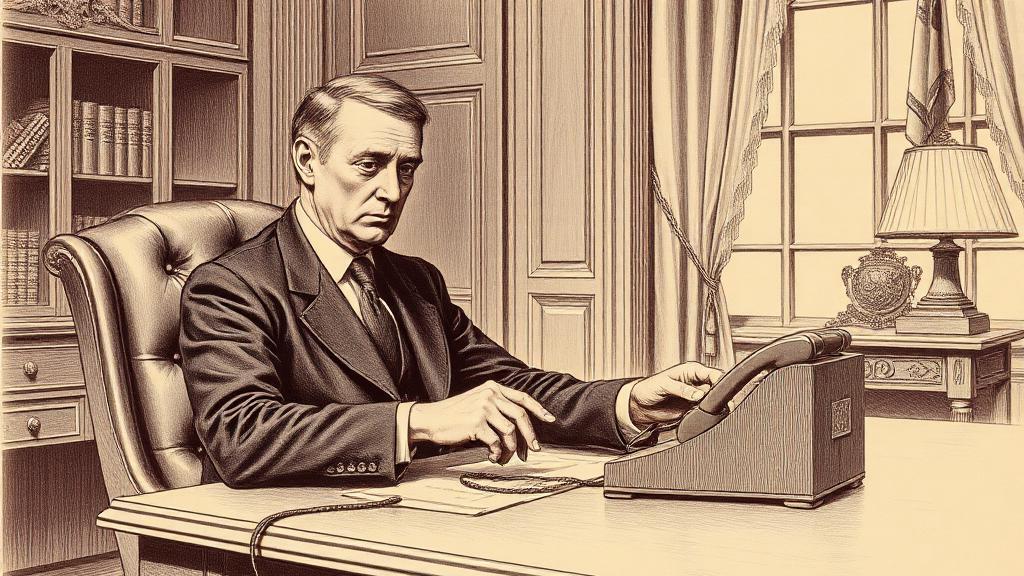
On April 22, 1963, President Kennedy sat at his desk in the Oval Office and pressed four buttons on a telephone handset: 1, 9, 6, 4. Each press produced a pair of pure tones — two different audio frequencies sounding at once, like a chord struck on a pipe organ with none of the pipes in the room. Across the country, a machine received the signal and started a countdown clock. The 1964 World’s Fair was now seven months away. Nobody had spoken a word.
That was the point.
The phone Kennedy held was a prototype of the Western Electric 1500, the device that Bell Telephone would officially launch to paying customers on November 18, 1963, in Carnegie and Greensburg, Pennsylvania — two mill towns on the outskirts of Pittsburgh chosen for their useful demographic mix (Hagley Museum). For an extra $1.50 a month above their standard dial service, subscribers could exchange their rotary dial for a flat panel of ten rectangular buttons. The telephone could already do everything it always had; these buttons were the part that let it do something new.
The technology was called Dual-Tone Multi-Frequency signaling — DTMF — and Bell registered it under the trademark “Touch-Tone,” first used in commerce on July 5, 1960. The premise is elegantly simple: each of the ten digits corresponds to a unique pair of audio frequencies drawn from a grid of seven tones between 697 Hz and 1633 Hz. Pressing 5 simultaneously broadcasts 770 Hz and 1336 Hz. The receiving equipment identifies the combination, not any single pitch — which makes it both resistant to accidental triggering and reliable across the noise and attenuation of long-distance lines. The rotary dial, by contrast, interrupted the electrical current a precise number of times per digit. Pulse dialing worked fine when calls terminated at a human operator. It was mute to anything downstream that wasn’t a switchboard.
The layout of the keypad was not a guess. It was the product of years of controlled experiments in Bell Laboratories’ human-engineering department, conducted under John Elias Karlin (1918–2013), a South African-born psychologist who spent his career at Bell studying how real people interact with real phones. Karlin tested dozens of arrangements: circular, two-row, arc-shaped. His researchers measured error rates, timing, and which configurations people rated most natural. The winning design placed 1, 2, and 3 across the top row — directly reversing the convention of adding machines and cash registers, which counted upward from the bottom. Calculators had logic on their side; Karlin had data. The telephone keypad has not changed in sixty years.
What Bell sold as a premium convenience was, in retrospect, an infrastructure decision of the first order. A rotary pulse is a signal addressed to a switch. A DTMF tone passes through the switch and arrives at whatever is listening on the far side. That meant a telephone call could now carry instructions to a machine, not just words to a person. Banks began offering automated account-inquiry lines in the mid-1960s. By the 1980s, DTMF was driving voicemail systems, automated attendants, and the interactive voice response trees that have occupied hold music ever since. “Press 1 for English” exists because a subscriber in Carnegie, Pennsylvania paid an extra dollar fifty a month in 1963.
The asterisk and pound keys arrived in 1968, added to the twelve-button Western Electric 2500 and reserved, in the original plan, for future computer-access codes. Nobody in 1968 was entirely certain what those codes would eventually do. Bell left two chairs at the table and figured the guests would arrive.
They did.
Sources
- Push-button telephone — Wikipedia — Kennedy anecdote, commercial launch dates and locations, Western Electric 1500 and 2500 models, $1.50/month pricing, Karlin’s keypad-layout research.
- Dual-tone multi-frequency signaling — Wikipedia — DTMF technical overview, frequency grid, Touch-Tone trademark date (July 5, 1960), replacement of pulse dialing.
- Hagley Museum — November 18, 1963, Bell Telephone commercial launch — primary confirmation of the Carnegie and Greensburg launch date and the Western Electric 1500 hardware.