The call across the Atlantic, or how Rocky Point and Rugby shrank the ocean
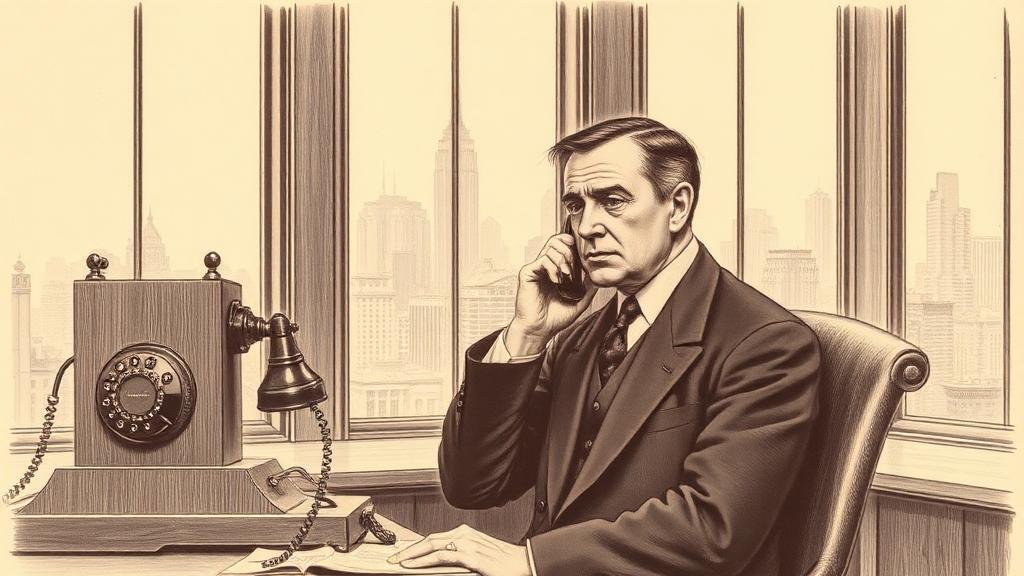
At 9:35 on the morning of January 7, 1927, Walter S. Gifford picked up a telephone on the 26th floor of AT&T’s building at 125 Broadway in New York and asked to be connected to London. His voice traveled by wire to a transmitter at Rocky Point, Long Island, was launched into the air as a long wave at 60,000 cycles per second, crossed three thousand miles of open Atlantic, and was caught by the receiving antenna of the Rugby Radio Station in Warwickshire. Wire carried it the rest of the way to the desk of Sir Evelyn Murray at the British General Post Office. Murray answered. The first commercial transatlantic telephone call had cost $75.
The experiment that made it possible had been running for twelve years. In October 1915, AT&T engineers installed a transmitter at the U.S. Navy’s station in Arlington, Virginia and sent a voice signal across the Atlantic for the first time in history. An engineer named B.B. Webb spoke into the microphone: “Hello… goodbye, Shreeve.” His colleagues H.E. Shreeve and A.M. Curtis, sitting at a receiver at the base of the Eiffel Tower in Paris, heard every word clearly. They had no transmitter of their own, so they sent the acknowledgment by telegraph. The telephone had crossed the ocean. It just couldn’t listen yet.
Getting to two-way required a careful division of labor. The 1927 commercial route ran the American side through Rocky Point and the British side through Rugby’s second long-wave transmitter — callsign GBT, 60 kilohertz — while American voices were received at Wroughton in Wiltshire and British voices at Houlton, Maine. All four stations had to work simultaneously to complete a single call. Only one conversation could be carried at a time.
None of that discouraged anyone. When AT&T announced the booking window two days before the service launched, queues formed immediately — for a service priced at $75 for the first three minutes, roughly $1,200 in today’s money, with the British side charging the equivalent at £15. The day the service opened, more than $6 million in business was transacted between New York and London. A news agency filed its first Europe-to-America dispatch by voice. During a test call on January 6, someone had remarked: “Distance doesn’t mean anything anymore. We are on the verge of a very high-speed world.”
They were not wrong, though the proof took longer than expected. Long-wave radio was temperamental — atmospheric interference could flatten a conversation mid-sentence — and the single-channel limit meant the whole Atlantic took turns. The underwater cable that would fix most of this, TAT-1, would not arrive until 1956.
But the premise had been demonstrated. A voice could leave New York and arrive in London without any physical medium connecting the two cities. The ocean was not a wall; it was an engineering problem. Every transatlantic cable, satellite link, and fiber strand laid since has been making that same case.
Murray and Gifford spoke for under three minutes. The Rugby transmitter has been silent for decades. The argument it started has not.
Sources
- Rugby Radio Station, 1927 — route details, Rugby GBT transmitter specs (60 kHz, callsign GBT), British pricing (£15 for three minutes), queues forming January 5.
- 1915 Arlington–Paris transmission, Early Radio History — B.B. Webb, H.E. Shreeve and A.M. Curtis, one-way limitation, the telegram acknowledgment.
- First Transatlantic Phone Call, UTA Libraries — January 7, 1927 date, Gifford and Murray as inaugural callers, $6M in business on opening day, the January 6 test-call quote.