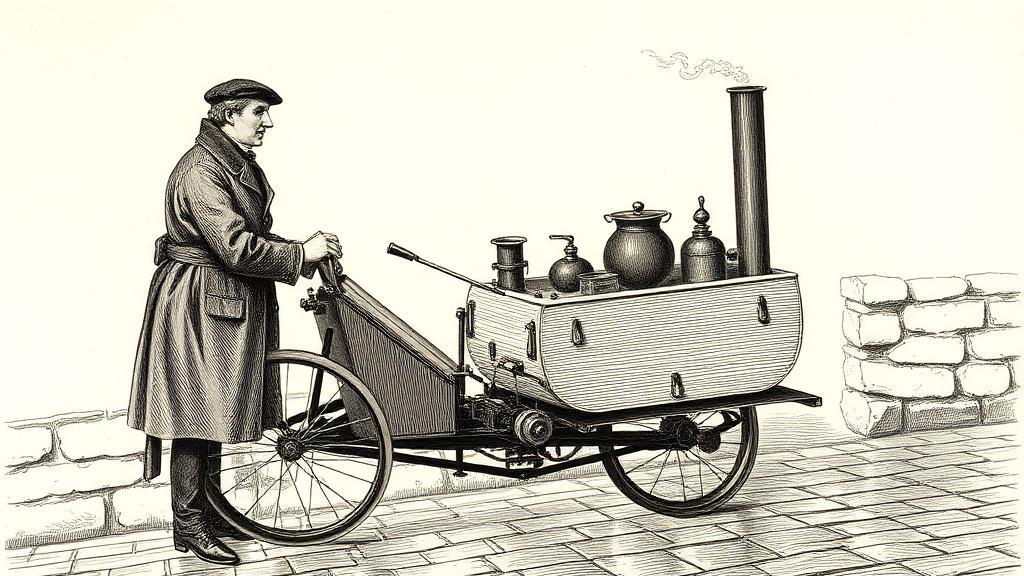
Trevithick's Puffing Devil: up Camborne Hill on Christmas Eve
On Christmas Eve 1801, in the rain outside Camborne in Cornwall, a cooper named Stephen Williams climbed aboard a machine running on high-pressure steam and reported that it went off “like a little bird.”
The machine was the work of Richard Trevithick, a Cornish engineer born in 1771 who had spent much of his career watching Watt-and-Boulton atmospheric engines pump water out of the tin mines around his home county. He understood what those engines were doing wrong: they worked by creating a partial vacuum — sucking the piston down — which meant the boiler pressure could never much exceed the air around it. Safe, certainly. But feeble. Trevithick’s insight was to reverse the logic: use high-pressure steam, something close to 145 pounds per square inch, to push the piston up. That halved the required boiler size, cut the weight, and — crucially — made the engine small enough to carry on wheels.
The Puffing Devil was assembled at Williams’ workshop in Weeth, near Camborne, and erected by a man named John Tyack. It had a single vertical cylinder, a boiler enclosed within a firebox, and connecting rods that converted piston strokes into rotation at the rear wheels. Trevithick’s cousin Andrew Vivian took the helm. On Christmas Eve, with Trevithick and four others aboard, the machine went up Fore Street and continued up Camborne Hill toward the village of Beacon — the first self-propelled vehicle to carry passengers on a public road. It was not fast by any measure a horse would recognise, but Williams reported that it outpaced a walking man. On a steep, rain-slicked road in December, that was enough.
The journey covered roughly half a mile in each direction. Then everyone went home for Christmas. Four days later — December 28 — came the coda. The Puffing Devil broke down on the road to Tehidy after passing over a gully. Trevithick and his crew, sensibly reluctant to stand in the Cornish winter beside a broken machine, decamped to the nearest public house for roast goose and strong drink. They left the fire burning in the boiler. The water boiled away. The engine overheated and caught fire, and the world’s first steam-powered passenger vehicle was destroyed by the very force that had propelled it, tended by nobody at all.
Trevithick rebuilt and moved on. In 1803 he drove an improved London Steam Carriage from Holborn to Paddington and back through the actual streets of the capital, drawing crowds before being quietly abandoned when it proved more expensive than a horse. The real argument came on February 21, 1804, at the Penydarren ironworks in South Wales: Trevithick’s locomotive hauled ten tons of iron, five wagons, and seventy men across nine miles of tramway, winning a 500-guinea wager and demonstrating that iron wheels on iron rails could sustain a useful load — the founding premise of the railway age.
Road or rail, the principle was the same one Trevithick had proved in the rain outside Camborne: high-pressure steam, compact enough to move itself. Cugnot’s fardier of 1769 had shown that a machine could propel itself. The Puffing Devil showed it could take people along for the ride. The distance between those two demonstrations is the distance between a proof of concept and the beginning of an industry.
Sources
- Richard Trevithick — Wikipedia — biography, the 1801 Camborne test, the 1803 London Steam Carriage, and the 1804 Penydarren locomotive.
- The Puffin’ Devil’s first journey — Cornwall For Ever — Stephen Williams’ eyewitness account, the December 28 pub-and-fire incident, and the route.
- Richard Trevithick — Linda Hall Library — Trevithick’s high-pressure steam innovation and engineering career timeline.