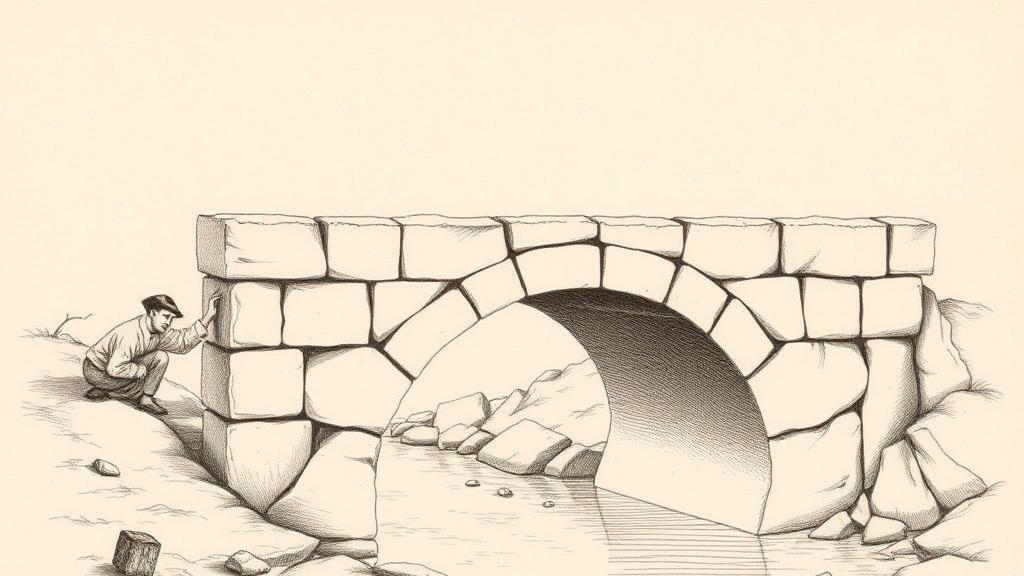
Anji Bridge: the flattest arch in the ancient world
Around 605 CE, a craftsman named Li Chun finished a bridge in Zhao County, Hebei Province, that was immediately, conspicuously flat. Its stone arch spans 37 meters but rises only 7.3 meters above the riverbed — a profile so low that anyone accustomed to Roman or Chinese semicircular arches would have doubted the math. The Sui dynasty that oversaw its construction lasted thirteen more years.
No contemporaneous account of Li Chun’s method survives; what we have is the bridge itself and a handful of later dynastic references. He was a master craftsman from Zhao Commandery, not a titled government engineer. The project ran from around 595 to 605 CE, a decade of cutting and fitting 28 limestone voussoirs into an arch bound with iron butterfly joints — dovetail clamps bedded into the stone that allow slight flex rather than rigid fracture under load shifts. He built the arch as a segmental arc, using only 84 degrees of a circle rather than the standard 180 of a full semicircle, which is why the profile looks drawn rather than humped.
The more radical move was in the spandrels — the roughly triangular zones of solid fill between the arch curve and the flat deck above it. Convention said you filled these solid. Li Chun punched four smaller arches through them, two per shoulder, leaving the stone open where a lesser engineer would have stacked it. This shed an estimated 700 tons of dead weight from the structure. During the Jiao River’s seasonal floods, water passed through the openings rather than battering a solid stone face. The bridge has survived at least ten major floods, eight wars, and a magnitude 7.6 earthquake in 1966 whose epicenter was forty kilometers away. The physics, it turns out, were impeccable.
About seventy years after the bridge was completed, a Tang dynasty official named Zhang Jiazhen stood on it and wrote an inscription that is still quoted: “How lofty is the flying arch. How large is the opening, yet without piers. Such a master-work could never have been achieved if this man had not applied his genius.” The Sui dynasty had already collapsed by then, replaced by the Tang. Li Chun was almost certainly dead. The observation that a vanished empire had produced something the current one could only stand on and admire was not lost on anyone.
Roman bridge engineers — the Pont du Gard, Trajan’s crossing of the Danube — built magnificently, but on the conventional full-circle arch with solid spandrels. Li Chun’s flatness ratio was not matched in European stone arch construction until the Ponte Vecchio in Florence in 1345 — 740 years later — and open-spandrel stone bridges of comparable sophistication did not appear in Europe until the mid-nineteenth century. The architectural historian Liang Sicheng surveyed the Anji Bridge in 1933, made precise measurements and photographs, and was, by his own account, astonished. The American Society of Civil Engineers designated it an International Historic Civil Engineering Landmark in 1991.
The Sui dynasty that commissioned the bridge lasted thirteen years. The bridge is now in its fifteenth century.
Sources
- Anji Bridge — Wikipedia — construction dates (595–605 CE), Li Chun’s identity, open-spandrel design, Tang inscription by Zhang Jiazhen, Liang Sicheng’s 1933 survey, flood and earthquake survival record.
- Zhaozhou Bridge — ASCE Historic Landmarks — ASCE 1991 designation, 37-meter span and 7.3-meter rise dimensions, iron dovetail joints, 605 CE completion.
- Anji Bridge: A Breakthrough in Bridge Construction — AIMIR CG — 700-ton weight reduction, flatness ratio comparison with Roman bridges, 740-year lag to Ponte Vecchio, 1,250-year gap to European open-spandrel stone bridges.