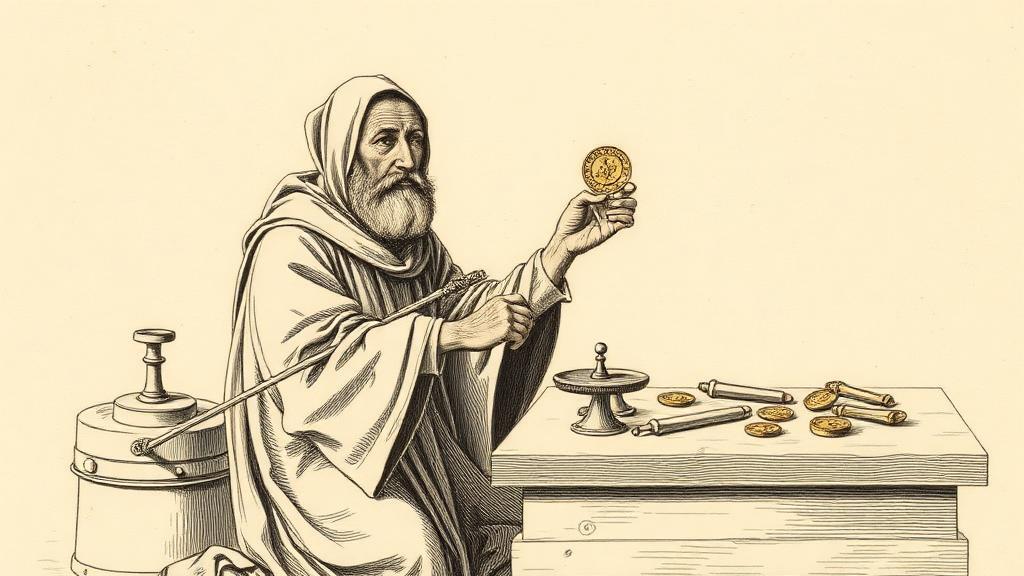
The Arab dinar, or the coin that erased the emperor's face
In the summer of 696, a new gold coin began moving through the markets of Damascus. It weighed 4.25 grams exactly — one mithqal — and it was covered entirely in text. On the face: There is no god but God alone; He has no associate. On the back: a verse from the Quran about the nature of God. No king, no cross, no portrait of any living thing. This had never been done before.
The backstory is, in part, a story about letters. Abd al-Malik ibn Marwan, the fifth Umayyad Caliph, had developed a habit of embedding Quranic declarations into his diplomatic correspondence with Constantinople — the shahada written into the header of official state letters, right where a Byzantine official expected a polite salutation. The young emperor Justinian II found this intolerable. He sent a warning: keep it up, and he would stamp phrases insulting the Prophet Muhammad onto the gold solidus — the coin his empire struck and the Islamic world spent daily.
Abd al-Malik convened his advisors. The threat landed hard, because his embarrassment ran deeper than the provocation: the entire Islamic economy was running on Byzantine money. Every market transaction, every tax receipt, every long-distance trade settlement across Syria and Egypt depended on coins that bore a Christian emperor’s face and a cross. He had reunited a caliphate torn by civil war and was building the Dome of the Rock in Jerusalem. He was not about to let his economy depend on foreign coinage.
The first attempt, around 693, shows how hard it was to get this right. Abd al-Malik struck a gold coin bearing his own image — the Standing Caliph dinar: himself in elaborate robes, hand resting on the hilt of a sheathed sword, deliberately crownless as a dig at imperial vanity. The shahada circled the margin. It was a striking object, about 20mm across, with a quiet authority in its refusal of the crown. Muslim religious opinion rejected it almost immediately. Figural imagery on coins was no less objectionable than figural imagery anywhere else. The Caliph had replaced the emperor’s face with his own, which rather missed the point.
The solution, issued from Damascus in AH 77, was to remove every face and let the words stand alone. The reformed dinar carried Sura al-Ikhlas on the reverse — God is one; God the eternal; He did not beget and was not begotten — and on the obverse, the full shahada. The margin noted the year and mint in God’s name: In the name of God, this dinar was struck in the year 77. No portrait, no heraldry, nothing figurative at all. Just theology, precisely weighed.
The weight itself was a declaration. The Byzantine solidus ran to 4.55 grams; the new Islamic mithqal was set at 4.25 — a deliberate, permanent divergence from the Roman standard. Two empires, two coins, and now no way to confuse one for the other.
The dinar spread as fast as the trade routes it travelled. From Ifriqiya to al-Andalus, from Egypt to Khorasan, the reformed coin became the currency of a world stretching from the Atlantic to the Indus. Abbasid caliphs inherited the design and kept it. The weight standard outlasted the dynasty by centuries. The modern word dinar still names the official currency of ten countries.
What Abd al-Malik had built, in response to a threat about insults on foreign coins, was a monetary system whose authority needed no face. The text was the authority. It still is.
Sources
- Gold dinar — Wikipedia — origins, 4.25g mithqal standard, design evolution from Byzantine-influenced to epigraphic, geographic spread from Spain to Central Asia.
- Standing Caliph Dinar — Ashmolean Museum — physical description (20mm, elaborate robes, sword hilt, crownless), historical context, transition to epigraphic coinage.
- Aniconic Reformed Dinar AH 77 — Islamic Awareness — specific obverse and reverse inscriptions, 4.25g weight, Quranic text used on each face, mint margin wording.