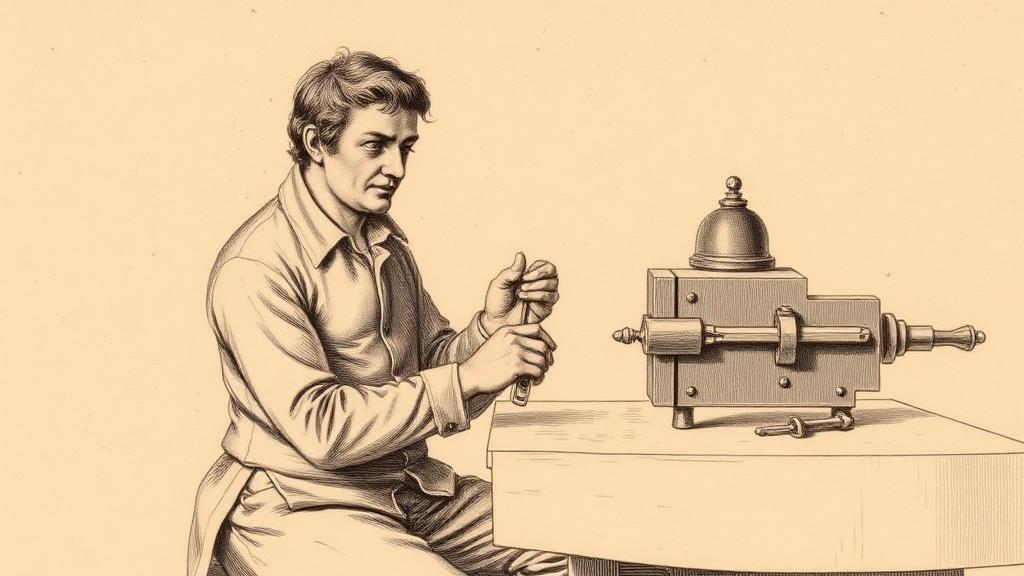
The precise lift, or how a Hoxton locksmith beat the pick
The lock on an eighteenth-century London counting-house was, by any reasonable measure, a bluff. The warded lock — Europe’s security standard since Rome had first cast it in iron — worked on fixed obstacles: metal ridges inside the case that blocked any key whose profile didn’t match their shape. A merchant trusted it because it was solid and familiar. A motivated thief trusted it for the same reason, because the ridges never moved, and anything that never moves can eventually be mapped.
In 1776, Robert Barron, a locksmith from Hoxton in Shoreditch, left his family’s shop and set about closing that gap. What he built in the next two years, patented as British Patent No. 1200 on 27 February 1778, was the double-acting lever tumbler lock — and it changed the terms of the problem entirely.
Inside his lock case sat two steel levers, each on a pivot, each bearing a small projecting stump. The bolt running through the case was cut with a gating: a notch through which each stump had to pass at a precise height before the bolt could move. The key’s job was to raise each lever to exactly that height — not a fraction lower, not a fraction higher. Lift too far and the stump jammed against the upper wall of the gate; not far enough and the lower wall stopped it. For the first time in the history of the lock, too much was as wrong as too little.
What the old single-tumbler designs had always allowed was the easy upward escape: raise the lever clear of the bolt’s path and you were done. Any overshoot simply didn’t matter. Barron’s double-acting levers fought back in both directions — the lever would block the bolt whether the picker had gone too far or not far enough. A pick working blind could no longer push until something gave; the click of “far enough” had been replaced by an invisible target wedged between two wrong answers.
Barron died in 1794 without seeing the moment that proved his idea. That came in 1817, when a gang broke into the Portsmouth Dockyard armoury using keys forged from wax impressions taken from locks already in use — the navy’s weapons store, opened by a copied key. The British government, sufficiently alarmed, ran a public competition for a lock that a forged key couldn’t open. Jeremiah Chubb won it in 1818 with a detector lock that added a trip lever: if any lever was raised too high by a pick, a catch snapped that jammed the bolt permanently, resetable only by the owner’s key. The thief arrived with his forged key and found a bolt that simply wouldn’t move. The owner arrived and knew at once that someone had tried.
Barron didn’t make an unpickable lock. He made a lock where the picker had to work precisely, without sensory feedback, against a target he could not locate by feel. That shift — from profile-matching to positional precision, from shape to exact height — became the grammar that every serious lockmaker after him spoke. Joseph Bramah took the same levers and multiplied them; Chubb used the double-action and added punishment for imprecision; Linus Yale Jr. translated the principle into a pin-tumbler cylinder small enough to fit in your front door.
The bolt still slides the same way. The target just keeps getting smaller.
Sources
- Robert Barron (locksmith) — Wikipedia — biographical details, Patent No. 1200 dated 27 February 1778, Hoxton address.
- Lever tumbler lock — Wikipedia — technical description of the double-acting mechanism, levers and gating, comparison with single-tumbler designs.
- Brief History of Locks Part 2 — London Locks — the 1817 Portsmouth Dockyard burglary and Chubb’s 1818 detector lock.