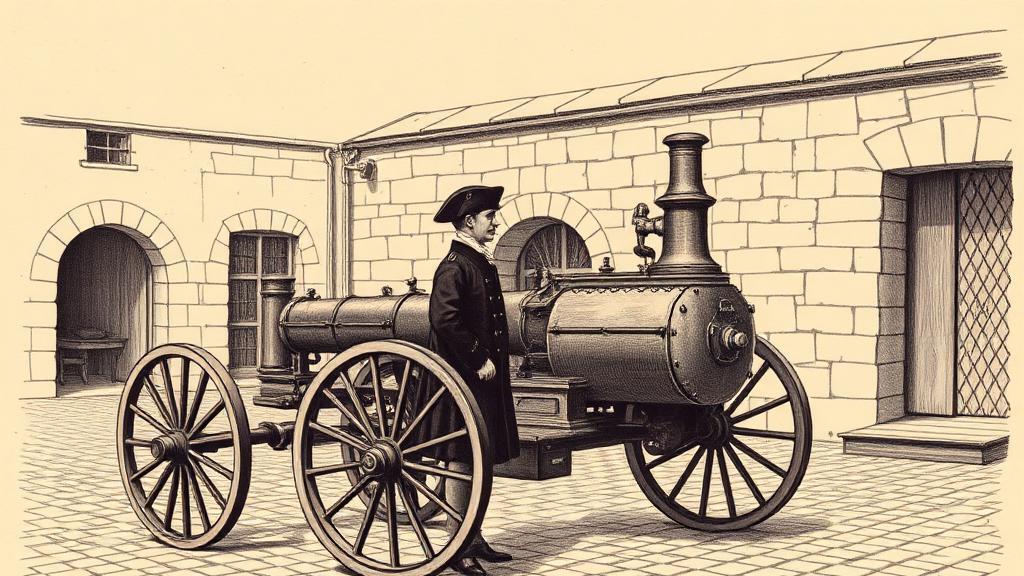
Cugnot's fardier: the first machine to move under its own power
In the courtyard of the Paris Arsenal in 1770, a three-wheeled machine the size of a loaded hay cart sat building steam and waiting to prove a point. At its front, a fat copper boiler squatted over a single driving wheel — an arrangement that looked provisional and was. Nicolas-Joseph Cugnot, a French military engineer in his mid-forties, had five years of argument invested in this moment.
Cugnot was born in 1725 in Void-Vacon, Lorraine, trained as a military engineer, and served in the Austrian army before returning to Paris in 1763. His professional output to that point had been military treatises — careful, underread, the usual fate of garrison intellectuals. But he had read Denis Papin, the 17th-century physicist who had theorized using high-pressure steam to drive a piston, and he saw something the cavalry did not: that the same principle could drive a wheel. In 1765 he sketched the concept for the French military. They found it worth funding, a small working model appeared in 1769, and the full-size vehicle followed the next year.
The fardier à vapeur weighed roughly 2.5 tonnes. It was designed to carry four tonnes of artillery at 7.8 kilometres per hour and achieved neither figure reliably. In practice it moved at about 3.6 km/h — a brisk walking pace — and had to stop every fifteen minutes so the fireman could relight the wood under the boiler and let pressure rebuild. Two cylinders connected to the front wheel via a ratchet mechanism converted piston motion into rotation. That same front wheel both drove and steered, controlled through a pair of wooden handles. Straight-line running was manageable. Corners were a matter of commitment.
In the 19th century a story began circulating that during a 1771 trial the fardier had charged into a stone wall and stuck, and that Cugnot was briefly arrested — history’s first automobile accident and first traffic citation, two milestones for the price of one. The Musée des Arts et Métiers, which holds the original machine, now calls it “a persistent legend, spread by the popularization press in the 19th century,” with no contemporary documentation to support it. What actually happened was quieter: the army dropped the project, and the machine went into storage at the Arsenal.
It outlasted the monarchy. The Revolution stripped Cugnot of his pension in 1789 and sent him to Brussels, where he spent fifteen years in modest poverty. Napoleon restored the pension in 1804, weeks before Cugnot died in Paris. The fardier had been transferred to the Conservatoire National des Arts et Métiers in 1800 and remains there today — the oldest surviving automobile, in the nave of a medieval abbey repurposed as a museum.
What Cugnot had established was the minimum necessary thing: that a vehicle could move itself, without an animal. Everything that followed — the boiler, the steering geometry, the fuel, the weight distribution — is the world’s longest argument about how to do it properly.
Sources
- Nicolas-Joseph Cugnot — Wikipedia — Technical specifications, trial dates, machine design, and preservation history.
- Fardier à vapeur de Joseph Cugnot — Musée des Arts et Métiers — Primary museum record of the artifact, including the debunked “crash” legend.
- Nicolas-Joseph Cugnot — Linda Hall Library — Biographical details, pension history, and fate after the Revolution.
- Nicolas-Joseph Cugnot — Encyclopaedia Britannica — Engine’s derivation from Denis Papin’s theoretical work; historical context.