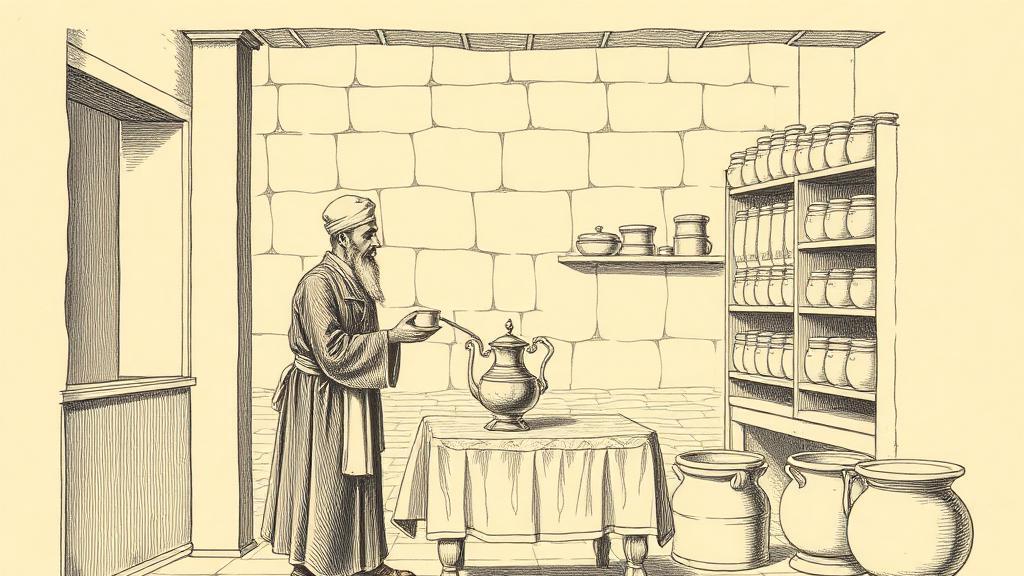
Hakem, Shems, and the first coffeehouse
Sometime around 1554, two merchants rented adjacent shops in the Tahtakale district of Constantinople — the waterfront quarter where Syrian traders had long unloaded cargo from the Bosphorus — and opened the city’s first coffeehouses. One was Hakem, from Aleppo. The other was Shems, from Damascus. Ottoman historian İbrahim Peçevi, writing some decades later, called Shems “a wag” — the only surviving characterization of the man — and recorded that both “opened a large shop in the district called Tahtakale, and began to purvey coffee” (Earthstoriez). The street where they operated would eventually be renamed Tahmis Sokak: Roasted and Ground Coffee Street.
The drink itself had been known in Constantinople for a generation — imported from Yemen, sold by apothecaries, carried in pilgrims’ bags. What Hakem and Shems invented was not the coffee but the room. They fitted their shops with low cushioned benches, kept cups coming for a single coin per serving, and created a space designed explicitly for staying. A judge, a merchant, a scholar, or a traveling pilgrim could occupy the same bench for an afternoon without owing anyone anything beyond the price of a cup. Coffee left the monastery and the medicine cabinet and became, for the first time, a public institution.
Contemporary observers gave these places two names. The Arabic phrase common in learned circles was something like maqha al-fukaha — coffeehouse of the learned. Europeans who visited the Ottoman capital translated the concept as “Schools of the Wise” (Wikipedia). What went on inside justified the title: poetry recitation, chess, backgammon, reports from the caravans, and the kind of political opinion that has always flourished wherever men from different stations share a table without a host to moderate them. That last item disturbed the authorities more than the beverage did.
Within a generation, the city’s religious establishment had declared coffee forbidden. The grounds were intoxication — a charge that had already been leveled and overturned in Mecca. Peçevi records the prohibition alongside a dry observation: the populace, he noted, “does not strictly observe this declaration.” The coffeehouses survived each attempt. What the authorities were really trying to close was not a drink but a room where the sultan’s subjects gathered without permission and talked.
Popular tradition places the first Constantinople coffeehouse at 1475, attributing it to an establishment called Kiva Han. No contemporary source supports that date; Peçevi’s account is what the written record actually contains — and Peçevi, for once, names the men, names the neighborhood, and supplies the entertaining detail that one of the city’s most consequential entrepreneurs was remembered mainly as a wag.
By the early seventeenth century, the coffeehouse model had reached Venice, then Vienna, then Oxford, then London — which counted two thousand of them by 1700, each one descended in some fashion from the low benches Hakem and Shems set out in Tahtakale (Wikipedia). They had designed a room for staying. Four hundred and seventy years on, people are still building that room.
Sources
- History of Ottoman coffeehouses in Istanbul — Earthstoriez — Peçevi’s account of Hakem and Shems, the Tahtakale location, the renaming to Tahmis Sokak, and the direct quotation calling Shems “a wag.”
- History of coffee — Wikipedia — spread of coffeehouses from Yemen through the Ottoman world to Europe; Hakem of Aleppo and Shems of Damascus as documented founders c. 1554; London’s two thousand coffeehouses by 1700.
- Coffeehouses in Arabic culture — Wikipedia — the “Schools of the Wise” designation and the social, intellectual, and political functions of early Ottoman coffeehouses.