Bellaso's cipher, or three centuries filed under the wrong name
For three hundred years, European courts called it le chiffre indéchiffrable — the indecipherable cipher. They were wrong about that, eventually. They were also wrong about who invented it.
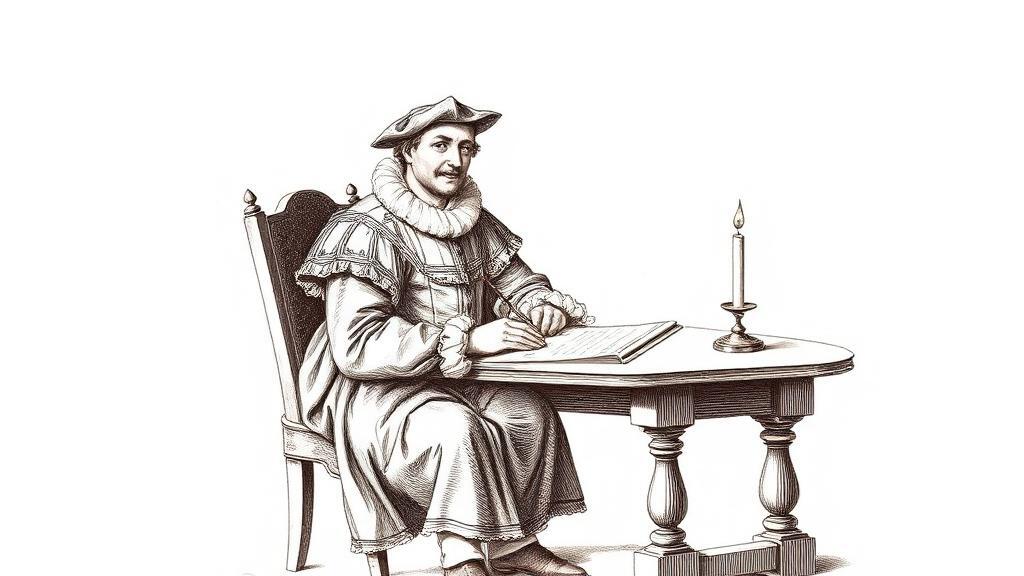
In 1553, a Brescian nobleman and papal secretary named Giovan Battista Bellaso published a short pamphlet: La Cifra del Sig. Giovan Battista Bellaso. He was not working in a vacuum. Leon Battista Alberti had already designed the first mixed cipher alphabets in 1467, and Johannes Trithemius had arranged them all into a systematic grid — the tabula recta — in 1518. What Bellaso added was the piece that transformed a clever table into a practical cipher: a shared keyword, agreed upon beforehand, that told both sender and receiver which alphabet to use for each letter.
The mechanics are simple enough to do by hand. Write the keyword above the message, repeating it until it covers every letter. Where the key letter is R, use the R-row of the table; where it is O, use the O-row; where it is M, use the M-row. Each plaintext letter encrypts into a different substitution alphabet, cycling with the keyword. The tool that had broken every cipher since al-Kindi’s day — counting letter frequencies against the statistical profile of a language — now found nothing to grip. An E in the plaintext might emerge as a B, a T, or a Z depending entirely on where the keyword happened to be at that position. Three alphabets might as well be two hundred.
In 1854, Charles Babbage received a letter from an amateur named John Hall Brock Thwaites, who was confident he had invented an unbreakable cipher. It was, on inspection, a Vigenère variant. Babbage cracked it by looking for repeated segments in the ciphertext — a short keyword applied to a long message will encrypt identical plaintext fragments identically, at intervals that are multiples of the key length. Measure the gaps, do the arithmetic, and the key length falls out. Babbage never published the method. His notes survive; his reasons for silence are not recorded, though the Crimean War was under way and British intelligence may have had views on the matter. Credit therefore went to Friedrich Kasiski, a retired Prussian infantry officer who rediscovered the approach and published it in 1863 — three centuries after Bellaso.
The principle Bellaso introduced still governs every encryption system in use today: security lives in the key, not in the algorithm. The table, the method, the cipher design — these can be published for anyone to read. What stays secret is a single shared string, known only to the two parties. A cipher whose safety requires concealing the mechanism is already half-broken, because mechanisms leak. A cipher whose safety requires only protecting the key can be analysed, standardised, and shared in the open without giving anything away. This is Kerckhoffs’s principle, as the 19th century would eventually name it, and it is the load-bearing assumption under AES, RSA, and every HTTPS session your browser opens today.
The name still says Vigenère. Blaise de Vigenère was a French diplomat who had read Bellaso carefully before publishing his own, genuinely stronger, autokey cipher in 1586. A 19th-century commentator confused the two and the label stuck. David Kahn, writing in The Codebreakers in 1967, called it a small injustice. The cipher algorithms changed. The key never did.
Sources
- Vigenère cipher — Wikipedia — Bellaso’s 1553 pamphlet, the le chiffre indéchiffrable reputation, Babbage’s 1854 solution and Kasiski’s 1863 publication, Vigenère’s distinct autokey cipher.
- Giovan Battista Bellaso — Wikipedia — Bellaso’s background, his synthesis of Alberti and Trithemius, the countersign concept.
- Vigenère cipher — Encyclopaedia Britannica — cipher mechanics, the misattribution to Vigenère, Kasiski’s attack.