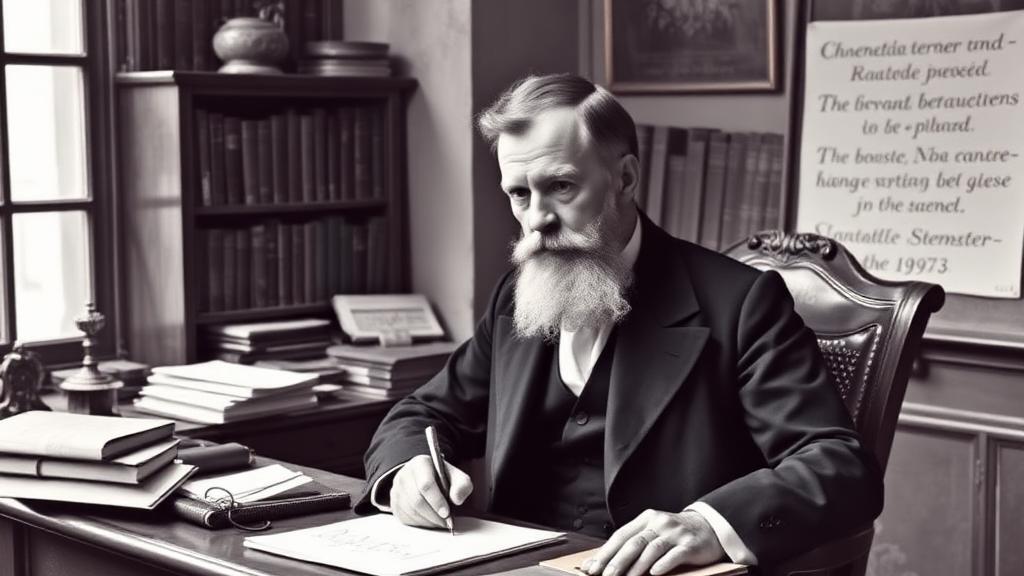
Frege's Begriffsschrift
In the autumn of 1879, a mathematics lecturer at the University of Jena published an eighty-eight-page pamphlet. The title was Begriffsschrift — “concept-script” in German — and the notation inside was like nothing anyone had seen: logical formulas arranged vertically on the page in forking branches, running top to bottom rather than left to right, each stroke and fork assigned a precise meaning. Ernst Schröder, the leading algebraic logician of the era, wrote the most considered review the book received. His verdict: Frege had merely reinvented Boolean algebra in an unnecessarily peculiar costume. He was wrong, and he would not be the last person to miss the point entirely.
Friedrich Ludwig Gottlob Frege (1848–1925) came to logic not as a philosopher but as a mathematician with a specific grievance. Arithmetic, he believed, rested on foundations no one had ever made rigorous — it depended on appeals to intuition, to counting, to geometric form. Leibniz had dreamed, two centuries earlier, of a universal calculus of pure thought. Frege intended to build one. The Begriffsschrift was the notation he constructed for the work.
The core innovation was the rejection of the ancient subject-predicate analysis of propositions. Since Aristotle, logic had carved every sentence into a subject and a predicate — a method that handled simple statements well enough but collapsed on anything with nested quantifiers. “All horses are animals” was manageable. “Every natural number has a successor that is also a natural number” was not. Frege replaced the old grammar with a function-argument analysis: a proposition is a function applied to its arguments, and quantifiers bind those arguments in precise, layered ways. For the first time, the full range of mathematical statements could be expressed in a single formal language.
The book sold poorly. The notation baffled typesetters and readers alike, and the academic world moved on. For nearly two decades the Begriffsschrift gathered dust on a handful of shelves while Frege quietly extended his project into a two-volume work on the arithmetic foundations, the Grundgesetze der Arithmetik.
Then, in June 1902, a letter arrived from Bertrand Russell. The second volume of the Grundgesetze was already at the printer. Russell had found a contradiction at the heart of Frege’s fifth axiom: a set of all sets that do not contain themselves either must or must not include itself — and in either case, the system breaks. Frege added a short appendix acknowledging the flaw. His response is one of the more candid sentences in the history of science: “Hardly anything more unfortunate can befall a scientific writer than to have one of the foundations of his edifice shaken after the work is finished” (Wikipedia). He never fully repaired it.
What survived was everything Russell and Whitehead absorbed into Principia Mathematica (1910): the quantifier, the function-argument structure, the formal treatment of inference. That framework became the foundation of mathematical logic, then of proof theory, then of the theory of computation. When the first AI programs of the 1950s tried to automate deductive reasoning, they were running on a calculus first sketched in those eighty-eight unread pages.
Frege spent his life trying to reduce mathematics to logic. He failed at that. But he built the instrument every logician, computer scientist, and language designer has used ever since.
Sources
- Begriffsschrift — Wikipedia — publication history, key innovations including quantified variables and function-argument analysis, reception by Schröder.
- Frege’s Logic — Stanford Encyclopedia of Philosophy — analysis of Begriffsschrift’s logical innovations, their departure from Boole and Aristotle, and the system’s influence on Russell and subsequent logic.
- Gottlob Frege — Wikipedia — biographical details, the June 1902 Russell letter, and Frege’s appendix response.