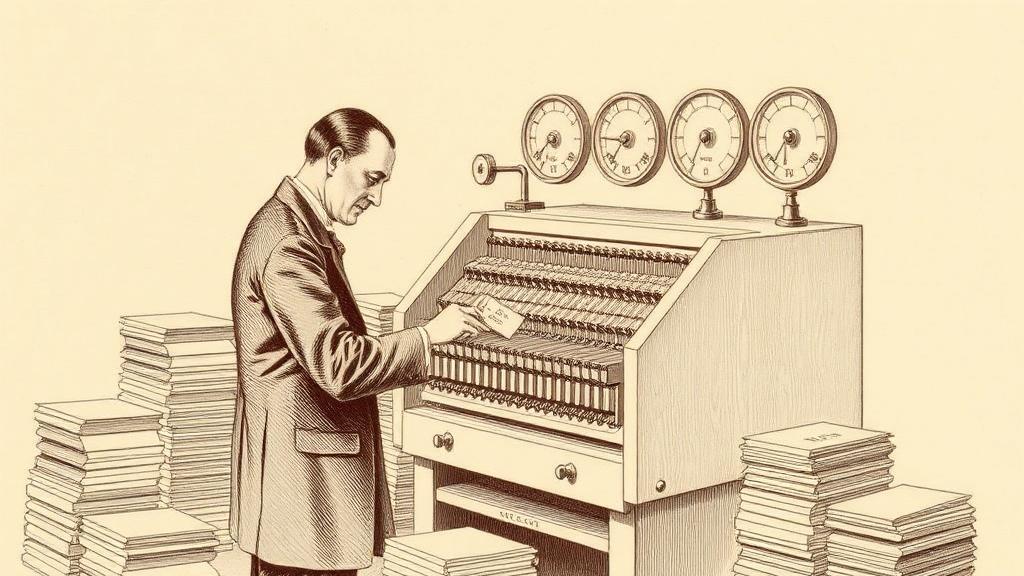
The Hollerith tabulator, or how counting Americans built a company called IBM
The 1880 census cost the United States eight years of clerks bent over ledgers before anyone could say how many Americans there were. With the population growing fast and the country preparing its next count, Census Bureau officials did the arithmetic and arrived at an uncomfortable answer: if nothing changed, the 1890 tabulation might not finish before 1900.
A 28-year-old engineer named Herman Hollerith had already been thinking about this. Hollerith had graduated from Columbia’s School of Mines in 1879 and gone straight to work for the Bureau as a special agent, watching the 1880 slowdown from the inside. A suggestion from John Shaw Billings, a Bureau physician and statistician, lodged itself in his mind: encode demographic data as holes in a card, then read them electrically. Hollerith spent the next several years building that suggestion into working hardware.
The machine operated through a press that descended onto a punched card. Spring-loaded pins passed through each hole into small wells of mercury below; wherever a hole appeared, the circuit closed and a magnetic dial advanced one notch. Each dial position corresponded to a different demographic fact — age bracket, sex, citizenship status. A trained clerk could process eighty cards a minute. One detail in the design was pure pragmatism: Hollerith sized his punch cards to match the dimensions of U.S. currency so that standard bank-note drawers could store and sort them without any new equipment.
In 1888, the Census Bureau staged a formal competition. Three contestants were given data from the 1880 count across four St. Louis districts. The brief: whoever processed it fastest got the contract for 1890. Hollerith captured the data in 72.5 hours; the other two needed 144.5 and 100.5 hours. For the tabulation itself, he finished in 5.5 hours while his competitors were still at work through hours forty-four and fifty-five. He earned the contract.
The 1890 census processed roughly 63 million Americans on an estimated 60 million punch cards. The official population count was delivered in six months. The results came in ahead of schedule and under budget, earning Hollerith a medal at the 1893 Chicago World’s Fair. Modified versions of his technology stayed in service at the Bureau until computers replaced them in the 1950s.
He founded the Tabulating Machine Company in 1896. Fifteen years later it merged with three other firms to form the Computing-Tabulating-Recording Company. In 1924, Thomas Watson renamed it International Business Machines.
The punched card outlasted every generation that adopted it. Mainframes ran on stacks of them. FORTRAN programs arrived at university computing centers encoded in their neat rows of holes. The “do not fold, spindle, or mutilate” warnings on government forms persisted into the 1970s. Every hole a one; every blank a zero.
Sources
- Herman Hollerith — Wikipedia — birth, education, company founding, path to IBM, tabulation time comparison.
- The Hollerith Machine — U.S. Census Bureau — 1888 competition times, operational speed, 1890 results.
- Making Sense of the Census — Computer History Museum — machine mechanics, card-size hack, speed vs. manual methods.