Han dynasty silk shoes, or the hierarchy sewn into every sole
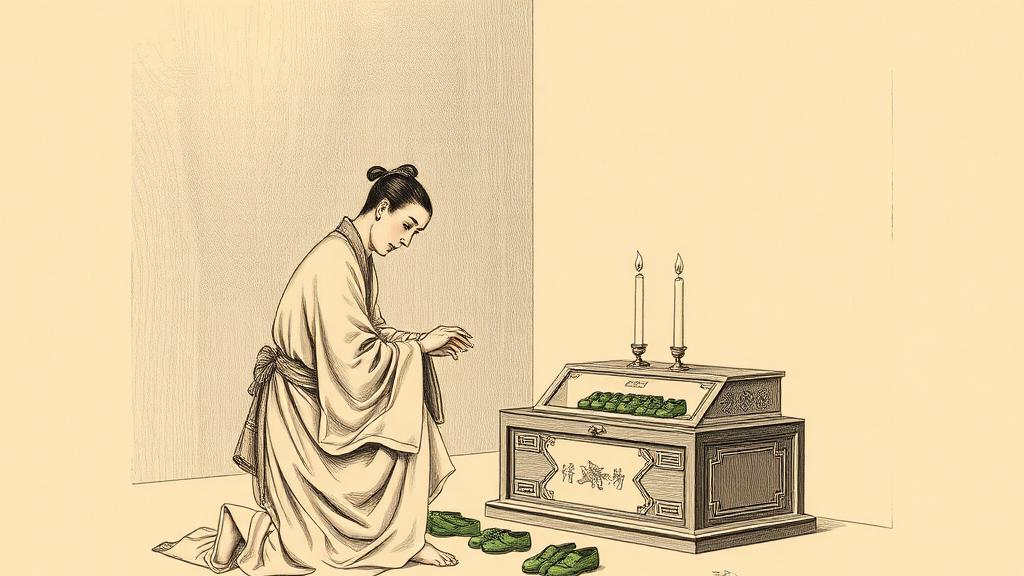
In the autumn of 168 BCE, workers sealed the tomb of a woman named Xin Zhui in a mound of white clay outside the city of Changsha, in what is now Hunan Province. They left her with 100 silk garments, 100 lacquer vessels, musical instruments, food for the journey, and — tucked among the textiles — four pairs of green silk shoes, each with a separate upper stitched to a layered hemp sole (Wikipedia).
Xin Zhui was the wife of Li Cang, Marquis of Dai and Chancellor of the Changsha Kingdom under the Western Han emperor. She was not the empress of China. She was, by the standards of her dynasty, a mid-ranking noblewoman — which says something about how thoroughly silk had saturated the upper registers of Han society by the second century BCE. Even a regional marquise went to the afterlife in silk on her feet.
The shoes from her tomb, now held at the Hunan Museum in Changsha, are the best-preserved examples of a type known as lü (履) — the standard Han dynasty word for shoes (Hanfu Footwear, Wikipedia). The term covered a wide range of materials, because the material was the point: silk shoes for officials and nobles, leather for the military, hemp and twisted grass for everyone else. By the Eastern Han period (25–220 CE) this hierarchy was no longer merely custom; it was codified in ritual law. Officials divested their shoes at the threshold when meeting the emperor. A dedicated court officer — the Keeper of Shoes — managed the choreography. The pair you removed at the door announced your rank before you said a word.
What distinguished the silk lü from its humbler cousins was the construction. Artisans stitched a plain-weave silk upper to a sole built from dozens of layers of compressed hemp cloth, sometimes at densities of 100 stitches per square inch — enough to give the sole resilience while keeping it flexible enough for indoor wear (China Daily). The uppers could be embroidered for ceremony or left plain for everyday use; inside the inner quarters of a house, silk slippers made more sense than boots on cold tile.
Here is the bureaucratic detail that makes Mawangdui worth pausing over. The people who packed Xin Zhui’s burial goods left a written inventory — a list carved into bamboo slips, found inside the tomb — accounting for every object in every compartment. The four pairs of shoes appear in that list alongside the melon she apparently ate shortly before she died: melon seeds were still in her stomach when excavators opened the tomb in 1972. An empire that itemized a dead woman’s melon was not an empire likely to leave its footwear unclassified.
What the silk lü codified was a principle older than the Han dynasty but newly explicit in its reach: that the material under your foot was a statement about your position in the world. When the Silk Road carried Chinese textiles westward to Persia and on to Rome in the first and second centuries CE, it carried not just thread but this proposition — that cloth could announce rank as clearly as a title or a seal.
The proposition, it turned out, traveled at least as well as the silk.
Sources
- Mawangdui — Wikipedia — Lady Xin Zhui’s burial date and contents, bamboo inventory slips, preservation details including melon seeds.
- Hanfu footwear — Wikipedia — Construction of Han dynasty lü, material hierarchy (silk, leather, hemp, grass), court protocols around shoes.
- Ancient Chinese Shoes — China Daily — Sole construction details, 100 stitches per square inch, social stratification of footwear across Chinese dynasties.