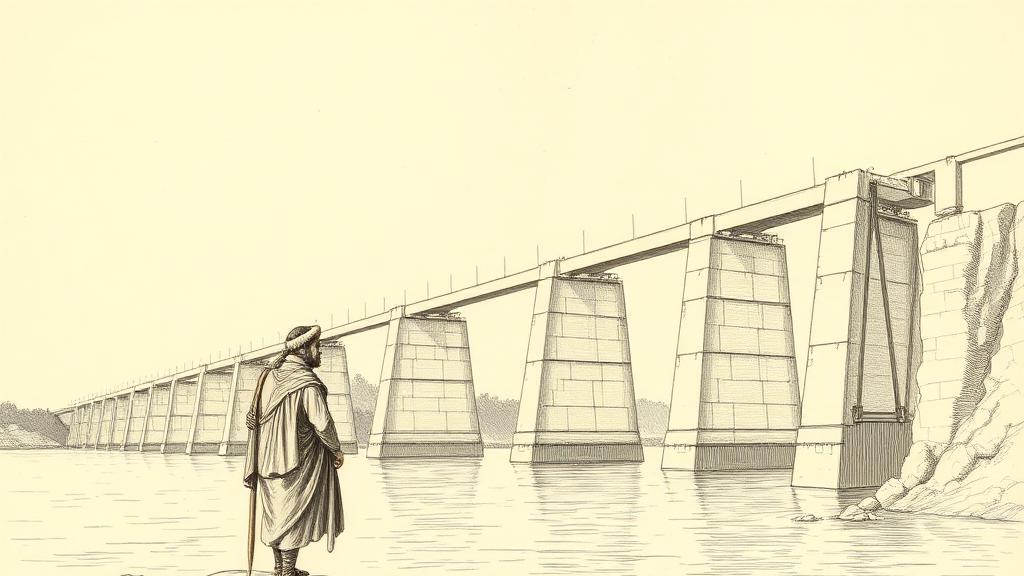
Trajan's Bridge, or how to cross a river by moving it first
The twenty stone towers still protrude from the Danube near the Serbian town of Kladovo — stumps of masonry, worn by nineteen centuries of current, still recognizable as the piers of a bridge. When it was finished in 105 CE, Trajan’s Bridge was the longest arch bridge in the world, by a margin that would take more than a thousand years to close.
The emperor needed it. His First Dacian War (101–102 CE) had crossed the river on a pontoon bridge, adequate for a campaign but not for an occupation. Dacia — roughly modern Romania — was conquered; holding it required a permanent supply line across an 800-metre-wide river. The man tasked with solving this was Trajan’s chief military engineer, Apollodorus of Damascus — a Syrian who had already given Rome its Forum, its Market, and its Column, and who apparently regarded nearly everyone else’s architectural opinions as an inconvenience.
For the bridge, Apollodorus reached for a technique of almost violent ingenuity. His engineers dug a canal 3.2 kilometres long to redirect a section of the Danube around the construction site, then sank twenty masonry piers into the exposed riverbed before letting the water back in. Each pier stood roughly 45 metres tall and 18 metres wide; wooden arches with 38-metre spans connected them. The whole structure ran 1,135 metres, stood 19 metres above the river surface, and was wide enough for a legion to cross in formation.
The legionaries who laid the bricks were not shy about claiming credit. Unit names were carved directly into the masonry as it went up — four legions, IV Flavia Felix, VII Claudia, V Macedonica, and XIII Gemina, plus several cohorts, each a 1,900-year-old contractor’s sign-off still legible in the surviving piers.
Apollodorus had a complicated relationship with the future. During one consultation between Trajan and his architect, the young Hadrian — Trajan’s eventual heir, who fancied himself an architect — interrupted with a suggestion. Apollodorus cut him off: “Be off, and draw your gourds. You don’t understand any of these matters.” Trajan was emperor then, so the remark passed without consequence. When Hadrian came to power in 117 CE, one of his first acts was to dismantle the bridge’s wooden roadway — officially to deny barbarians a crossing. Then, as Cassius Dio records, Hadrian sent Apollodorus his plans for the new Temple of Venus and Rome and asked for comment. Apollodorus said the proportions were wrong. Hadrian had him executed.
The arches rotted. The piers endured. No bridge matched Trajan’s record spans for over a millennium — not until the stone-arch builders of the High Medieval period crept toward comparable lengths. The bridge survives in one more form: the reliefs on Trajan’s Column in Rome, still standing in the city centre, show the high piers and flat wooden arches exactly as they looked when the legions first crossed.
For a thousand years, no one built longer. The record fell not through some new leap of invention but through slow accumulation — centuries of builders gradually catching up to what one Syrian architect had already solved on the bank of the Danube in 105 CE.
Sources
- Trajan’s Bridge — Wikipedia — dimensions, the canal diversion method, pier materials and construction, legionary inscriptions, Hadrian’s demolition of the wooden superstructure.
- Trajan’s Bridge — Encyclopaedia Britannica — strategic purpose, Apollodorus’s role, the bridge’s spans unmatched for over 1,000 years.
- Apollodorus of Damascus — Encyclopaedia Romana, University of Chicago — Apollodorus’s background, the “draw your gourds” episode, his conflict with Hadrian and execution as recorded by Cassius Dio.