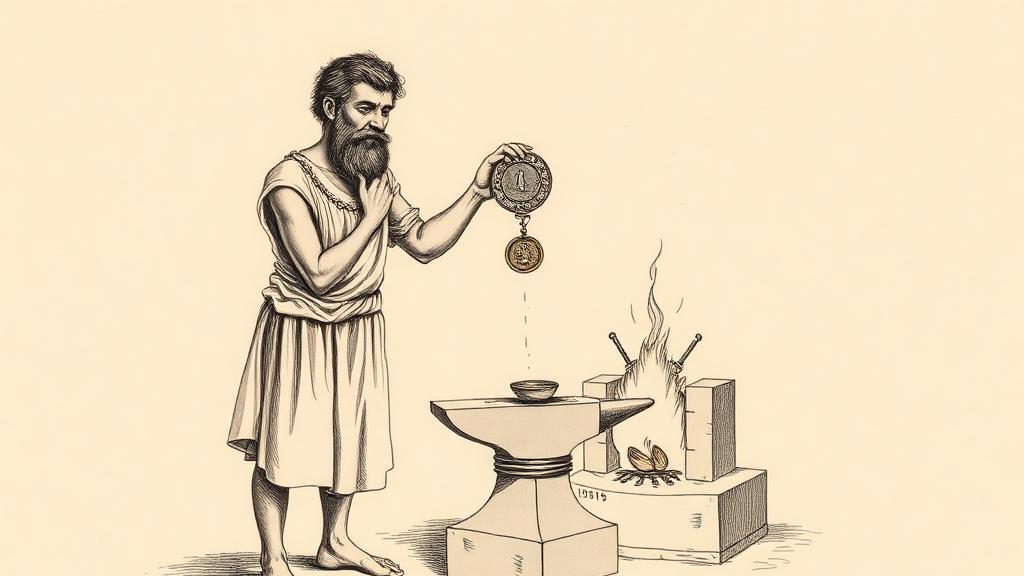
The Lydian stater
The Pactolus River runs through the heart of ancient Sardis carrying something useful in its sand: flecks of electrum, a natural gold-silver alloy that glitters like gold even when it is only half gold. For centuries, Lydian craftsmen scooped it from the riverbed and traded it as rings or crude ingots, weighed at every transaction on a balance scale. Every sale required a judgment about the metal’s purity and the merchant’s honesty. By roughly 610 BCE, under King Alyattes, the royal mint at Sardis had a better answer. They melted the riverbed metal into bean-shaped lumps of consistent weight and stamped one face with a lion’s head. The first coin had a government’s word behind it.
Alyattes’ staters were good but not perfect. Electrum from the Pactolus varied in composition — anywhere from 55 to 80 percent gold depending on where you dug — so the coins, though consistent in weight, carried uncertain value beyond Lydia’s borders. Herodotus records that “the Lydians were the first to mint and use a coinage of gold and silver,” and the full payoff came one generation later. When Croesus took the throne around 560 BCE, he scrapped the electrum stater and replaced it with two new coins: a pure gold stater of 8.1 grams and a pure silver one of 10.7 grams, with fractions struck down to a 1/48th. The Croeseid — the world’s first bimetallic monetary system — fixed one gold piece at exactly ten silver ones by royal decree.
The design was almost aggressively simple: confronting foreparts of a lion and a bull on the obverse, two incuse punch squares on the reverse. No portrait, no inscription. The state’s guarantee was implicit in the metal itself.
Croesus was famous for being rich — “as rich as Croesus” has lasted twenty-five centuries as a phrase — and less famous for what that wealth cost him. Before launching his campaign against Persia around 547 BCE, he consulted the Oracle at Delphi, who told him that if he crossed the Halys River, a great empire would fall. He crossed it. The empire that fell was his own: Cyrus the Great took Sardis in fourteen days. The Persians then kept minting the lion-and-bull Croeseid design for roughly thirty more years before Darius I replaced it with the Persian daric around 515 BCE. The conquerors kept the coin.
What coinage solved was trust at scale. Before the royal mint, two strangers trading in a bazaar had to verify the metal at every transaction — a friction that capped how far commerce could travel. A stamped coin moved trust from the individual deal to the issuing authority: weigh it once, use it everywhere. The Greek city-states adopted the model within a generation, spreading the silver drachm across the Mediterranean in a way that electrum rings never could have.
The Pactolus still flows through Sardis, now Sart, in western Turkey. Excavations there have found the actual refinery floor where Lydian goldsmiths separated gold from silver before the royal die came down. The lion-and-bull dies are long gone. The mechanism they encoded — a trusted authority, a fixed weight, a seal that travels without argument — never left.
Sources
- World History Encyclopedia — Lydian Stater — first government-issued coin, Alyattes’ electrum stater, Croesus’s reform, spread to Greek city-states.
- Sardis Expedition — The Coins of Sardis — Herodotus attribution, refinery excavations, denominations, Persian adoption after conquest.
- Wikipedia — Croeseid — bimetallic system design, exchange ratio, Persian continuation, Daric succession.