The Greek alphabet, or how borrowed consonants became the world's first vowels
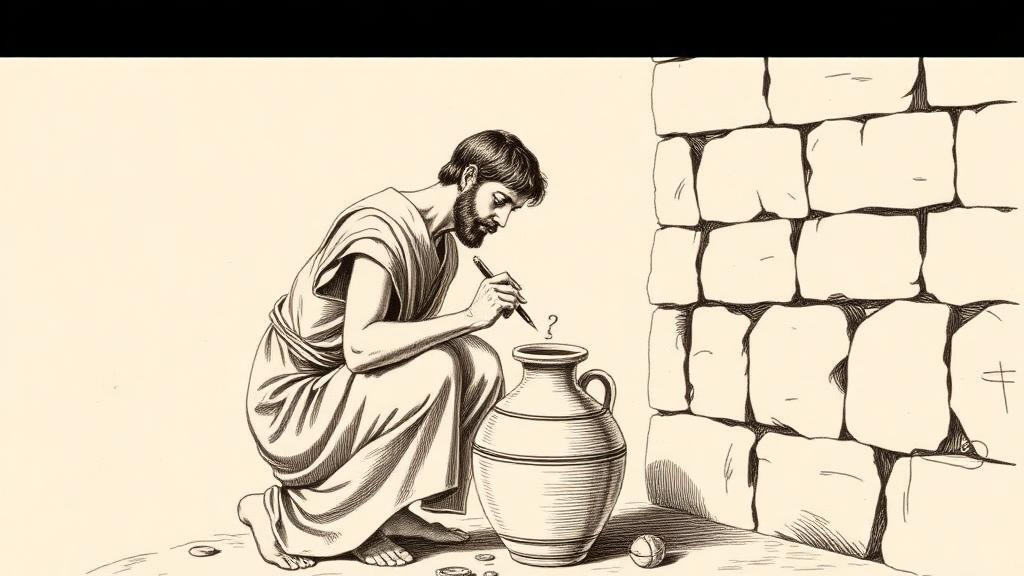
Scratched around the shoulder of a terracotta wine jug found near the Kerameikos cemetery in Athens, the text reads: “Whoever of all these dancers now plays most delicately, of him this pot…” The sentence breaks off — the rest is lost — but what survives is enough. The Dipylon oenochoe, dug up in 1871 and now in the National Archaeological Museum of Athens (inventory no. 192), dates to roughly 740 BCE. It was a prize for a dancing contest, scratched in forty-six characters that still lean right-to-left in the old Phoenician direction. It is one of the earliest surviving texts written in the Greek alphabet.
The Greeks hadn’t invented their alphabet from scratch. They borrowed it from the Phoenicians — the same traders who ran the cedar and purple-dye routes out of Byblos and Tyre — sometime around 800 BCE, almost certainly through commercial contact in ports like those on the island of Euboea. The Phoenician alphabet had twenty-two letters, all consonants. It worked perfectly well for Semitic languages, where vowels are largely predictable from context. For Greek, with its tangle of diphthongs and long vowels and words that collapse in meaning if you mishear a single sound, it was not enough.
What the Greeks did next was the decisive step in alphabetic history. They took Phoenician letters that represented sounds Greek didn’t use — the glottal stop aleph, the breathy he, the fricative waw, the guttural ayin — and reassigned them to the vowels Greek did use. Aleph became alpha; he became epsilon; ayin became omicron. The result was the first alphabet in the world to systematically represent both consonants and vowels. In the words of classicist Barry B. Powell, it was “the first writing that informed the reader what the words sounded like, whether or not he knew what the words meant”. That is not a refinement. It is a different kind of writing altogether.
Almost certainly from around the same moment — and arguably more memorable — is an inscription found in 1954 by the archaeologist Giorgio Buchner at Pithekoussai, a Greek trading colony on the island of Ischia in the Bay of Naples. Scratched onto a small clay cup, in the same Euboean alphabet variant as the Dipylon text, is a three-line verse: “I am the cup of Nestor good for drinking. Whoever drinks from this cup, desire for beautifully crowned Aphrodite will seize him instantly.” The Nestor’s Cup, dated to roughly 740–720 BCE, was found in a cremation grave, buried alongside a silver brooch and twenty-five other vessel fragments. One of the earliest surviving uses of the new Greek alphabet was, apparently, a joke about getting lucky.
In 403 BCE, following the end of the Peloponnesian War, Athens formally standardized the Ionic variant — twenty-four letters, with the vowel system intact — and it spread across the Greek-speaking world. The Iliad and the Odyssey could now be committed to something permanent; philosophy, geometry, and medicine recorded precisely enough to travel intact across centuries. The vowels didn’t just make the alphabet easier to learn. They made knowledge reproducible.
The Latin alphabet is a dialect of Greek. So are Cyrillic, Coptic, and Gothic. Every letter in this sentence arrived here from Kerameikos.
Sources
- Dipylon inscription — Wikipedia — date (c. 740 BCE), 1871 discovery, inscription text, right-to-left orientation, current location.
- Greek alphabet — Wikipedia — Phoenician origins, vowel reassignment (aleph → alpha, etc.), standardization, descendant scripts.
- Nestor’s Cup (Pithekoussai) — Wikipedia — Giorgio Buchner’s 1954 discovery, inscription text, burial context.
- Greek Alphabet — World History Encyclopedia — Barry B. Powell quotation; broader historical significance.
- Greek language: The Greek alphabet — Encyclopaedia Britannica — 403 BCE standardization of the Ionic variant; Latin inheritance.