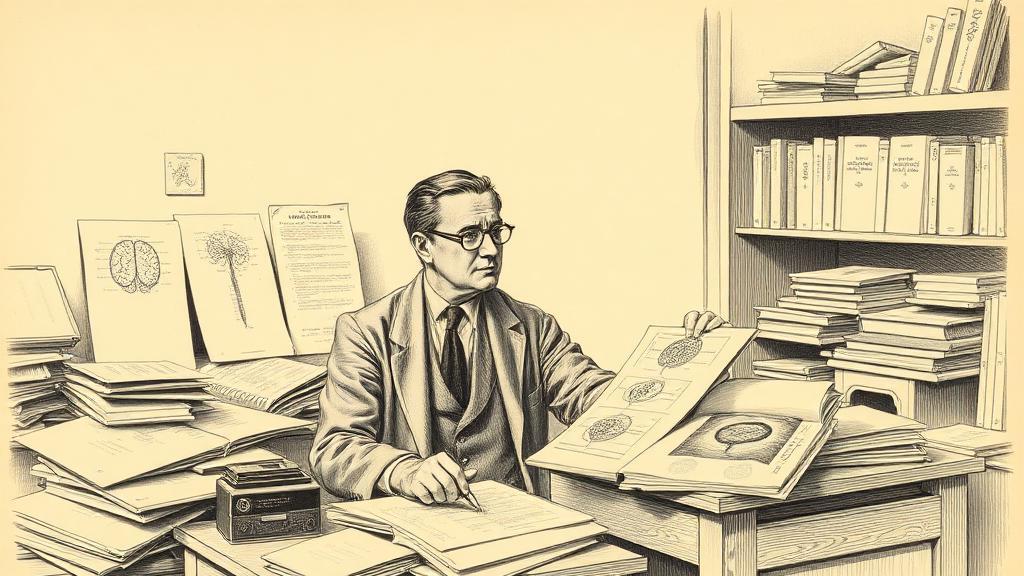
McCulloch and Pitts, or a mind made of thresholds
When Walter Pitts arrived at the University of Chicago in 1938, he was fifteen years old, had run away from home in Detroit, and had no intention of enrolling in anything. He attended lectures informally, read whatever the library held, and had reportedly, at age twelve, sent Bertrand Russell a letter pointing out errors in Principia Mathematica. Russell wrote back. The university, perhaps recognizing something, let him stay.
Four years later, in 1942, a neurophysiologist named Warren McCulloch invited Pitts to come and live at his house in the city. McCulloch held a position at the Illinois Neuropsychiatric Institute of the University of Illinois and had spent the better part of a decade trying to express what a neuron does — not in the vocabulary of anatomy, but in the vocabulary of logic. He had the biological intuition and the experimental background. Pitts — twenty years old, still without a formal degree — had been studying symbolic logic under Rudolf Carnap and had the mathematical precision McCulloch had been missing. Within a year, they had written a paper that would be read by everyone who mattered.
“A Logical Calculus of the Ideas Immanent in Nervous Activity” appeared in the Bulletin of Mathematical Biophysics in December 1943. The central argument was simple and strange: a neuron is a logic gate. It collects inputs; if those inputs exceed a threshold, it fires. Configure two neurons so that both must fire to trigger the next — that’s AND. Allow either one to trigger it — that’s OR. Set one to suppress the next — that’s NOT. Wire enough of these units together and the network is Turing-complete: theoretically capable of any computation at all. They proved this formally, borrowing the framework Turing had published seven years earlier. The brain, in this account, did not require mystery — only the right arrangement of thresholds.
The paper arrived at exactly the right moment. John von Neumann, then designing the architecture for stored-program computers, recognized what McCulloch and Pitts had done and circulated it widely among colleagues. Norbert Wiener, assembling the foundations of cybernetics at MIT, took the McCulloch-Pitts neuron as a central reference for the Macy Conferences of the late 1940s — the cross-disciplinary gatherings where mathematicians, neurologists, and engineers first debated whether machines could think.
For Pitts, recognition came at a cost. His collaboration with Wiener collapsed in the early 1950s over a falling-out neither man ever explained clearly. Pitts withdrew from academic life, never completed the doctorate he was nominally pursuing, and died in Cambridge, Massachusetts, in 1969 at forty-six — having never held a formal position in the field his paper had quietly made possible for thousands of others.
The threshold McCulloch and Pitts described was as simple as a decision gets: zero or one, not yet or yes. It did not require spirit or mystery — only arithmetic, repeated at scale. Everything that followed — perceptrons, back-propagation, deep neural networks, language models — is that same threshold, multiplied.
Sources
- A Logical Calculus of the Ideas Immanent in Nervous Activity — Wikipedia — overview of the paper, the neuron model, and its early reception by von Neumann and Wiener
- Original paper — Springer / Bulletin of Mathematical Biophysics — publication record: vol. 5 (1943), pp. 115–133; the canonical source for the paper’s content and formal claims
- Birthplace of Neural Networks: McCulloch & Pitts at UChicago — University of Chicago Machine Learning — biographical context on Pitts and McCulloch, the collaboration, and the paper’s reception in the cybernetics community