The Atanasoff-Berry Computer, or the basement machine that unmade ENIAC
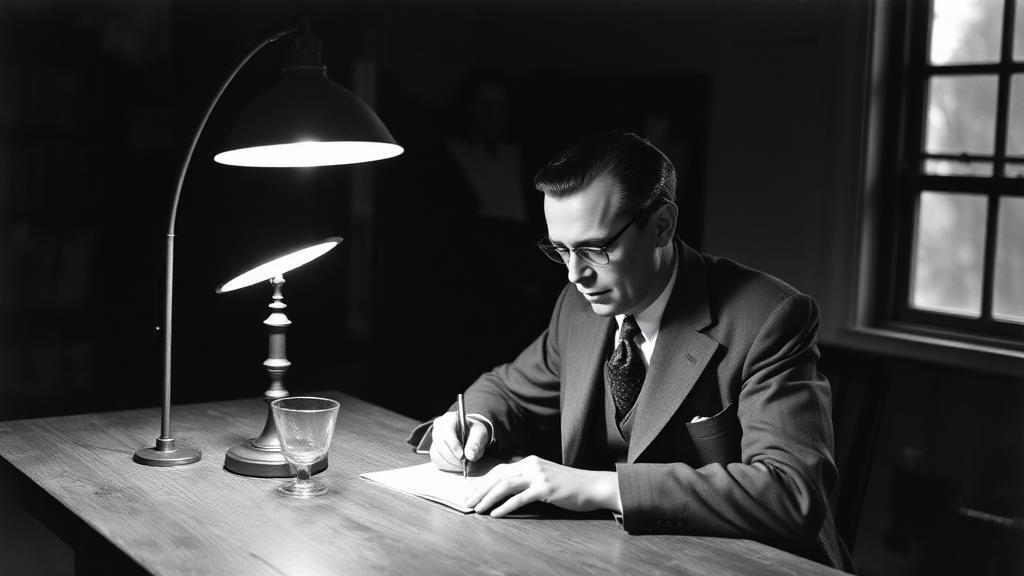
In the winter of 1937, John Atanasoff drove east across Iowa into the dark. He was thirty-three, a physics and mathematics professor at Iowa State College in Ames, and he had a problem he could not shake loose: his graduate students were burning their days on the same rote arithmetic — the same equations, the same pencil-and-paper method — and there had to be a better way. He drove for hours without stopping. Somewhere in Illinois, near Rock Island on the Mississippi, he turned into a roadhouse and ordered a drink (Wikipedia). He began writing on whatever paper was in front of him.
What he wrote down amounted to four principles: count in binary rather than decimal, use electronic vacuum tubes instead of mechanical relays, store numbers on capacitors, and keep memory separate from the logic that did the computing. Back in Ames, he recruited a graduate student named Clifford Berry, claimed space in the basement of the physics building, and got to work. A small eleven-tube prototype ran in October 1939 (Computer History Museum). The full machine — the Atanasoff-Berry Computer — was completed in 1942: a desk-sized cabinet holding some three hundred vacuum tubes and two rotating memory drums, each storing thirty binary numbers.
The ABC was built for exactly one class of problem: systems of simultaneous linear equations, up to twenty-nine unknowns at a time. You fed it punched cards; it punched intermediate results onto new cards; eventually it returned the answer. The card reader was reportedly unreliable. But the way it computed was new: where every other calculating device in 1939 counted in decimal through mechanical wheels or telephone relays, the ABC counted in binary and switched with vacuum tubes. The difference in speed was not incremental.
In June 1941, a physicist from the University of Pennsylvania named John Mauchly drove to Ames and spent several days in the basement studying the machine. Atanasoff showed him the schematics and walked him through the design (Computer History Museum). Three years later, Mauchly and J. Presper Eckert unveiled ENIAC — the Electronic Numerical Integrator and Computer — and collected patents that would earn Sperry Rand hundreds of millions in licensing fees. ENIAC was declared the first electronic digital computer. The ABC, meanwhile, was dismantled in 1948 when Iowa State converted the basement to classrooms. Most of it went to the scrap heap.
The ghost returned in 1967, when Honeywell sued Sperry Rand to break the ENIAC patents. After six years of testimony, Judge Earl R. Larson ruled on October 19, 1973 (Wikipedia): “Eckert and Mauchly did not themselves first invent the automatic electronic digital computer, but instead derived that subject matter from one Dr. John Vincent Atanasoff.” The ENIAC patents were voided. A machine that had been scrapped for twenty-five years had just legally unmade the most famous computer in history.
What the ABC established — first in practice, then in law — were the principles Atanasoff worked out at a roadhouse table in Illinois: binary arithmetic, electronic switching, memory kept separate from computation. These were not refinements of what came before. They were the architecture.
Of the original machine, only one memory drum survived the 1948 cleanout. The principles have done rather better.
Sources
- Atanasoff–Berry computer — Wikipedia — Timeline, technical specifications, the Mauchly visit, and Judge Larson’s 1973 ruling.
- Atanasoff-Berry Computer — Computer History Museum — The winter drive to Rock Island, Mauchly’s visit, and the legal aftermath.
- Atanasoff-Berry Computer Operation — Iowa State University — Technical description of the machine’s design and its role solving systems of linear equations.