The mechanical escapement, or when clocks learned to tick
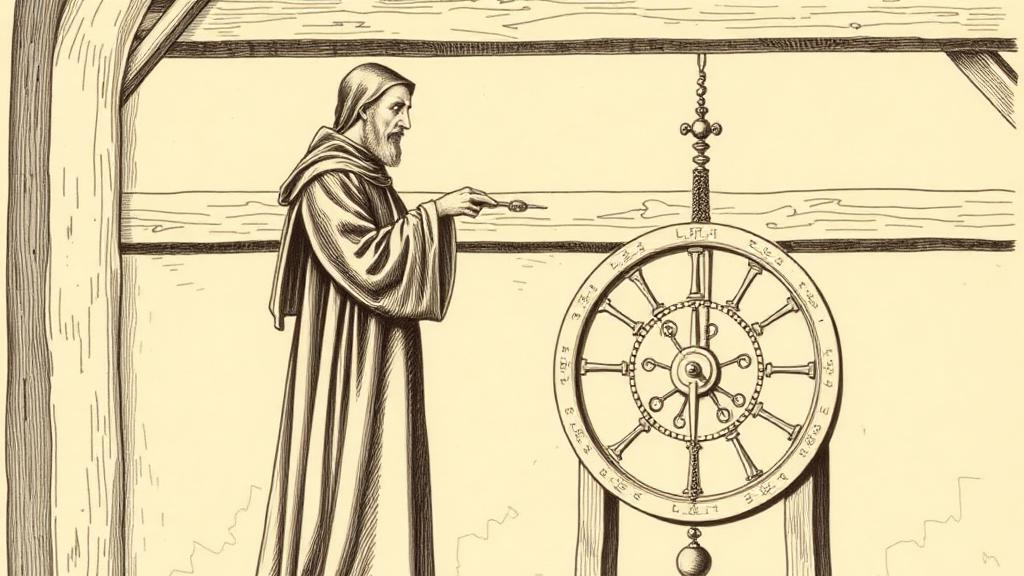
From a beam above the choir screen at Dunstable Priory, Bedfordshire, in 1283, there hung something the Augustinian canons recorded in their annals with terse satisfaction: a horologium placed above the pulpitum (Dunstable History). Eight words of Latin. What those words didn’t need to explain was that this one ran without water, without sand, without sun. It had a falling weight, a toothed wheel, and an iron bar that swung back and forth in the dark above the chancel, counting.
The fact that it existed at all was not obvious. In 1271, an English astronomer writing in Montpellier under the name Robertus Anglicus had noted that clockmakers had been trying for years to build a weight-powered mechanism that would turn a wheel exactly once in twenty-four hours — and could not complete it (Wikipedia). The problem was elementary and maddening. A falling weight wants to fall. Left to itself, it would spin a gear train in seconds rather than hours. What no one had yet built was a device that could ration that descent, releasing the wheel tooth by tooth in a rhythm slow enough to count. They were looking, without knowing quite what to look for, for an escapement.
The verge-and-foliot mechanism was the answer. A crown wheel — so named because its teeth projected sideways like the points of a crown — was driven by the descending weight. Threading vertically through the wheel was the verge, a thin rod fitted with two angled metal tabs called pallets, one engaging the upper teeth of the crown wheel and the other the lower. Balanced across the top of the verge was the foliot: a horizontal bar with small movable weights near each end. As the crown wheel pushed against the upper pallet, the foliot swung one way; its own inertia swung it back; the pallet released; the lower pallet caught the opposite tooth; the foliot swung the other way. Back, forth, tick, tock (Wikipedia). The weight fell not freely but in steps — one tooth at a time.
The clock at Dunstable had no face and no hands. It was not there to tell anyone the time in any visual sense. Its entire purpose was to ring a bell at the hours of the divine office — prime, terce, sext, none, vespers, compline — without requiring a monk to sit up all night watching a candle burn to a mark. The machine kept the liturgy. For a community bound by the Rule, that was quite enough.
It drifted. Early verge-and-foliot clocks were accurate to no better than an hour a day, depending on temperature and the foliot’s tuning. The cathedrals didn’t much care. Exeter installed one in 1284, St. Paul’s in London in 1286, Westminster in 1288, Canterbury in 1292 (Wikipedia). Within a decade, the escapement was the institutional technology of England’s churches. The question of precision would come later; the question of whether it was possible to mechanize time at all had just been answered.
What the escapement actually changed was not a number on a dial but a philosophy of measurement. Every timekeeping technology before it — water flowing, sand falling, a candle burning to a notch — worked by continuity, by a process that ran until it ran out. The escapement replaced all of that with repetition: a regular oscillation, countable, adjustable, and in principle improvable without limit.
No trace of the Dunstable machine survives. But every clock built since has borrowed its logic: not a flow to be measured, but a count of equal steps.
Sources
- Verge escapement — Wikipedia — mechanism details, Robertus Anglicus reference, spread of verge-and-foliot clocks across England.
- Dunstable Priory in 1283 — Dunstable History — Latin primary-source text of the 1283 Annals, installation context, monastic function, subsequent early English clock dates.