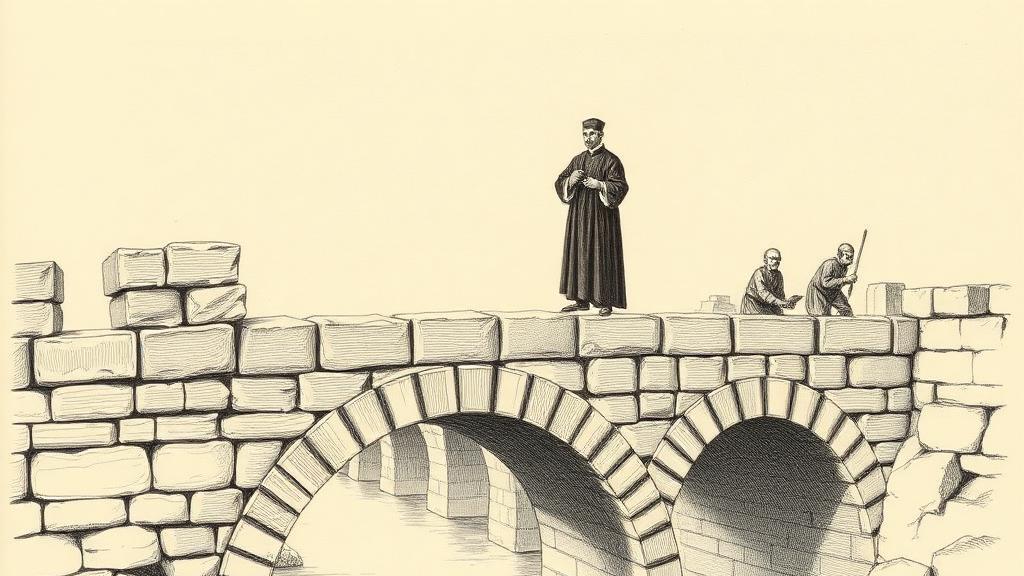
Old London Bridge, the crossing that became a city
Every waterman on the Thames knew the rule: pass over the bridge if you can, pass under it if you dare. The nineteen stone piers of Old London Bridge were encased in massive boat-shaped timber frames called starlings, and the starlings squeezed the river into less than a quarter of its natural width. The difference in water level between the upstream and downstream sides could reach six feet. The resulting white-water rush through the narrow arches was fast enough to swamp a barge and drown a boatman, and it regularly did. “London Bridge was made for wise men to pass over,” the old proverb ran, “and for fools to pass under.”
Construction had begun in 1176, when a priest-builder named Peter of Colechurch laid the first stone on Henry II’s commission to replace the old timber crossing with something permanent. Peter had already overseen a timber rebuild in 1163; now the brief was stone. He designed nineteen pointed arches spanning 926 feet of tidal Thames, each pier resting on a raft of elm piles driven into the riverbed (Britannica). He did not live to see it finished. Peter died in 1205, four years short of completion, and was interred in the crypt of the chapel of St Thomas Becket, which he had built as part of the bridge itself.
Within a generation of the bridge’s completion in 1209, commerce had moved in. By the late fourteenth century, a hundred and forty premises lined the twenty-four-foot carriageway — drapers, haberdashers, cloth merchants, tavern-keepers — their jettied upper floors leaning out so far that neighbours on opposing sides could nearly touch across the gap (Wikipedia). It was one of London’s main shopping streets. It was also, for five hundred and forty-one years, the only Thames crossing between the city and the sea. Westminster Bridge opened in 1750. Until that moment, every merchant, pilgrim, diplomat, and army that needed to move between London’s north and south banks had no other way.
The drawbridge gate at the southern end served a secondary purpose that foreign visitors invariably noted. When William Wallace was executed in 1305, his head was boiled in tar, set on a pike, and mounted on the gatehouse. It was the first of very many. Thomas More, Thomas Cromwell, Jack Cade — by 1598, a visitor counted more than thirty heads along the gate. The volume eventually warranted a dedicated official: the Master of the Heads, charged with managing the display, retiring those too far decomposed to be presentable, and when the time came, dropping them into the Thames.
The same starlings that killed careless boatmen also powered the city. In 1578, a Dutch engineer named Peter Morris installed water wheels under the northernmost arches, using the force of the manufactured rapids to pump fresh water through wooden pipes to London homes. The city’s first waterworks ran for nearly two centuries, off the back of what was, in effect, a design flaw.
The old bridge was demolished in 1831 and Rennie’s five-arch span took its place. The rapids calmed. The shops moved ashore, and London got its first Thames crossing that was simply a crossing. The river, for its part, had been waiting six hundred years for exactly that.
Sources
- London Bridge — Encyclopaedia Britannica — Construction dates, Peter of Colechurch, 19 arches, starlings, engineering details, Westminster Bridge 1750.
- London Bridge — Wikipedia — Buildings on the bridge, heads on spikes, William Wallace, Peter Morris water wheels, 1831 demolition.