Oracle bone script, or how the Shang talked to their ancestors
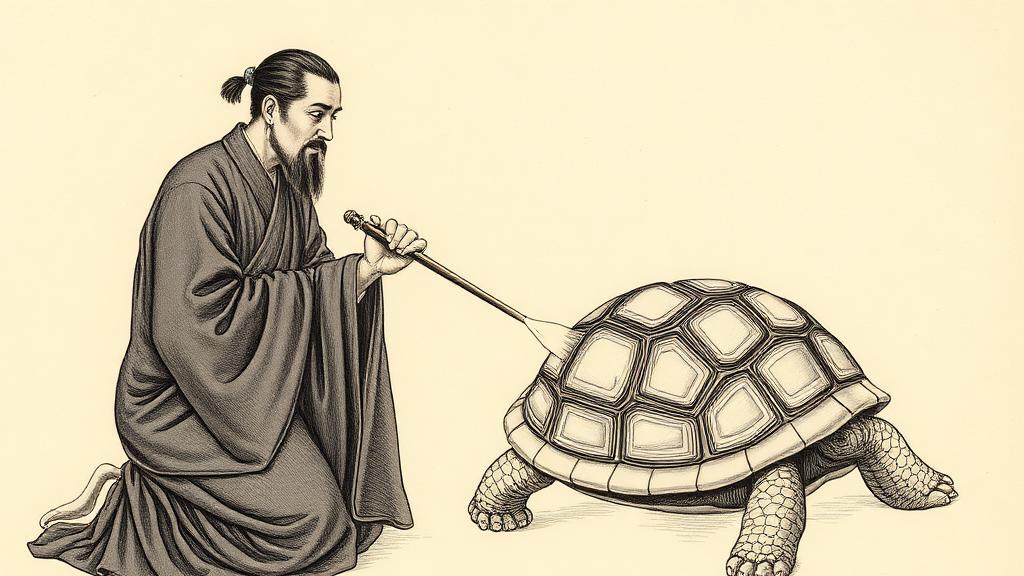
On a winter morning sometime around 1200 BCE, a court diviner at Yinxu — the walled capital of the Shang dynasty, in what is now Henan Province — pressed a heated bronze rod into a notch drilled on the underside of a turtle shell. The shell cracked. The direction of the crack answered the king’s question. The diviner’s assistant then carved the entire exchange into the bone: the date, the name of the diviner, the question, and the crack’s verdict. If the prophecy proved accurate later, a final note confirmed it. The Shang dynasty had, more or less by accident, invented the bureaucratic memo.
Roughly 150,000 such inscribed pieces have been excavated at Yinxu, predominantly the shoulder blades of cattle and the flat belly shells — plastrons — of turtles (Wikipedia). The diviners worked across roughly two centuries, 1250–1050 BCE. The most active period belongs to King Wu Ding, who reigned around 1200 BCE and seems to have consulted the bones about everything.
The questions ranged. “Divination: today, will it rain?” appears frequently, in the plainspoken way of anyone planning a harvest. Military campaigns get their own records: “It should be Lady Hao whom the king orders to campaign against Yi” refers to Fu Hao, one of Wu Ding’s consorts, who was also a military commander. Her tomb, discovered intact in 1976 near Anyang, confirmed exactly what the bones said about her campaigns (chinasage.info). Even a toothache required a consultation: “There is a sick tooth; is it not Father Yi who is causing it?” The ancestor cult and the medical complaint, sharing the same slab.
The script itself is already sophisticated. About 4,500 distinct characters appear across the corpus; roughly 2,000 have been mapped to modern Chinese equivalents. The characters for sun, moon, mountain, and person still carry visible traces of the pictographs carved into bone thirty-two centuries ago. Whatever happened after — the Qin standardization, the brush and ink revolution, the printing press — it happened to this material.
Here is the part that should be impossible. In 1899, a scholar-official in Beijing named Wang Yirong fell ill and was sent a medicine labeled lónggǔ — “dragon bones,” ground-up bone sold by pharmacists across the city as a remedy for various complaints. Wang, a calligrapher and scholar of ancient texts, noticed that a fragment in the package hadn’t been fully pulverized. Faint marks on the surface. He recognized them as writing. He bought every intact piece the pharmacist had, then scoured the city’s apothecaries, then sent letters to dealers across the country (World History Encyclopedia). For decades, Chinese pharmacies had been grinding the oldest surviving corpus of Chinese writing — by weight — into fever medicine.
Wang died in 1900 during the Boxer Rebellion, before the full significance of his discovery was mapped. But the bones stopped being medicine. Excavations at Yinxu began formally in 1928 and have not really stopped since.
What oracle bone script established was not just the existence of Shang China — whose historical reality had been disputed — but the starting point of a continuous line. The script that formed at Yinxu evolved without interruption into classical Chinese, then into the characters carved on Han dynasty monuments, then into the forms standardized across a continent. A student in Shanghai, writing the character for sun this morning, is tracing a line begun here.
Sources
- Oracle bone script — Wikipedia — dates, script development, excavation numbers, connection to modern Chinese
- Oracle Bones — World History Encyclopedia — divination ritual, Wang Yirong discovery, inscription format
- Oracle Bones — chinasage.info — translated inscriptions, Fu Hao, character recognition rate, Wu Ding