The Phoenician alphabet, or how twenty-two consonants built the rest
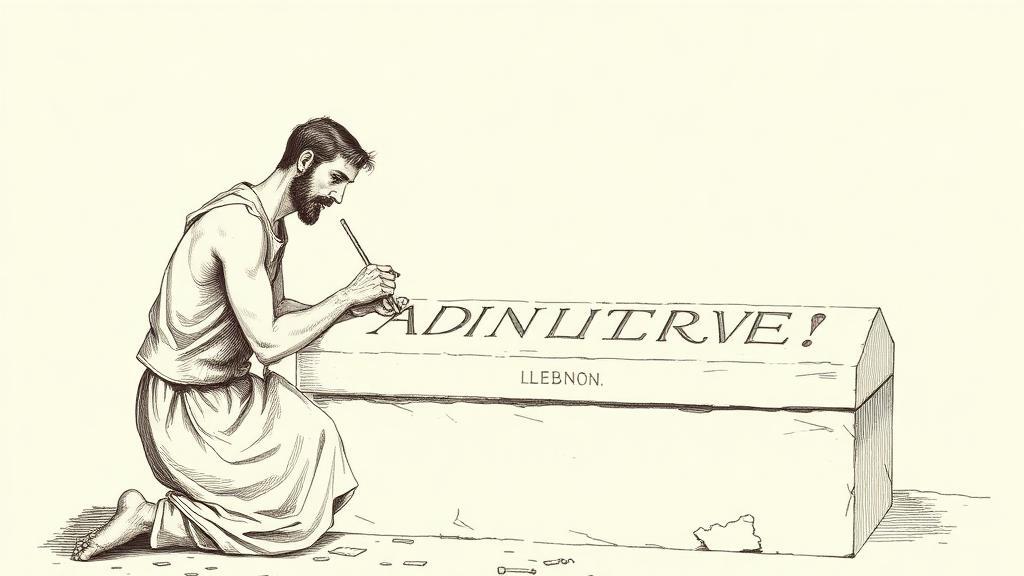
Cut into the lid of King Ahiram’s limestone sarcophagus — discovered in 1923 in a cliff-side tomb at Byblos, Lebanon, and now in the National Museum of Beirut — is a warning: any king or governor who disturbs this tomb will have his royal scepter broken and his throne overturned. The inscription dates to roughly the 10th century BCE, and it is one of the earliest surviving examples of what we now call the Phoenician alphabet — the system that would eventually, through a long chain of borrowings and adaptations, put letters on this screen.
Byblos sits on the Lebanese coast, about thirty kilometers north of Beirut, and in the second millennium BCE it was one of the busiest ports in the known world. Cedar timber for Egypt, purple dye from murex shells, copper, linen, glass — everything moved through these quays. The Greeks named their word for “book” (biblos) after the city, which tells you something about how much papyrus passed through its harbor. The people who ran this trade needed writing — not the thousand-sign apparatus of cuneiform, which required years of scribal training, but something fast, flexible, and portable enough for a merchant’s ledger.
What they produced was an abjad: twenty-two letters, each representing a consonant, written from right to left, vowels unwritten. The reader was expected to supply vowel sounds from context — the way a modern reader of English can decode “th ct st n th mt” as “the cat sat on the mat.” Each letter had a name that described what its ancestor pictogram had looked like: aleph (ox), bet (house), gimel (camel), daleth (door). Rotate aleph upside-down and you have something resembling the letter A; compress bet’s house-floor plan and you have B. The alphabet was carrying its own fossil record in its names.
This acrophonic principle — name the letter after a word that starts with that sound — traces back to the Proto-Sinaitic script, developed in the Sinai peninsula around the 19th century BCE by Semitic workers who simplified Egyptian hieroglyphic signs into a phonetic system (Wikipedia). Phoenician standardized and streamlined that inheritance. The result was something anyone could learn in weeks rather than years: twenty-two shapes versus the eight hundred or more signs required to read Akkadian cuneiform. A palace scribe wasn’t needed. A sailor could read a manifest; a merchant could write a receipt.
The trade routes did the rest. By the 9th century BCE the script had spread to the Aramaeans; by the 8th century it had crossed the Aegean. The Greeks found the twenty-two letters useful but incomplete — Phoenician had no symbols for the vowels that Indo-European languages couldn’t leave implicit. So the Greeks repurposed the consonant letters they didn’t need: aleph, the glottal stop, became alpha, the vowel /a/; he became eta; semi-consonants became /u/ and /i/. The Greek alphabet — a Phoenician alphabet with its spare consonant slots converted to vowels — became the template for Etruscan, then Latin, then every Western script in use today.
The letter A began as an ox head. The letter B began as a house. Three thousand years of simplification and borrowing separate those original Phoenician shapes from the characters on your screen — but the line is unbroken, running back through Greece and Rome to a limestone tomb on the Lebanese coast where a stonemason once cut a king’s warning into stone.
Sources
- Phoenician alphabet — Wikipedia — Proto-Sinaitic origins, the Ahiram sarcophagus, 22-letter consonantal structure, acrophonic naming system, Greek vowel adaptation.
- Phoenician alphabet — Encyclopaedia Britannica — Ahiram epitaph at Byblos, relationship to Greek and Western alphabets, spread via Mediterranean trade.
- The Phoenician Alphabet in Archaeology — Biblical Archaeology Society — earliest inscriptions, 22 letters versus ~1,000 cuneiform signs, Mediterranean diffusion.