Shannon's chess paper and the problem it was really solving
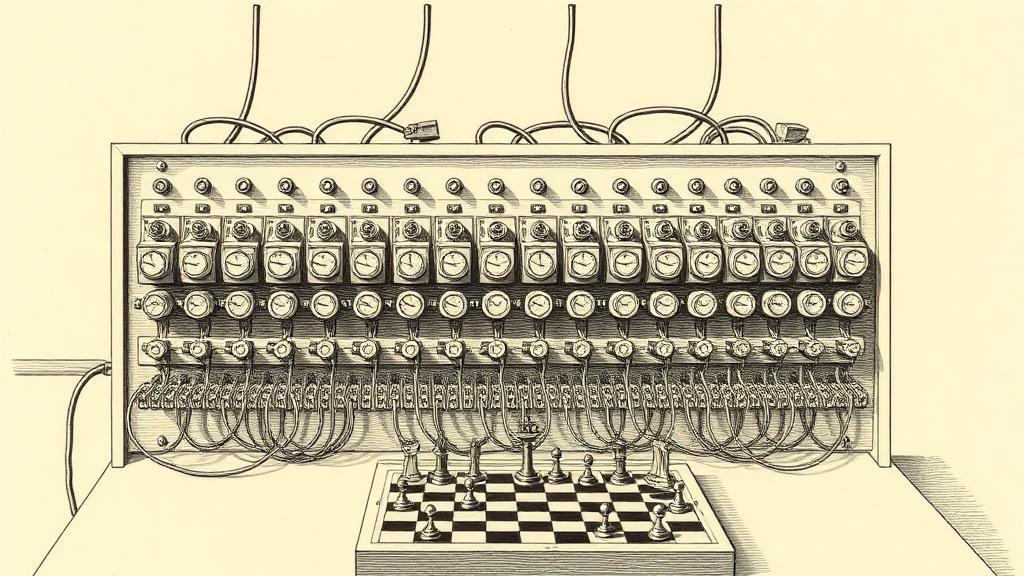
In a room at Bell Laboratories in Murray Hill, New Jersey, around 1950, a relay-switching machine was playing chess. Each move required 150 relays to fire in sequence, each one audible — a mechanical drumroll that lasted ten to fifteen seconds. The machine could handle only six pieces at once. Among its observers was Edward Lasker, one of America’s strongest chess players of the era, who had been invited to watch it think.
Shannon had built the machine to demonstrate an idea. The idea was in a paper he had presented at the National IRE Convention on March 9, 1949, and published in the Philosophical Magazine in March 1950: Programming a Computer for Playing Chess. Eighteen pages. Shannon said in the opening paragraph that chess was a “wedge” for harder problems: language translation, circuit design, logical deduction. He was describing, three years before Dartmouth gave it a name, what artificial intelligence would spend the next seventy years attempting.
The paper’s two lasting contributions are the evaluation function and the minimax procedure. The evaluation function assigns a numerical score to any chess position — queen = 9, rook = 5, bishop and knight = 3, pawn = 1 — then adjusts for mobility, pawn structure, and king safety. The minimax procedure alternates between imagining each player choosing their best move, looks ahead to a fixed depth, and picks the branch with the highest guaranteed score. Put them together and you have a program reasoning about the future by modeling an adversary. That trick turns out to be useful far beyond chess.
Shannon saw the problem with brute force immediately. Looking three moves ahead for both sides demanded roughly 10^9 evaluations — more than sixteen minutes per move on 1950 hardware. His answer was Type B search: focus on checks, captures, and threats; prune the quiet branches. The machine couldn’t examine everything, so it had to decide what mattered. That decision, Shannon recognized, was itself a form of intelligence.
He had already estimated chess’s full game-tree complexity at roughly 10^120 — the Shannon number, a figure larger than the estimated count of atoms in the observable universe and still the standard citation for why perfect chess is not on any machine’s roadmap. The number predates the paper; it was Shannon’s way of describing the territory before he wrote the map.
He was, by all accounts, a singular presence at Bell Labs: a man who unicycled down its corridors while juggling, who built foam shoes intended for walking on water and a flame-throwing trumpet, for reasons that remain his own. The chess paper fits the same temperament — a serious technical problem pursued partly because asking it was entertaining, pursued until it opened into something far larger. Byte magazine offered the verdict in 1978: “There have been few new ideas in computer chess since Claude Shannon.”
The machines that beat Kasparov in 1997 were still running Shannon’s minimax. The relays had been replaced. The logic hadn’t.
Sources
- Programming a Computer for Playing Chess (1950) — the full original paper; evaluation function, minimax procedure, Type A/B search, and Shannon’s framing of chess as a wedge into harder AI problems.
- Claude Shannon — Chessprogramming wiki — relay chess machine details, the Lasker demonstration, Shannon number, and the Byte magazine verdict.
- Claude Shannon — Wikipedia — biography, Bell Labs career, Shannon number, and personal anecdotes.