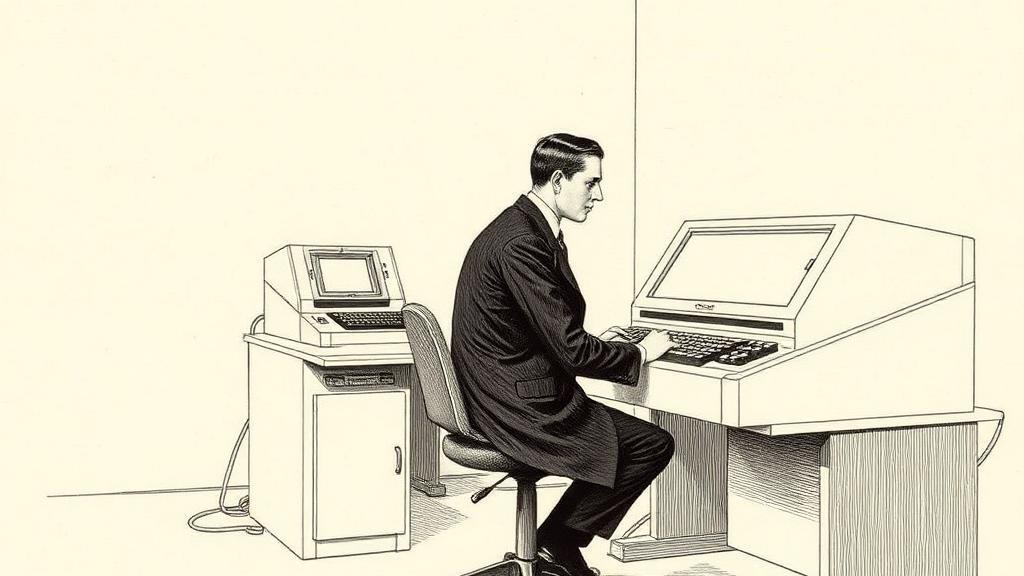
Turing's imitation game
Picture the parlor game: a man and a woman are sent into separate rooms, and guests must identify them by written questions alone — slips of paper, typed replies, the slow work of inference. The game had been played in drawing rooms for years before Alan Turing borrowed it. His modification, announced in October 1950 in the journal Mind, was simple: replace the man with a machine.
Turing was 38 and Deputy Director of the Computing Machine Laboratory at the Victoria University of Manchester, working alongside some of the first stored-program computers ever built. The paper he published that autumn — “Computing Machinery and Intelligence” — opened with a question he immediately called unanswerable: Can machines think? Rather than argue over what “thinking” meant, he proposed a substitution: don’t ask what machines are; ask what they can do.
Three players sit in separate rooms, communicating through a teletype: an interrogator, a human confederate, and the machine. The interrogator must determine which is which. The machine must convince the interrogator it is human; the human’s job is to help the interrogator succeed — which is its own kind of competition. The test was not about raw intelligence. It was about performance — whether the surface of thought was indistinguishable from thought itself.
Here is the detail that has bothered philosophers ever since. Turing’s friend the mathematician Robin Gandy later said the paper was written not “as a penetrating contribution to philosophy but as propaganda” — an argument meant to expand what people thought computers could become, not to settle the hard questions of mind (Wikipedia). The nine objections Turing addressed — from “machines cannot have souls” to Lady Lovelace’s classic “machines can only do what they are told” — were handled with patient good humor rather than strict refutation. He was clearing underbrush so the real question could grow.
His prediction was calibrated and wrong in the most interesting way. He estimated that within fifty years — by the year 2000 — a machine with roughly a billion bits of storage could fool an average interrogator correctly identifying it no more than 70 percent of the time after five minutes of questioning (Stanford Encyclopedia of Philosophy). By 2000, that benchmark had not been reached. Whether it has been reached since depends on whom you ask and how loosely you read the original test conditions.
What the 1950 paper actually gave the world was not a test but a vocabulary. Before it, machine intelligence had no agreed framework — it lived in science fiction and engineering intuition, in Frankenstein and Babbage. After it, researchers had a benchmark they could aim for, dismiss, or argue about, and a name — the imitation game — that was playful enough to outlast all the arguing.
The question Can machines think? turned out to be the wrong question. Asking it clearly, in 1950, is how the right questions eventually got asked.
Sources
- Computing Machinery and Intelligence — Wikipedia — publication details (Mind, October 1950, vol. LIX, issue 236), the nine objections, Robin Gandy’s assessment, and reception history.
- The Turing Test — Stanford Encyclopedia of Philosophy — mechanics of the imitation game, Turing’s 50-year prediction, and the philosophical debate the paper generated.
- The Imitation Game — CMU Libraries — Turing’s context at the Victoria University of Manchester and the paper’s broader significance.