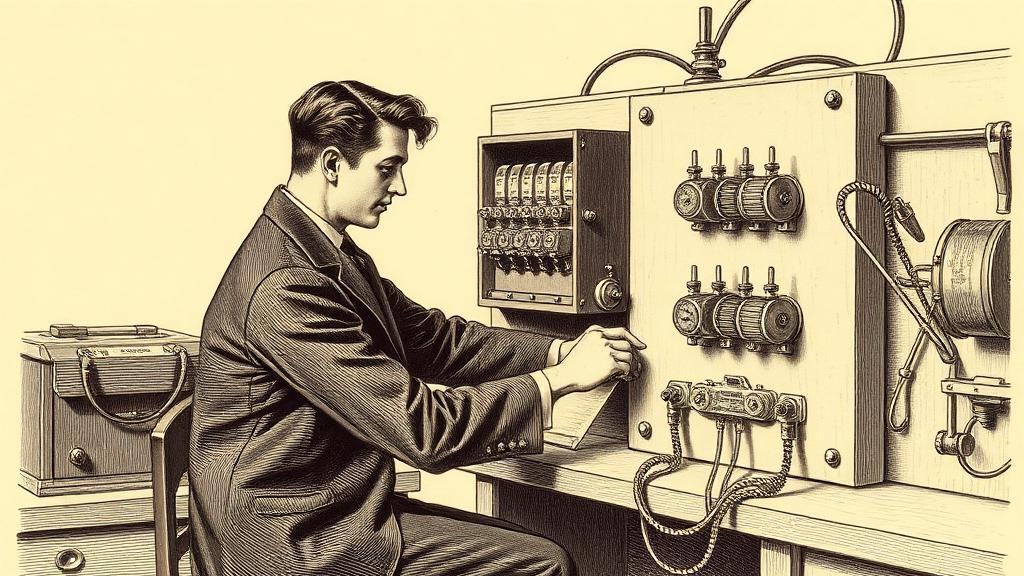
Shannon's switching circuits, 1937
An electromagnetic relay is about as simple as machinery gets. Current flows through a coil, the coil becomes a magnet, the magnet pulls a metal arm, the arm closes a contact. Two states: open or closed. A twenty-one-year-old named Claude Shannon spent the autumn of 1936 maintaining a room full of them, and somewhere in the clicking and the clacking, he noticed something these switches shared with a dead English mathematician’s algebra.
Shannon had arrived at MIT that autumn from the University of Michigan, where he finished two bachelor’s degrees in 1936 — one in electrical engineering, one in mathematics. His job at MIT: research assistant to Vannevar Bush, who had built the differential analyzer, a room-sized analog computer that solved differential equations by means of rotating shafts, integrator wheels, and more than a hundred electromechanical relays. Bush’s machine was the most ambitious calculator in the world. Shannon’s job was to keep it running.
What Shannon saw — and what no engineer had spelled out in print before him — was that the relay’s two states, open and closed, mapped exactly onto the two values in the algebra George Boole had published in 1854. Boole had built a symbolic system for manipulating true and false: AND, OR, NOT. For the eighty years since he published it, the algebra had been a philosopher’s curiosity, with no clear practical application. Shannon recognized that it was also, and far more concretely, a theory of switches.
He developed the idea through the summer of 1937 at Bell Telephone Laboratories in New York, then returned to MIT and on August 10, 1937, submitted his master’s thesis: A Symbolic Analysis of Relay and Switching Circuits. The paper showed how to use Boolean algebra to simplify any relay circuit — to find the configuration that produced a given logical result using the fewest switches — and proved that any logical operation could be expressed in hardware. It ran to 57 pages. Published in the Transactions of the American Institute of Electrical Engineers in 1938, it won the 1939 Alfred Noble Prize. Shannon was twenty-two.
The competition existed but was invisible. A Soviet engineer named Victor Shestakov had independently arrived at the same connection in 1935, but his paper sat unpublished until 1941, then appeared only in Russian. Shannon’s work circulated in English, in the right journal, at the right moment — and the field took its shape from his framing.
Vannevar Bush, having supervised the thesis, wrote that “the genius of this young man is that he has translated thought into machinery.” Howard Gardner, the psychologist, called it in 1985 “possibly the most important, and also the most famous, master’s thesis of the century.” Neither assessment overstates it.
Before Shannon, relay-circuit design was an art — experience and intuition, no algebraic tools to verify or compress a design. After Shannon, it was a branch of mathematics. Every digital circuit that followed — the ENIAC in 1945, the transistor in 1947, the integrated circuit, the microprocessor — inherited his insight: that two positions of a switch can carry the full weight of logic.
Boole had mapped the territory. Shannon built the roads.
Sources
- A Symbolic Analysis of Relay and Switching Circuits — Wikipedia — thesis title and submission date, Howard Gardner’s assessment, Victor Shestakov parallel, Alfred Noble Prize.
- How Do Digital Computers “Think”? — Computer History Museum — Bush’s differential analyzer, Shestakov context, circuit design transformed from art to science.
- Claude Shannon — Wikipedia — biographical background, University of Michigan degrees, Bell Labs summer 1937, Vannevar Bush’s assessment.