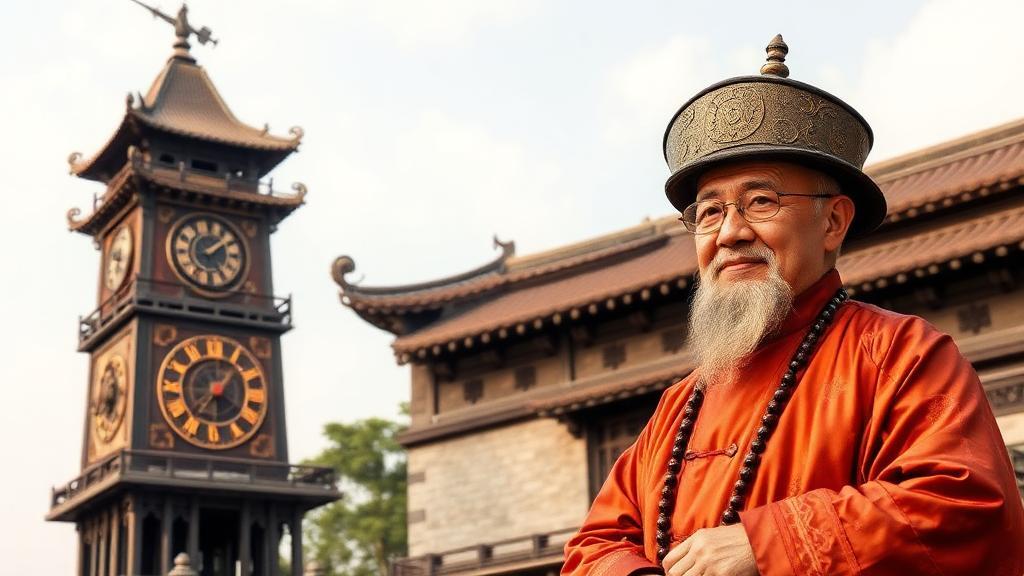
Su Song's clock tower, or the machine that told the whole sky
The machine stood twelve meters tall in the imperial capital of Kaifeng, powered entirely by falling water, its crown an armillary sphere that tracked the position of planets against the stars. The man who built it was sixty-six, a poet, and had been a diplomat and a pharmacologist before anyone asked him to design a clock.
Su Song (1020–1101) had served the Song dynasty as official, diplomat, and mapmaker for decades when Emperor Zhezong summoned him in 1086 to build a new astronomical instrument. Working with the mathematician Han Gonglian, he delivered a wooden prototype in 1088, then cast its parts in bronze over the following years. The finished tower, complete in 1094, tracked not just the hour but the day of the month, the moon’s phase, and the positions of visible planets — a twelve-meter machine that kept the sky as well as the time.
The heart of the device was an eleven-foot wheel fitted with thirty-six bronze scoops. Water from a constant-head supply tank filled each scoop at a measured rate; when a scoop reached the right weight, it tipped, releasing a locking lever, advancing the wheel by one step, and locking again before the next scoop could move. Su Song recorded his reasoning in plain terms: “The heavens move without ceasing but so also does water flow. If the water is made to pour with perfect evenness, then the rotary movements will show no discrepancy.” That mechanism — the step-by-step, gravity-gated advance — is an escapement. Every mechanical clock that followed is built on the same logic (Wikipedia).
Power traveled from the drive wheel to the sphere above through a nineteen-and-a-half-foot iron chain, the oldest illustrated endless chain drive in the engineering record (Revolution Watch). A hundred and thirty-three carved wooden figures moved on rotating platforms at the base, striking gongs and bells on schedule. Su Song published the full design in 1092 — forty-seven diagrams, in exhaustive detail — in a treatise called the Xinyi Xiangfayao. He was seventy-two.
The tower stood in Kaifeng for thirty-three years. In 1127, the Jurchen armies of the Jin dynasty took the city and dismantled the clock piece by piece, carting the components north to their own capital. They had the parts. They had the treatise. They could not make it run (Hong Kong Space Museum). The Jurchens were conquerors, not horologists, and a machine calibrated by hand over eight years turned out to be rather difficult to reconstruct from a diagram. Su Song’s son later attempted it. He failed, too.
What survived was the idea. The escapement — the conversion of steady energy into precisely metered steps — would appear in European iron-gear clocks by the late thirteenth century, where the same problem was solved the same way: a wheel held back until a precisely timed release let it advance by one tooth. Whether the concept migrated along Silk Road channels or was independently derived is still open. The function is not open at all.
The scoops are gone. The steps remain.
Sources
- Su Song — Wikipedia — Biographical details, the 1086 commission, tower specifications, the escapement mechanism, the Jurchen capture and failed reconstruction.
- Su Song and the Water-driven Astronomical Clock-tower — Hong Kong Space Museum — Tower dimensions and functional layout, significance, and the loss of the working original.
- The Astronomical Water Clock of Su Song — Revolution Watch — Chain drive, escapement mechanics, surviving treatise and replica.