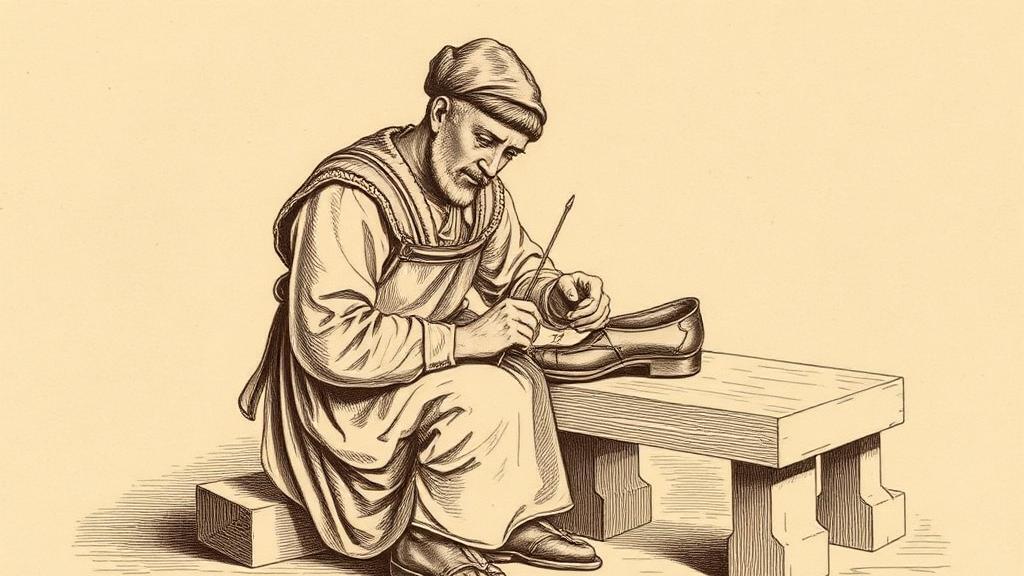
The turnshoe, or how medieval cordwainers sewed the seam inside
In 12th-century London, a cordwainer assembles a shoe the wrong way round. The leather is inside out — rough flesh side facing up, smooth grain side pressed against the wooden last. He stitches sole to upper along what will become an interior seam. When the last waxed-linen stitch is tied, he grips the toe with one hand and the heel with the other and inverts the whole thing. The grain emerges, the seam disappears, and the shoe is ready to walk in.
This was the turnshoe: the dominant method for making leather footwear across medieval Europe from roughly the 10th century to the late 15th. The logic was structural. By burying the seam inside the shoe after assembly, the maker removed it from direct contact with mud, wet pavings, and the repeated flexing of the foot. A shoe built this way lasted better and let in less moisture than one where the seam faced outward. The engineering was basic; the insight was not.
The method placed strict demands on materials. Sole leather ran to about 3 or 4 millimetres — thick enough to protect the foot, thin enough to invert without cracking. Uppers were thinner still, around 2 millimetres, typically cowhide, occasionally goatskin in England during the 12th and 13th centuries. Thread was waxed wool first; waxed linen soon replaced it and lasted far longer in damp ground. We know these specifications not from guild records alone but from the shoes themselves: nearly 2,000 examples, many still complete, recovered from the anaerobic mud of the Thames’s north bank and now held by the Museum of London. Buried mud turns out to be an excellent archive.
The craftsmen who made them in London were called cordwainers — from cordwain, the premium goatskin imported from Córdoba in Moorish Spain. In 1272, the Worshipful Company of Cordwainers was granted its First Ordinances by the Crown, formally separating their work from that of cobblers, who were licensed only to repair shoes using lower-grade leather. Calling a skilled maker a cobbler was an insult, and the guild intended to keep it that way.
The turnshoe’s weakness was its own defining feature. Thin enough to be inverted, the sole wore through faster than a stiffer construction would. By around 1500, the welted shoe had largely replaced it across Europe: the welt method stitched the upper to a thin strip of leather, which was then stitched to a much heavier sole — no inversion required, no need to limit sole thickness. The seam was still hidden; just by a different geometry.
The Thames collection runs from the 12th century to the 15th, and the silhouettes shift visibly across those four hundred years — round toes in the early period, then the absurdly elongated poulaine of the 14th century, then the blunt squared toe of the 15th. The construction never shifted at all. Every one of those shoes was assembled inside out first. The welt eventually replaced the flip, and the welt is still in almost every leather shoe made today.
Sources
- Turnshoe — Wikipedia — construction technique, materials (cowhide, waxed linen thread), time period, replacement by welted construction.
- Shoes and Pattens: Finds from Medieval Excavations in London — medieval.eu — the Thames collection of nearly 2,000 shoes, Museum of London holdings, fashion evolution 12th–15th centuries.
- Worshipful Company of Cordwainers — Wikipedia — 1272 First Ordinances, distinction between cordwainers and cobblers, Córdoba leather origin.