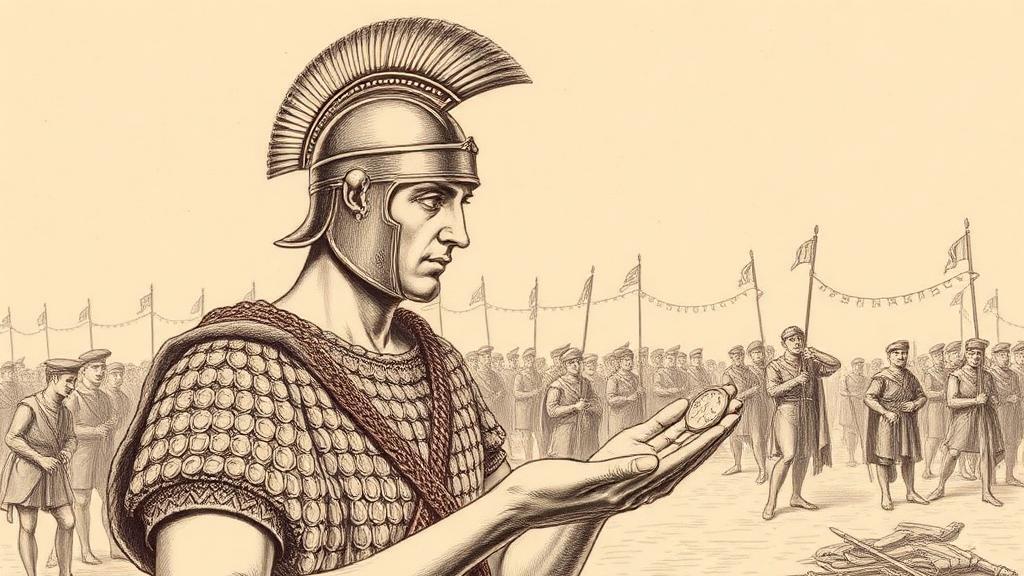
The Roman denarius, or the coin that named money
In 210 BCE, the general Publius Cornelius Scipio crossed to Spain with a war chest of 2,400,000 freshly minted coins. They had been struck barely twelve months earlier.
Rome had introduced the denarius in 211 BCE out of sheer necessity. The Second Punic War had been grinding for seven years: two catastrophic defeats at Trebia and Lake Trasimene, then Cannae in 216 BCE, where Hannibal’s encirclement left roughly fifty thousand Roman dead on an Apulian plain. To keep paying soldiers after Cannae, the treasury had clipped, debased, and re-rated its bronze coinage until the official exchange rates were running on collective goodwill. Then plunder began flowing back — from Spain and from the freshly sacked city of Syracuse — and the Roman mint had enough silver to do something more durable than another emergency patch.
The denarius — from the Latin deni, “containing ten” — was a silver disc roughly four centimeters across, weighing 4.55 grams at 95–98% purity, struck at 1/72 of a Roman pound. The obverse bore a helmeted head of Roma facing right, with a small X behind her neck: the mark of value, ten bronze asses. The reverse showed Castor and Pollux, the Dioscuri — patron gods of the Roman cavalry — charging forward with lances leveled. Divine protection, state authority, and a numerical guarantee, all on a coin small enough to disappear into a clenched fist.
For a soldier on campaign, the coin was calibrated to feel real. Annual pay in the early Republic was around 120 denarii; Julius Caesar, who understood what well-paid soldiers are worth, later doubled it to 225. The silver was good enough that a merchant in Massalia or Carthago Nova would accept it without weighing — which was the point. A money that required scales at every transaction was a friction tax on trade.
Here is the part that escaped the empire. The denarius traveled wherever Rome administered: into Spain, North Africa, Syria, Britain. Spanish says dinero. Portuguese says dinheiro. Arabic says dinar — borrowed through Byzantine Greek from the same Latin root. The English “pennyweight” traces a Germanic cousin. By the time the western empire collapsed in the fifth century, the word was already too widely embedded in the world’s commercial vocabulary to go down with it. A coin minted to fund the war against Hannibal is still naming money in a dozen languages.
What the denarius made possible was fiscal coherence at scale. The old Roman didrachm had been modeled on Greek coinage and felt foreign in a Latin-speaking republic. The denarius was Roman in name, weight, and iconography — and it served as the monetary common tongue of an empire for four and a half centuries.
By 300 CE, the silver content was down to roughly five percent. Emperors had shaved, restruck, and diluted their way to a coin of bronze with a silver wash. The word, though, had already traveled too far for the metal to call it back.
Sources
- Denarius — Wikipedia — introduction date, design (Roma, Dioscuri, X mark), etymology, revaluation history, debasement under later emperors.
- Denarius — Encyclopaedia Britannica — weight and purity specifications (4.55g, 95–98% silver), monetary equivalences, role in Roman economy.
- Roman Coins from the War Against Hannibal — CoinWeek — Second Punic War financial context, Scipio’s 2.4-million-denarius war chest, the 211 BCE currency reform.