The ban liang, or the coin that outlasted its empire
The knife money in a Qi merchant’s purse was worth exactly nothing after 221 BCE. Not because the bronze had degraded, or the markets had moved — but because the man who had just swallowed seven kingdoms by conquest had decided there would be only one coin in China, and this was not it.
That man was Qin Shi Huang, the First Emperor, and the coin was the ban liang — bàn liǎng, meaning “half tael,” a small bronze disc about three centimeters across, weighing roughly seven grams. Plain and round, with a square hole punched through the center. No king’s portrait, no city crest. Just two characters in small seal script on its face: the coin’s own name and weight.
The money it replaced was genuinely a mess. During the Warring States period (c. 475–221 BCE), the seven kingdoms had run five incompatible monetary systems simultaneously. The state of Qi favored knife money — bronze blades shaped like actual knives — while Zhou, Wei, Han, and Qin cast spade money, coins in the outline of a bronze hoe. The southern state of Chu used something stranger still: yibi, the “ant-nose coin,” a tiny bronze lump bearing what looked vaguely like a face. Crossing a border with a cartload of grain meant haggling over exchange rates before you could even quote a price.
Qin Shi Huang abolished all other currency by imperial edict. According to later accounts, the two-character inscription was composed by Prime Minister Li Si — the same official standardizing the written script, axle widths, and weights across the new empire. In 221 BCE, the bureaucracy of unification was working at full speed, and money was item four on a very long list.
The round-over-square design was not purely practical. It embodied tiānyuán dìfāng, the ancient cosmological principle that heaven is round and earth is square. An emperor who called himself the First and intended there to be a ten-thousandth was not going to miss a chance to embed the Mandate of Heaven into pocket change.
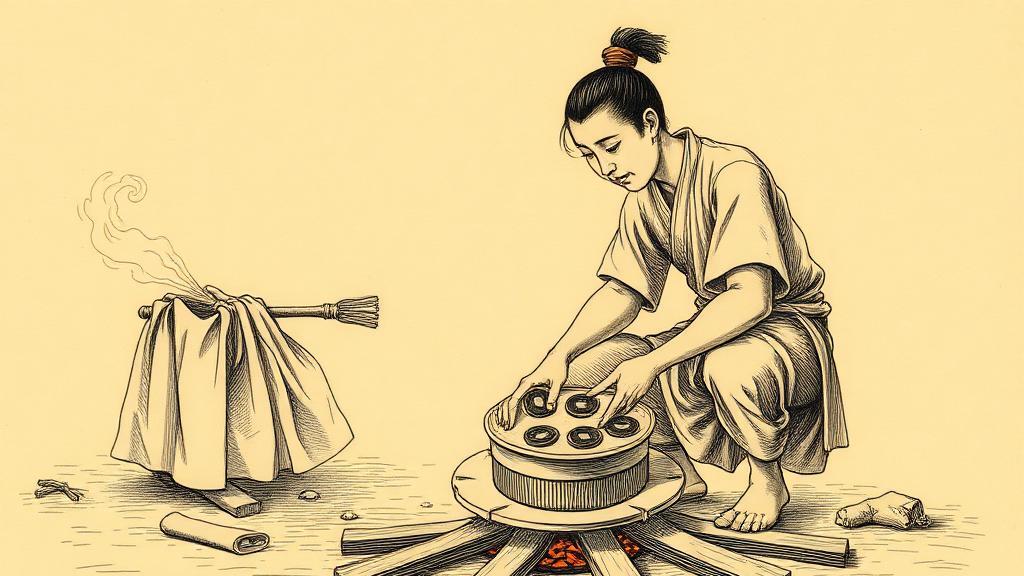
The square hole also had a mundane dividend: coins could be threaded onto a square rod for filing smooth, which kept the edges uniform. Ordinary people strung hundreds onto a cord for carrying — a habit that persisted through Han, Tang, Song, Ming, and Qing dynasties for more than two thousand years, until the early Republic of China retired the last cash coins in the 1910s.
The American Numismatic Association puts it plainly: the round disc with square hole “became the basic form for Oriental coinage for the next 2,300 years.” The Han dynasty tweaked the weight and renamed the coin the wu zhu in 118 BCE. The Tang refined the inscription. But every coin, dynasty after dynasty, kept the round body and the square hole, as if the design had closed before the empire did.
The Qin dynasty itself collapsed in 207 BCE, fifteen years after its founding. The ban liang outlasted it by two millennia.
Sources
- Banliang — Wikipedia — introduction, weight standardization, the round-square-hole design, persistence through 20th century
- History of Chinese Currency — Wikipedia — pre-Qin monetary diversity, knife money, spade money, ant-nose coins, Warring States fragmentation
- Chinese Coinage — American Numismatic Association — “basic form for Oriental coinage for 2,300 years,” Han dynasty wu zhu refinements
- The Qin Ban Liang — Deep China — cosmological symbolism, Li Si’s inscription, economic integration purpose