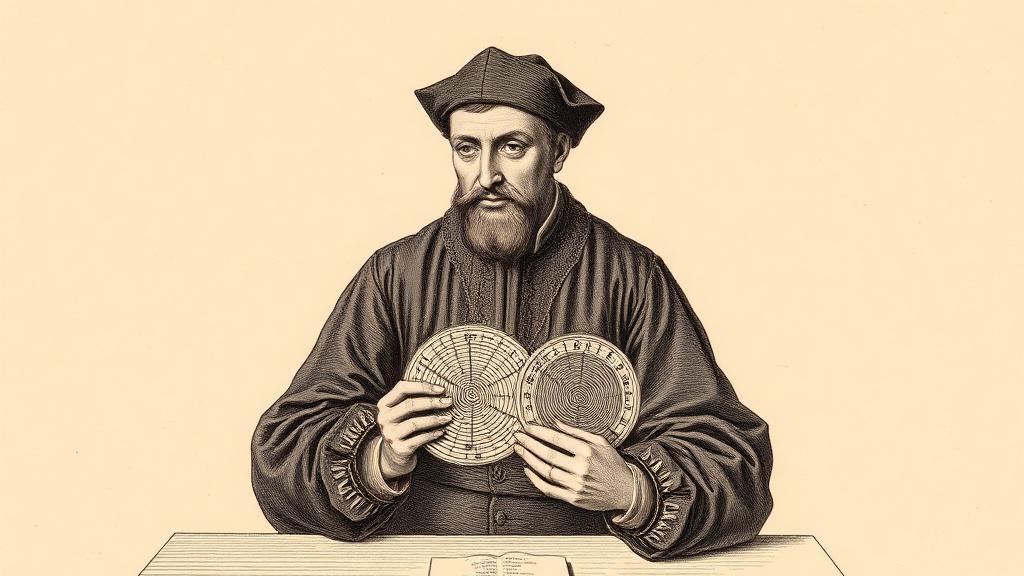
Alberti's cipher disk: the wheel that broke frequency analysis
The device had two parts: two metal disks, one fixed and one rotating, twenty-four notches cut around each rim. It fit in a hand. It was enough to defeat the only cryptanalytic technique the Western world had possessed for the previous six hundred years.
Leon Battista Alberti was not, by training or vocation, a cryptographer. He was an architect — the Palazzo Rucellai in Florence, the Church of Sant’Andrea in Mantua — a humanist who wrote the first Italian-language grammar, a theorist of painting who taught a generation the mathematics of perspective, and by his own account something of a showoff. David Kahn, the definitive historian of cryptology, would later call him the Father of Western Cryptology; Alberti himself regarded the whole subject as a pleasant digression.
The disk started with a walk. Sometime around 1466, Alberti was strolling in the Vatican gardens with Leonardo Dati, secretary to Pope Paul II, when their conversation drifted from the newly invented printing press to the art of secret writing. Dati asked if Alberti had any thoughts. Alberti went home and produced De componendis cifris — a twenty-page Latin treatise that remains the oldest surviving Western work on systematic cryptography.
The treatise opens with a move that would have struck any contemporary codebreaker as reckless: Alberti teaches frequency analysis. He counts the relative letter frequencies in Italian text, identifies the most common and rarest, and demonstrates exactly how a monoalphabetic cipher — where each letter maps to a fixed substitute — can be cracked by anyone patient enough to count. He hands the reader the key to the only lock then in use. Then he describes a better lock.
The disk defeats frequency analysis by shifting the cipher alphabet mid-message. Sender and receiver each carry a Formula: a larger fixed disk, the Stabilis, bearing twenty uppercase Latin letters plus the numerals 1 through 4; and a smaller rotating inner disk, the Mobilis, carrying a randomized lowercase alphabet. The disks start at an agreed alignment. Encipher a few words, then rotate the inner disk to a new position — signaled by inserting a capital letter into the ciphertext — and continue. The same plaintext letter now enciphers differently than it did a line earlier. Frequency counting, which depends on a letter always wearing the same mask, collapses.
The numerals on the outer disk went further still. Each digit indexed a codebook of set phrases — diplomatic formulas, military commands, standard courtesies — compressing whole sentences into a single character. Alberti had, in twenty pages, combined polyalphabetic substitution with a codebook cipher.
No original Formula survives, though later reconstructions do. What survived was the principle. The Vigenère cipher of 1553 extended it. The rotor machines of the First and Second World Wars — the Enigma included — are mechanical elaborations of the same idea: keep rotating the alphabet, and the statistical regularity that analysis depends on never accumulates.
Alberti died in 1472, five years after De cifris, long before any of it was used at scale. He had been too busy building things.
Five centuries later, every encrypted connection on the internet uses a cipher that mutates as it runs — Alberti’s core insight, replicated across a billion simultaneous conversations.
Sources
- Alberti cipher — Wikipedia — disk mechanics, Kahn’s “Father of Western Cryptology” attribution, frequency analysis demonstration, the Dati conversation.
- The Alberti Cipher — Trinity College Computer Science — Alberti’s architectural and humanist background, codebook function of the numerals 1–4, treatise history.
- Leon Battista Alberti — Wikipedia — biographical details, death year 1472, career overview.