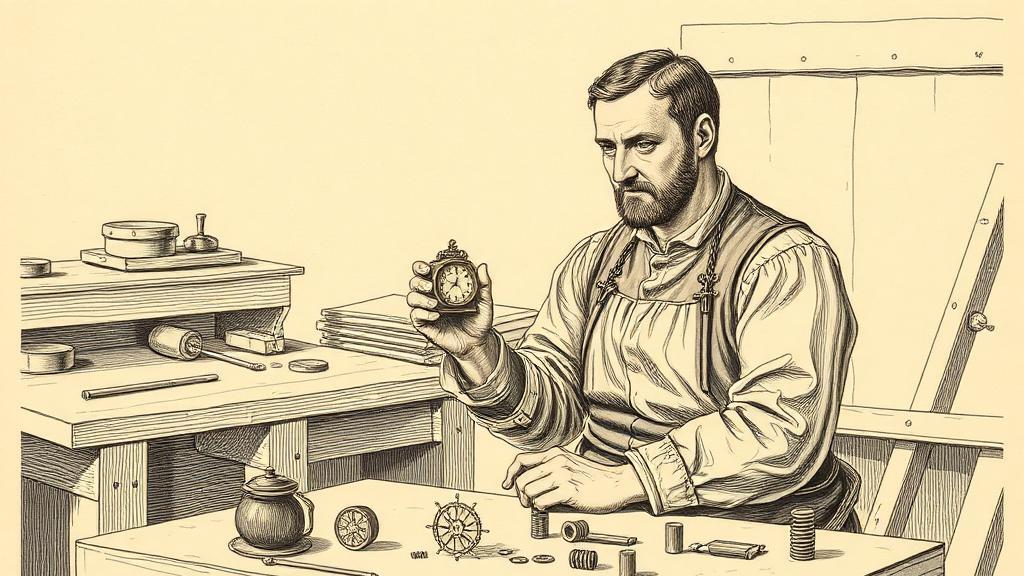
Peter Henlein's pomander, or the clock that fit in a hand
The brass case was the size of a fist, shaped like the pomander pendants that wealthy Nurembergers wore to ward off plague — a perforated metal ball meant to hold perfume or ambergris. Except this one contained no perfume. It contained wheels: tiny interlocking wheels powered by a coiled spring, accurate enough to mark the hours and keep running for forty hours without winding, whether carried at the breast or dropped in a purse. Peter Henlein, a locksmith turned clockmaker, built it in Nuremberg around 1510.
The key was the mainspring: a thin ribbon of steel wound into a spiral, storing energy like a clenched fist. Clock technology had relied on falling weights for two centuries — an arrangement that worked beautifully for cathedral towers and badly for anything else. Mainsprings had existed in some form since the early 1400s, but no one had successfully miniaturized an entire movement around one until Henlein. A contemporary humanist, Johannes Cochlaeus, documented the result in 1512: Henlein fashioned “clocks with many wheels, which — even without any weights — show and chime the hours for forty hours, whether carried in the breast or in a handbag” (Wikipedia).
The device was not yet a watch in any modern sense. It had only an hour hand — minute hands being roughly as useful as mile-markers on an unpaved road for a mechanism this imprecise. The case was brass or gilt metal, perforated so you could read the hand through the cover. By the 1520s, Henlein was supplying princes: Albrecht of Brandenburg placed an order; the ducal court of Mecklenburg-Schwerin followed (Sammler-Uhren). A Nuremberg locksmith had, within a decade, built a continental reputation on the back of a device that fit in a coat.
Then there is the matter of the famous Henlein watch. In 1897, the Germanisches Nationalmuseum in Nuremberg acquired a small gilt clock engraved “Peter Henlein made this in 1510.” It was displayed for decades as direct physical evidence of the founding moment of portable horology. In 2019, the museum subjected it to high-resolution imaging and 3D tomography. The findings were not kind: the parts had not originally belonged together, and the signature itself extended across older scratches that predated the inscription — proving it had been engraved later (Google Arts & Culture / Leibniz Association). The watch was a 19th-century construction. Henlein was real. His invention was real. The exhibit was not.
What Henlein built mattered precisely because it had no fixed address. Before 1510, time was something you went to — the church clock, the sundial in the courtyard, the clepsydra in the market. After Henlein, time was something you carried. That shift is easy to underestimate. The personal relationship between a person and their own clock — the glance at the wrist, the quick check before a meeting — is not a feature of technology. It is a reorganisation of daily consciousness, and a Nuremberg locksmith set it in motion with a coiled strip of steel inside a perforated brass ball.
The minute hand came later. The glass face in 1610. The flat, rounded form we recognise by the 1670s (Wikipedia). But the premise — one person, one timepiece, time as a private possession — was Henlein’s, worked out in a workshop on the edge of a city still haunted by plague.
Sources
- Peter Henlein — Wikipedia — biographical details, the Cochlaeus quote (1512), guild status, mainspring context.
- Pocket watch — Wikipedia — early portable watch chronology, shift to pocket carry c. 1675, design evolution.
- The so-called Henlein pocket watch — Google Arts & Culture / Leibniz Association — the 2019 forensic analysis that exposed the Germanisches Nationalmuseum watch as a later forgery.
- Peter Henlein — Sammler-Uhren — pomander-shaped designs, princely clientele from the 1520s.