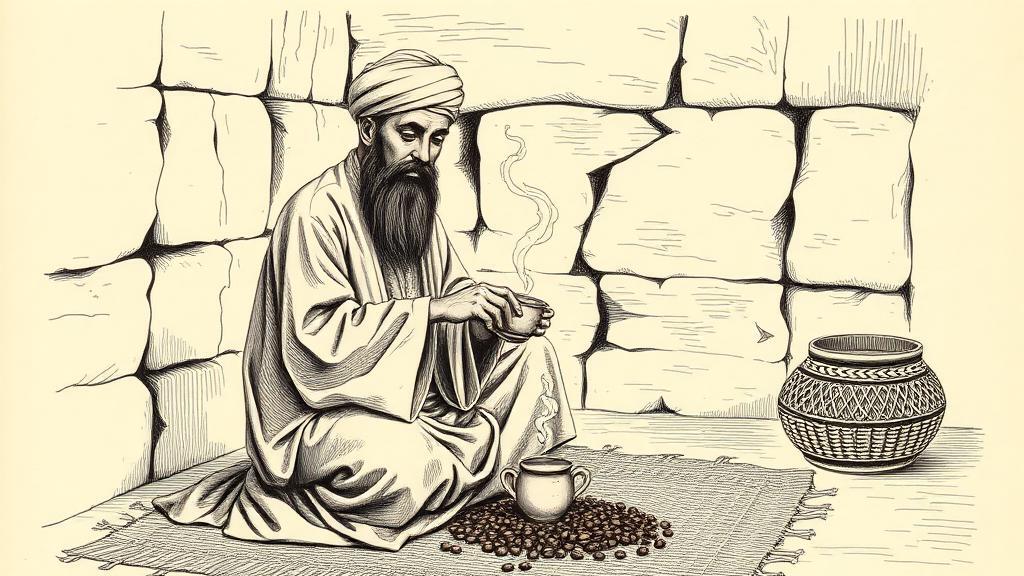
Qahwa and the Sufi monks of Aden
In the port city of Aden, sometime around 1454, a scholar named Jamal-al-Din al-Dhabhani asked his Sufi disciples to try something new. The drink was dark and bitter, made from roasted beans carried across the Red Sea from the Ethiopian highlands. He called it qahwa. It drove away, he later reported, “fatigue and lethargy, and brought to the body a certain sprightliness and vigour.” Al-Dhabhani was the mufti of Aden — the city’s chief legal authority on Islamic law — and the problem he had just solved was this: how to keep his monks awake through the night for dhikr.
Dhikr was the Sufi practice of chanting the names of God for hours at a stretch, a form of devotion that was meant to dissolve the self into remembrance. It worked better, naturally, if you weren’t asleep. The order al-Dhabhani led — the Shadhiliyya, named for the 13th-century Moroccan mystic Abu al-Hasan al-Shadhili — had long relied on qat, a stimulating leaf chewed across the Horn of Africa and the Arabian Peninsula. When Aden’s qat supplies grew unreliable, al-Dhabhani turned to bunn, the coffee bean, which Ethiopian traders had been selling in Yemeni markets for years. He roasted the beans, brewed them in hot water, and served the result in small clay cups at the start of the night’s long vigil (Muslim Heritage).
We know the date and the man not from al-Dhabhani’s own records but from a scholar writing more than a century later. In 1587, Abd al-Qadir al-Jaziri compiled a legal and historical treatise on the subject — its full title translates roughly as The Pure Source on the Permissibility of Qahwa — tracing the drink’s spread from Yemen northward through Mecca, Cairo, Damascus, Baghdad, and Constantinople, and naming al-Dhabhani as “the first to adopt the use of coffee, circa 1454” (Wikipedia). The title is worth sitting with. By 1587, coffee had generated so much legal controversy across the Islamic world that it required a formal written defense. The controversy began almost immediately after al-Dhabhani’s first cup.
Within a generation, qahwa had traveled from Aden to Mecca with pilgrims returning from the Hajj. Coffeehouses appeared in the holy city’s streets and in ports along the Red Sea. In 1511, Khair Beg, the governor of Mecca, declared coffee an intoxicant and ordered every coffeehouse shuttered. The Sultan in Cairo overruled him within months. The argument about whether coffee was spiritual fuel or a social menace had been settled — at least for the moment, and at least officially — in coffee’s favor (Folger Shakespeare Library).
The Shadhiliyya’s contribution to coffee history wasn’t quite the cup itself. People had probably been chewing raw coffee beans and drinking rough infusions in Ethiopia long before al-Dhabhani’s more deliberate preparation. What the Sufi orders added was something more durable: a ritual context that made the drink respectable, a legal framework that made it defensible, and a trade network — the pilgrimage routes to Mecca — that sent it across the known world. Coffee traveled the same roads as the devout, tucked into the baggage of pilgrims who had discovered it in Aden and wanted more.
By the time European merchants tasted coffee in Ottoman ports in the early 1600s, Yemen’s highland terraces had been cultivating Coffea arabica for nearly two centuries, and the drink had already acquired its defining role: the fuel of the long, wakeful night. What the Sufis invented for God, the rest of the world adopted for everything else.
Sources
- History of coffee — Wikipedia — al-Dhabhani as first documented adopter of coffee c. 1454; al-Jaziri’s 1587 manuscript tracing coffee’s spread through the Islamic world; the Shadhiliyya order’s role.
- The Coffee Route from Yemen to London — Muslim Heritage — Sufi use of qahwa in Aden for nighttime dhikr, the shift from qat to coffee beans, and the Red Sea trade networks connecting Yemen to Mecca and beyond.
- Early modern coffee culture in the Islamic world — Folger Shakespeare Library — Coffee introduced by Sufi saints in 15th-century Yemen for nighttime zikr rituals; the 1511 Mecca ban and the Yemeni port of Mocha as the Red Sea trade hub.