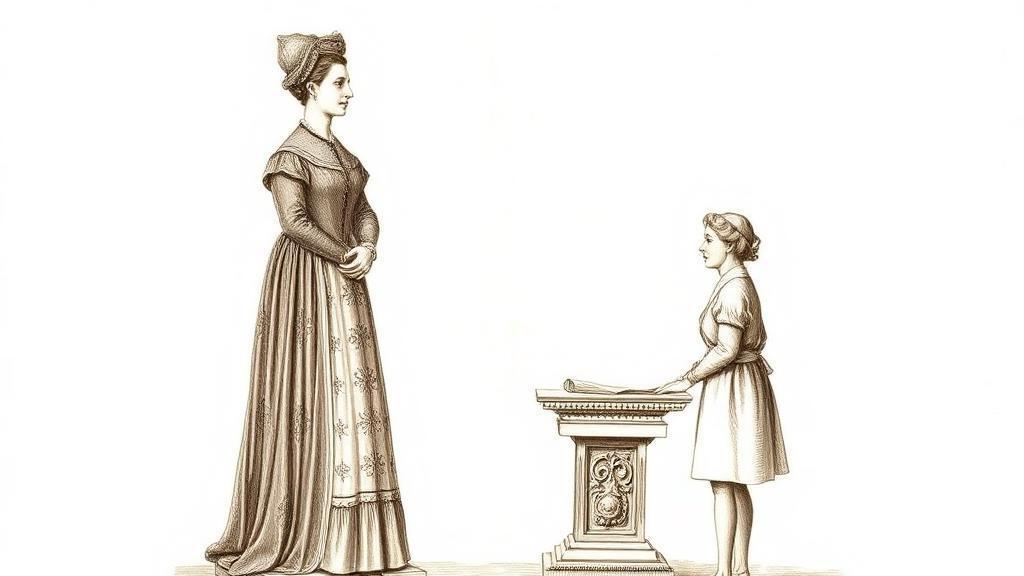
The chopine, or how Venice balanced status on a fifty-centimetre platform
In sixteenth-century Venice, a patrician woman going out required at minimum one attendant — not for company, but for structural support. The reason was the chopine: a carved-wood platform strapped beneath her foot that, by the sixteenth century, could raise her to a full fifty-four centimetres off the ground. That is approximately the height of a toddler. The tallest surviving examples, on display today at the Museo Correr in Venice, are not exaggerations. They are the actual shoes.
The chopine (from the Spanish chapin, though Venice made it its own) arrived in the lagoon city around 1400, initially as a practical overshoe — a raised platform to lift a woman’s dress and feet clear of the unpaved, frequently flooded streets. The logic was sound. The execution, eventually, was not. In Venice, both patrician women and the city’s celebrated cortigiane oneste — “honest courtesans” — wore them from roughly 1400 to 1700, and the height of your chopine was the height of your social standing, made literal and architectural. Wikipedia’s entry on chopines puts the symmetry plainly: the higher the chopine, the higher the status of the wearer.
Venetian authorities were not amused. In 1430, the city passed a law capping chopine height at three inches. The law was ignored comprehensively. By the sixteenth century, chopines had long since crossed into territory that the republic’s sumptuary-law writers described as “an insult to God, perilous to the wearer’s souls as well as their bodies.” The theology here is unclear. The biomechanics, less so.
What made the chopine stranger still was its concealment. The fashion required that a noblewoman’s gown fall all the way to the ground, hiding the platform entirely — a woman of means appeared to float rather than walk. As a 2026 analysis in Retrospect Journal argues, this reframes the shoe entirely: if the aim were practical, you’d want the platform visible to explain why your skirt cleared the mud. Hiding it served a different logic. Venice’s textile economy benefited from the extra metres of expensive brocade required to conceal the height, and the attendant hovering at a noblewoman’s elbow — necessary because walking unassisted on fifty centimetres of carved wood was not a casual achievement — read, to the Venetian eye, as affluence rather than inconvenience.
The dancing master Fabritio Caroso da Sermoneta, in his 1581 manual Il Ballarino, took the trouble to instruct noblewomen on how to dance in chopines correctly — which implies they were dancing in them, instruction or not. Shakespeare caught the fashion from across the Channel: in Hamlet Act 2, greeting a young actor who has grown taller since their last meeting, Hamlet quips that the youth has grown “by the altitude of a chopine.” That the joke required no explanation for an English audience suggests chopines had become shorthand, by 1600, for Venetian excess — the kind of absurdity a northern European could picture perfectly without having worn one.
What chopines established was something footwear has never quite put down: that a shoe can be a declaration rather than a garment. Before the chopine, shoes were practical, symbolic, or decorative. The chopine was all three and added a fourth register — architectural, performative, unapologetically inconvenient. When the platform eventually collapsed back to earth, the heel quietly stepped into its structural role. Louis XIV, who would soon make red heels the signature of the French court, was paying attention.
Sources
- Chopine — Wikipedia — Origins c. 1400, height range, the 1430 sumptuary law, Shakespeare’s Hamlet reference, Spanish vs. Venetian styles, materials and construction, social spread across Europe.
- Concealed Chopines: Height and Hierarchy in Early Modern Venice — Retrospect Journal — Analysis of the concealment requirement as a wealth-display mechanism rather than mud prevention; the 54 cm height of surviving examples; Fabritio Caroso da Sermoneta’s 1581 Il Ballarino.