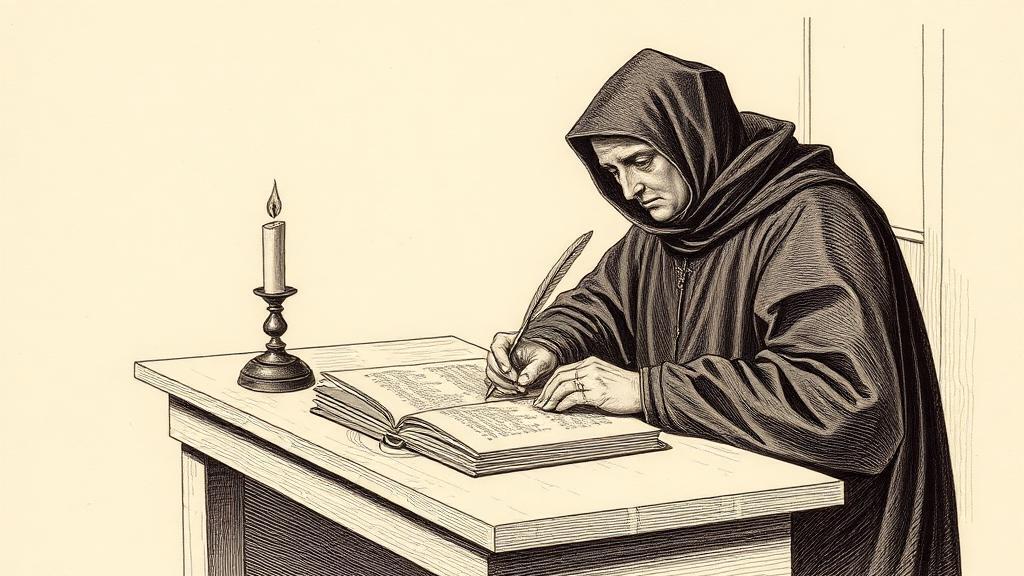
Trithemius's Polygraphia: the abbot's grid that launched three centuries of polyalphabetic ciphers
In 1499, the monks at a Carmelite priory in Ghent opened a letter that had arrived too late: its intended recipient, the scholar Arnold Bostius, had died in May. The letter was from Johannes Trithemius, Benedictine abbot of Sponheim, a man widely regarded as an authority on Christian learning. What it described alarmed them. Trithemius had written that he was developing a method to transmit messages across hundreds of miles without physical messengers — using, he said, invisible spirits as carriers. Copies circulated. Within weeks, Trithemius was answering accusations of demonology.
The scandal taught him something useful. From that point, he concealed what he was doing inside text that looked like something else entirely.
Johann Heidenberg had taken his surname from Trittenheim, the village on the Moselle where he was born in 1462. At twenty-one, caught in a snowstorm while travelling, he took shelter at Sponheim Abbey in the Rhineland and never left. He was elected abbot within months. When he arrived, the library held about fifty volumes; when he departed twenty-three years later, it held more than two thousand. He was, alongside his theological work, steadily developing what would become the first systematic printed account of cryptography.
The book that resulted was Polygraphia, written around 1508 at his new abbey in Würzburg and published in Basel in 1518 — two years after his death. Its core was a device Trithemius called the tabula recta: a 26×26 grid in which each row contains the alphabet shifted one position to the left of the row above. To encrypt a message, you take each successive plaintext letter from a successive row of the grid — so the same letter encodes differently depending on where in the message it falls. The cipher Al-Kindi had dismantled in Baghdad in 850 CE was a single substitution alphabet, exploitable by counting letter frequencies; the tabula recta gave each position its own alphabet, defeating that attack by design.
The book also included an Ave Maria cipher: a system in which each letter of plaintext was replaced by a word drawn from Latin prayers, producing output that read, to any casual observer, as a devotional poem. Trithemius provided nearly a hundred pages of correspondence tables between plaintext letters and pious phrases. The encryption and the camouflage operated together.
That dual purpose was not accidental. The 1499 letter scandal had shown him exactly what happened when text looked unusual. Steganographia, the work he had been describing to Bostius, appeared to be a grimoire of spirit conjurations; it was placed on the Index Librorum Prohibitorum in 1609 and held there for three centuries. Its first two volumes were eventually recognized as cryptography in disguise; the third, the most arcane-looking of all, was not fully decoded until 1998, when Jim Reeds finally cracked the underlying cipher. The spells were tables. The spirits were keys.
The tabula recta outlasted all of it. Giovan Battista Bellaso in 1553 took Trithemius’s grid and added a repeating keyword to select which row to use at each step — the element that made the system properly secure. The result, misattributed for centuries to Blaise de Vigenère, who popularized it in 1586, became the cipher that resisted systematic cryptanalysis until Charles Babbage cracked it privately in the 1850s. Every polyalphabetic cipher in the intervening three hundred years was a descendant of the abbot’s grid.
The book was printed after he was dead, in a town he never reached, by a publisher who probably didn’t know it would matter. Cryptography’s founding text arrived posthumously, as a theological curiosity, and immediately became the grid that the next three centuries of cipher-makers would work from.
Sources
- Johannes Trithemius — Wikipedia — biography, Sponheim Abbey library, the Steganographia scandal and demonology accusations
- Steganographia — Wikipedia — the Bostius letter, the Index Librorum Prohibitorum (1609–1900), and Jim Reeds’s 1998 decipherment of Volume III
- Johannes Trithemius Issues the First Book on Cryptography — History of Information — 1518 Basel publication and significance as the first printed cryptography text
- Tabula recta — Wikipedia — structure of the cipher grid and influence on later polyalphabetic systems including the Vigenère cipher