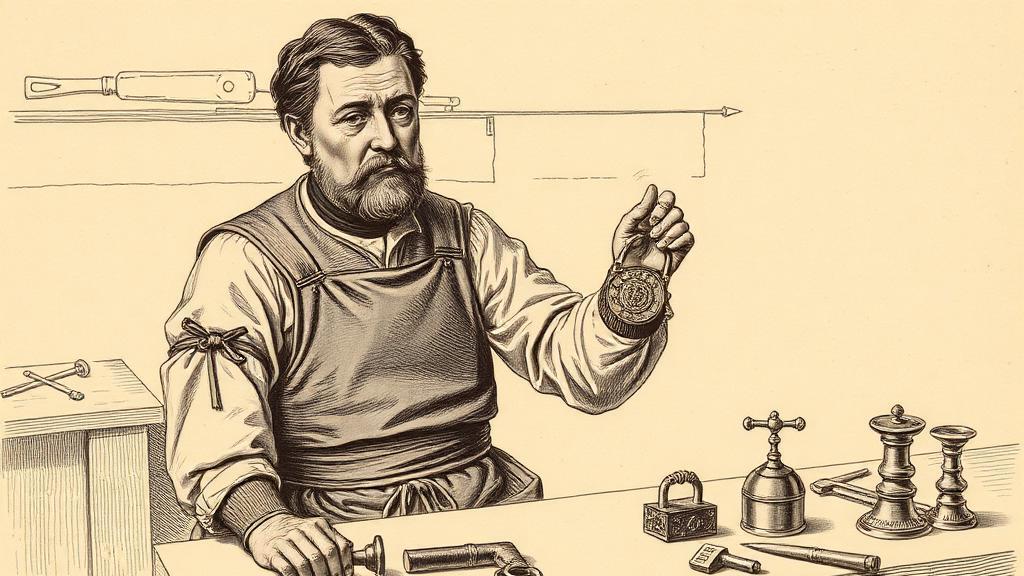
The guild masterpiece, or the keyhole that wasn't there
In 1531, a craftsman in southern Germany named André Omereler signed his name to a padlock. The inscription is on the shackle — the kind of confidence you show when you know the object will outlast any argument about quality. The padlock is now in the Metropolitan Museum of Art, and it has a trick. The keyhole is not visible. To find it, you must turn one of the decorative shields on the face to the right; two bolts release, a panel slides upward, and there it is. The wrong person could stare at it all day and go nowhere.
To produce something like that took centuries of guild work. The locksmith trade of medieval Europe descended from the Roman blacksmith — iron replacing bronze, wards still the core principle — but by the 13th century, in cities like Nuremberg, Paris, and London, it had become a formal guild trade with examiners, records, and standards. King Philip Augustus of France organized the first guild locksmiths in the 12th century. In 1411, the German emperor Charles IV formalized the title of Master Locksmith. By 1422, London’s guilds officially included the Lockyers, a body separate from the general smithing trades. To earn the title of master, a candidate submitted a Meisterstück: a finished lock, inspected by officials, recorded in the books. The Omereler padlock may have been exactly that.
Nuremberg was the proving ground. The city recognized two locksmith specialties: Platschlosser, who built large door locks, and Glötschlosser, who made padlocks. The finest of either worked at a scale that astonished — the Germanisches Nationalmuseum holds guild locks ranging from a padlock the size of a walnut to a chest lock requiring three full turns of the key. The decorative work on these pieces — foliate ironwork, carved medallions, intricate escutcheons shielding the keyhole behind tracery — was not ornament applied over a mechanism. It was the mechanism: each carved layer another obstacle for a key cut wrong.
There is a more personal specimen. The Beddington Lock, now in the Victoria and Albert Museum in London, is 38 centimetres wide, 12 kilograms, gilded, Gothic in style, and made by Henry Romaynes — the royal locksmith — between 1539 and 1547. Henry VIII had seized Beddington House from the Carew family after Sir Nicholas Carew was executed for treason in 1539, and the lock carries the king’s arms across its face. It was the kind of object that traveled with the court, installed on a chamber door wherever the king spent the night.
The security was not purely mechanical — the court knew the key. What the lock announced, to every host and servant in the building, was where power lived that night.
What the guild tradition bequeathed to its successors was not a better ward geometry, though that would come. It was the discipline of treating a lock as an object worth signing. André Omereler put his name on the shackle because he expected to be judged by it.
The ward had one persistent weakness: a thin key cut to clear all obstructions at once. The guild masters knew this. They responded by making the escutcheons more intricate — which was not a solution, but it was very good-looking.
Sources
- André Omereler Padlock and Key — Metropolitan Museum of Art — 1531 Southern German guild padlock, concealed keyhole mechanism, guild masterpiece tradition
- The Beddington Lock — V&A Collections — maker, date, materials, royal arms decoration, connection to Henry VIII and Beddington House
- The Ancient Art of the Locksmith — Building Conservation — guild formation dates, London Lockyers 1422, Charles IV’s Master Locksmith title 1411