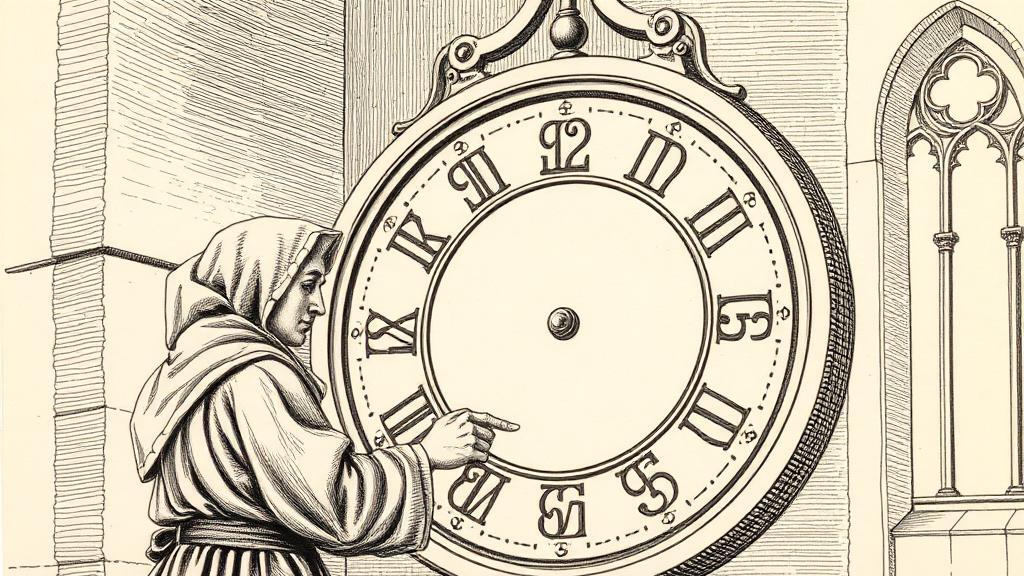
The Salisbury clock, or the machine that forgot to have a face
In 1928, a horologist named T.R. Robinson climbed the tower of Salisbury Cathedral to inspect the building’s relatively modern clock — the one installed in 1884, the safe one, the one that actually worked. While he was up there, he found something else: a heap of iron machinery gathering dust in a corner, its stone driving weights long since removed, its purpose apparently forgotten. Nobody working in the cathedral could tell him what it was. Robinson could.
What he had stumbled across was a clock built sometime around 1386, very likely the oldest surviving mechanical timepiece on earth.
The clock hangs now in Salisbury’s north nave aisle — a spare, angular cage of hand-wrought iron, 1.24 metres high and barely a metre wide, looking nothing like what most people picture when they hear the word “clock.” There is no face. No dial. No hands. None of that was the point. The Salisbury clock existed to do one thing: strike the hours, signalling the canonical hours of prayer to the clergy who lived and worked in the cathedral close. Knowing the exact minute was a luxury; knowing the hour was salvation, in more ways than one.
The mechanism is a verge-and-foliot escapement — the earliest design that a modern engineer would recognize. Two large stone weights descend on ropes wound around wooden barrels, one driving the going train and one the striking train. Between them, the verge — a vertical rod fitted with two small pallets — catches and releases a gear tooth with each half-turn of the foliot, a horizontal bar whose adjustable weights set the rate. Wind the weights twice a day, the thing runs. This clock might drift two minutes over twenty-four hours, which meant that somewhere near the tower, a sacristan was comparing it to a sundial and nudging it back.
It is, in other words, a machine with a permanent margin of error — and in 1386, this was considered perfectly adequate.
After the separate bell tower housing the clock was demolished in 1790, the mechanism moved to the cathedral’s central tower, where it continued striking until 1884, when a new clock made it redundant. Then it was shunted aside and forgotten for forty-four years, until Robinson’s accidental visit.
The 1956 restoration is its own kind of story. John Smith & Sons of Derby disassembled the clock and shipped it to their workshop. X-ray analysis by Rolls-Royce — a manufacturer of jet engines pressed into service as a horological detective — revealed that the mechanism had been converted to pendulum operation not once but twice, each conversion burying the original design a little deeper. Smith’s team reversed the modifications, reconstructed a working verge and foliot, and returned the clock to something close to its fourteenth-century form.
In 1993, the Antiquarian Horological Society convened a symposium to settle the question of the clock’s age. About two-thirds of the assembled experts voted for 1386. The remaining third argued the workmanship looked too refined for the fourteenth century, placing construction somewhere in the sixteenth or seventeenth. The question has not been definitively resolved, which is perhaps fitting: a machine designed to mark time has, for once, slipped its own measurement.
What the Salisbury clock marks is a threshold. Before the mechanical escapement, time in Europe was approximate — measured in water, fire, sand, and shadow, each medium imprecise in its own way. The escapement gave the continent a machine that could be standardized, manufactured, and eventually miniaturized into something a person could carry. The clock installed in 1884 to replace it is long gone. The one from 1386 is still running.
Sources
- Salisbury Cathedral clock — Wikipedia — technical specifications, location history, restoration details, and the 1993 dating symposium.
- The world’s oldest working clock — Experience Salisbury — Guinness World Record status and mechanism description.
- Salisbury Cathedral Clock rediscovered in 1928 — The Vintage News — the 1928 rediscovery, the 1884 replacement, and the 1956 restoration.